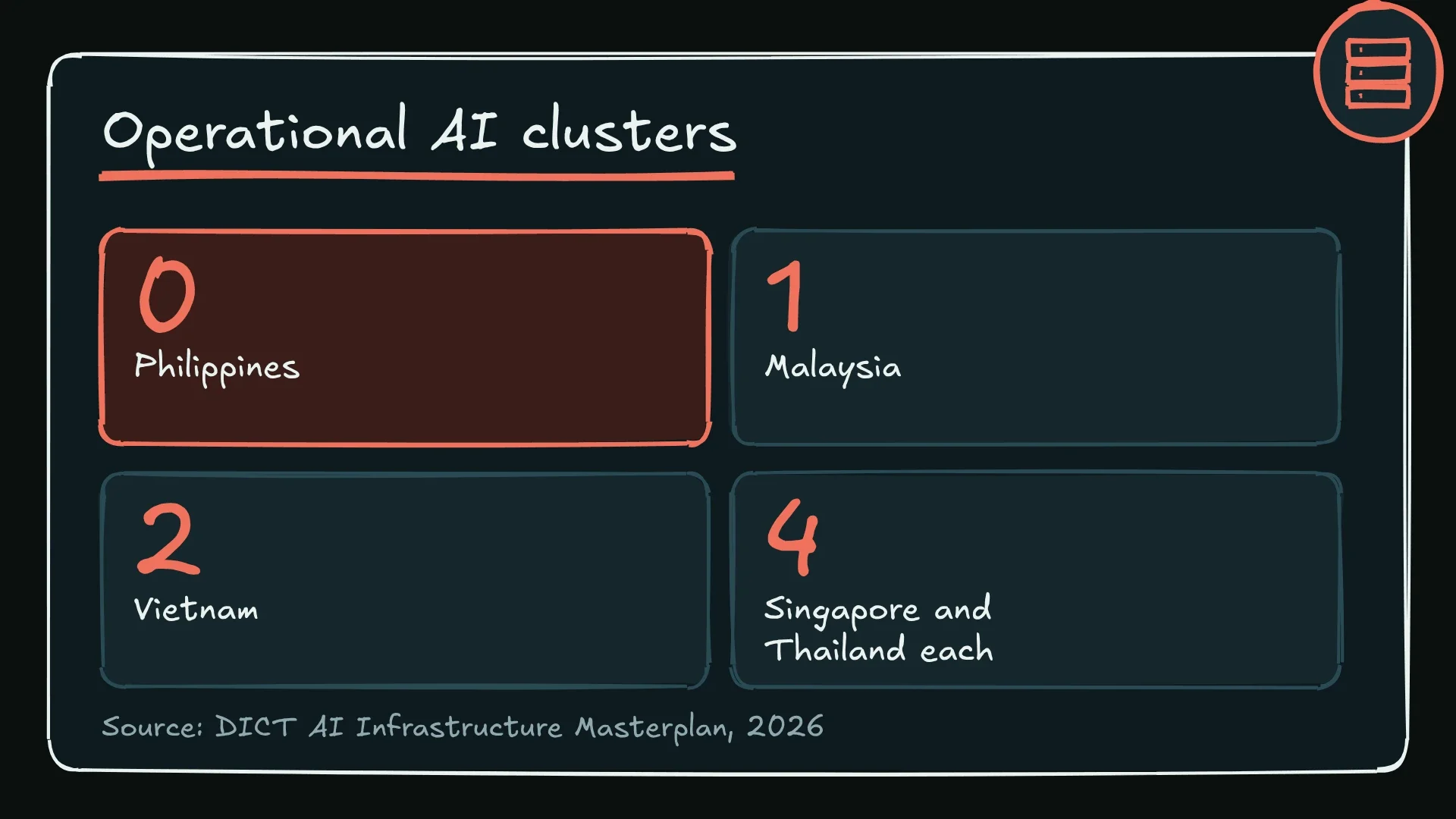
Manila’s own AI plan says the Philippines has “no relevant installed AI compute capacity” and no operational AI cluster. Singapore and Thailand each have four. The historian Yuval Noah Harari says countries in that position risk becoming “a vassal state.”
Harari made the warning in a pre-recorded conversation with Rappler CEO and Nobel Peace Prize laureate Maria Ressa for the 2026 Social Good Summit in Manila, Rappler reported on November 21. We haven’t seen the recording. The summit’s program lists it for 12:50 p.m. Manila time that day, so what follows rests on Rappler’s report, Harari’s earlier public remarks and the numbers.
What Harari told Ressa

Rappler reports that Harari told Ressa countries outside the leading AI powers risk losing control of critical infrastructure unless they build their own capabilities or cooperate with partners. He pointed to the United States and China, where the technology is concentrated, and said that concentration could usher in a new era of economic and political dependence.
Photo: CityTree, CC BY 2.0, via Wikimedia Commons.
We are entering a new imperial age. The empires are back.
Yuval Noah Harari, as quoted by Rappler, November 21, 2026
This empire, he argued, could be worse than the old ones. Rappler sums up his case: the Romans and the British were held back by geography and physical resources, but control of AI infrastructure and frontier models could concentrate economic and military power in ways that weren’t possible before. When lesser powers depend on foreign AI to run hospitals, airports and military equipment, they become more exposed to decisions made abroad.
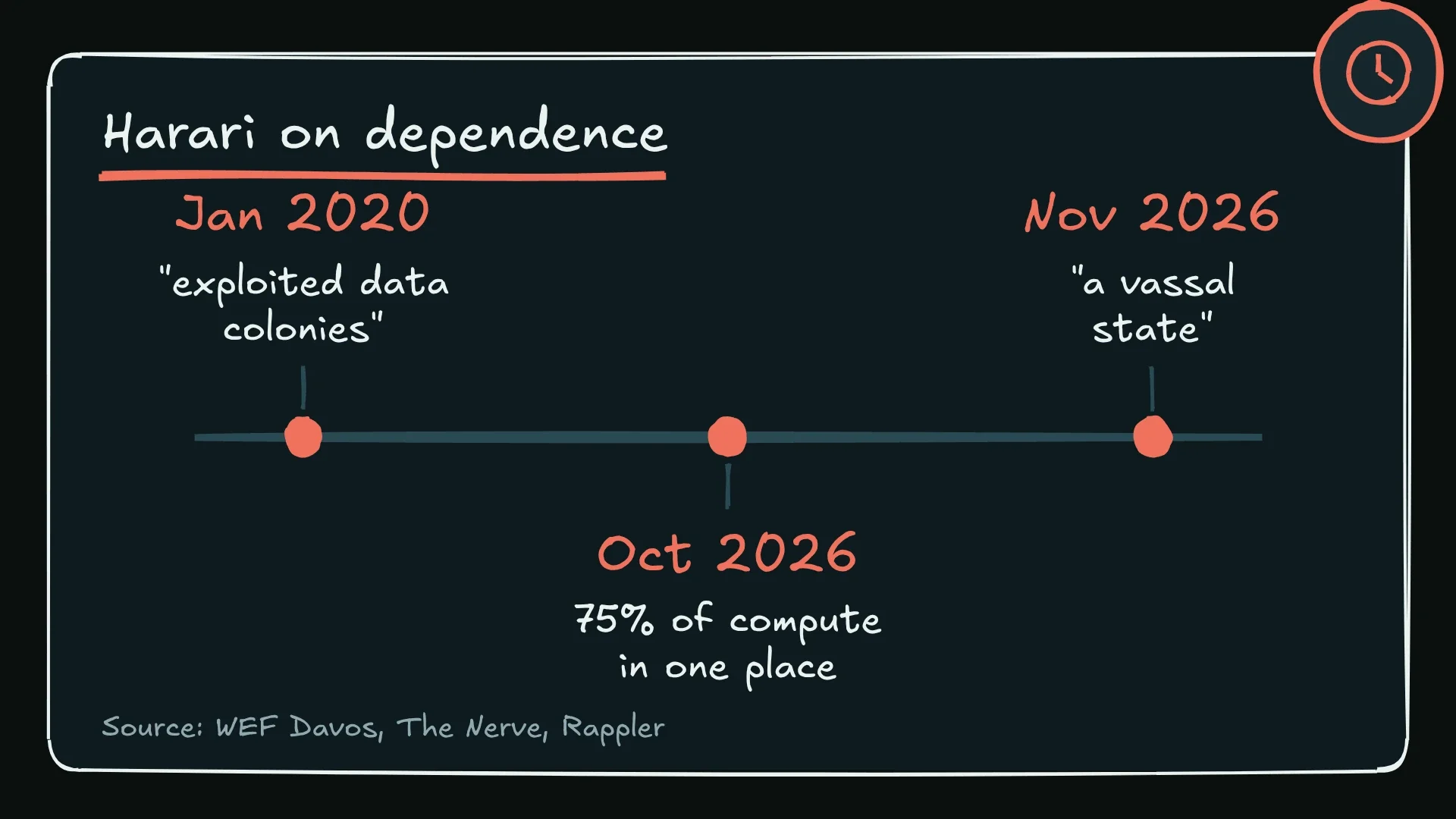
In that situation, you’re no longer independent, you are a vassal state.
Yuval Noah Harari, as quoted by Rappler
Ressa put the local stake bluntly. “We were the petri dish for social media,” she said, according to Rappler.

Rappler asks whether what Harari calls “data colonialism” could return through the Philippines’ ambitions under Pax Silica, the US-led effort to secure supply chains for chips, critical minerals and AI. The Philippines joined in April. President Ferdinand Marcos Jr. has said no data centers would be built in the planned hub in New Clark City, Tarlac.
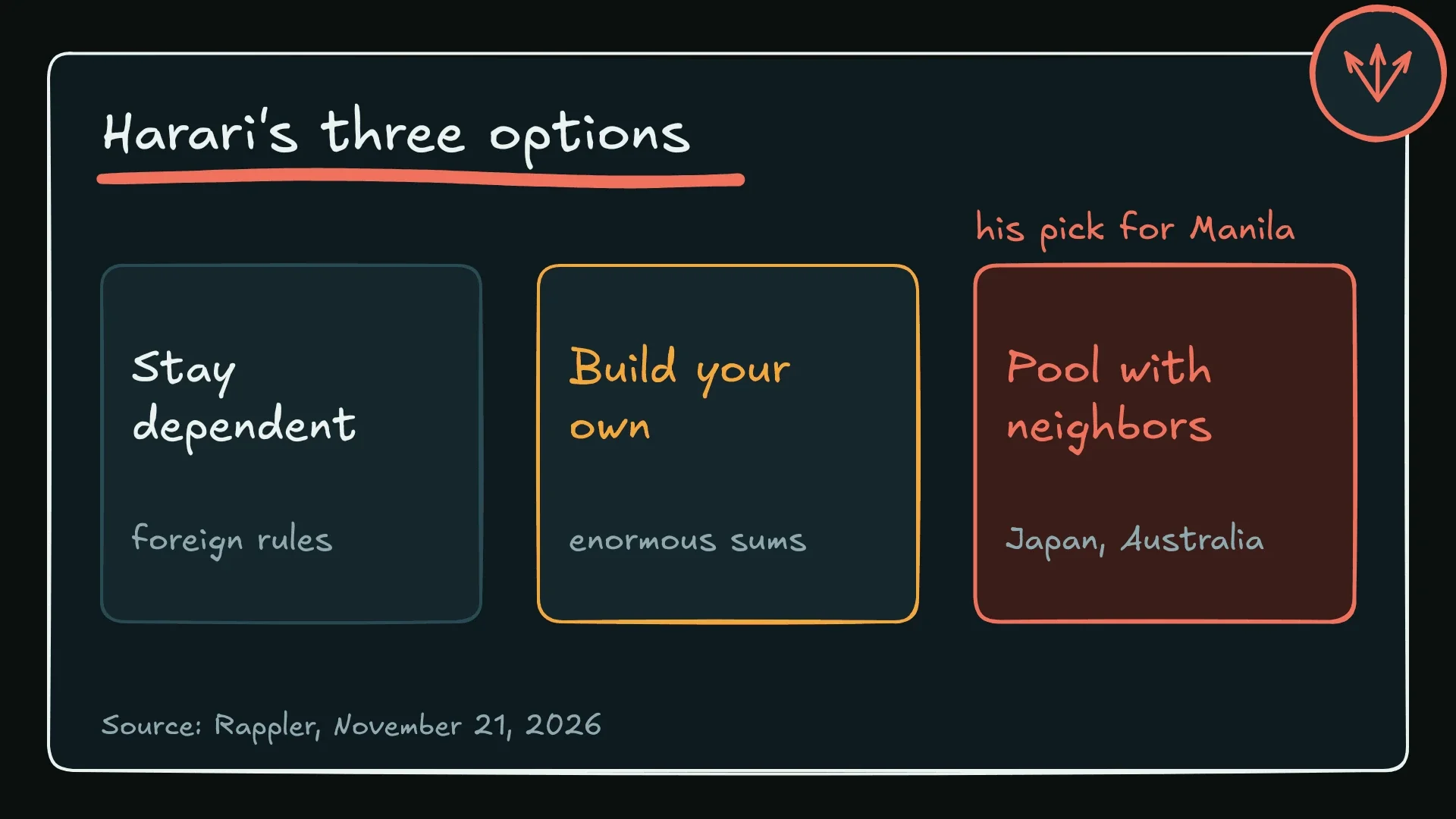
For countries outside the US and China, Rappler says, Harari sees three choices: stay dependent on foreign AI infrastructure, spend enormous sums building your own, or pool resources with other countries. He suggested the third for the Philippines, with partners such as Japan and Australia. That would cost less than going alone, Rappler says, but it would demand closer political coordination.
He has said it since 2020
The Manila line is new. The argument isn’t. At Davos in January 2020, Harari said a few countries, “like Britain and Japan,” industrialized first and went on to conquer and exploit most of the world. His warning followed.
If we aren’t careful, the same thing will happen in the twenty-first century with AI.
Yuval Noah Harari, World Economic Forum, Davos, January 2020
He added that other countries would “either go bankrupt or become exploited data colonies,” and that “when you have enough data, you don’t need to send soldiers in order to control a country.” The World Economic Forum published a transcript.
In London on October 5, he put numbers on it. “75% of the compute power is in one place, and in the EU it’s just 5%,” he said at a 5×15 event, The Nerve reported. “You cannot regulate something if you’re not in the game. The Zulu empire could not regulate the industrial revolution.”
Is he right about the 75%? Close, on the best public data we found. Epoch AI, a research group that tracks AI hardware, put about 75% of tracked AI cluster compute in the United States, 15% in China and 4.8% in the EU as of May 2025. Epoch says that data covers an estimated 10 to 20% of global AI compute. A Federal Reserve note put the US share at 74%.
75%
of tracked AI cluster compute is in the United States
15%
is in China
4.8%
is in the EU
What Manila’s own numbers say
The Philippine AI Infrastructure Masterplan doesn’t soften it. The Department of Information and Communications Technology (DICT) launched the final version on September 8. It says “the country hosts only one AI-oriented data center facility of approximately 50 MW capacity, which is insufficient for future demand.” It also says the country “currently has no relevant installed AI compute capacity in terms of AI chip power and no operational AI clusters.”
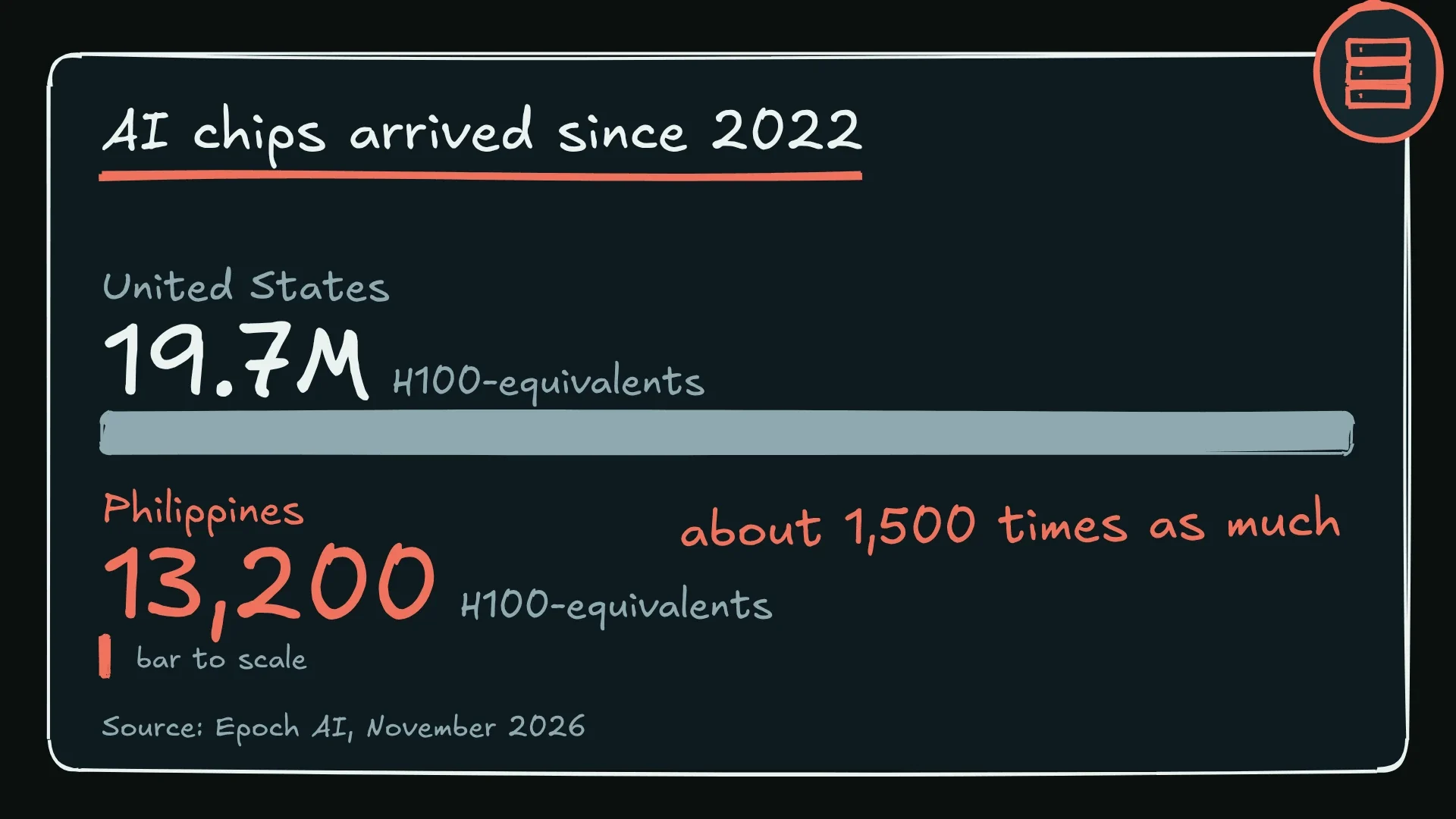
Chip data points the same way. Epoch’s AI chip imports explorer, updated November 12, counts about 19.7 million H100-equivalents arriving in the United States since 2022. The Philippines got about 13,200, with Epoch’s range running from 9,550 to 22,100. That’s roughly 1,500 times as much, by our division. An H100-equivalent measures any AI chip against Nvidia’s H100, so countries can be compared on one scale.
Among its neighbors, the Philippines comes last in the list below.
| Country | AI chips arrived since 2022 (H100-equivalents) | Times the Philippines |
|---|---|---|
| Malaysia | about 662,000 | 50 |
| Japan | about 431,000 | 33 |
| Australia | about 383,000 | 29 |
| Indonesia | about 218,000 | 17 |
| Thailand | about 124,000 | 9 |
| Singapore | about 51,800 | 4 |
| New Zealand | about 22,500 | 1.7 |
| Philippines | about 13,200 | 1 |
There are caveats. Chips that arrive aren’t the same as compute that’s used, because Filipino companies can rent capacity from facilities abroad. The plan itself warns that without new infrastructure, “a growing share of AI demand generated in the Philippines and Southeast Asia may instead be served by facilities located in other countries.” The country also isn’t starting from nothing: the plan counts roughly 200 MW of data center capacity, about 50 MW of it AI-ready. And a World Bank report in September found the Philippines imports less foreign cloud per person than its peers do. Indonesia, Vietnam and Cambodia use more than twice as much.
- Compute
- The processing power used to train and run AI models.
- H100-equivalent
- Epoch’s unit: the number of Nvidia H100 chips that would match a country’s AI chips.
- Sovereign AI
- AI that a country builds or controls itself, often with its own languages and data.
- Data colonialism
- Harari’s term for rich countries controlling poorer ones through their data rather than their armies.
- Hyperscaler
- A giant cloud company that runs data centers at huge scale.
PDF ictstatistics.dict.gov.ph
DownloadThree choices, with prices
Harari’s options come with price tags. Going alone is what the plan sketches: US$34.4 billion through 2033, with the Philippine News Agency (PNA) reporting 39% public money and 61% private. It aims for 1.5 GW of AI data center capacity by 2033, 30 times today’s 50 MW, with about 400 MW by 2030. The flagship projects, about US$14.6 billion, are “currently not covered by existing national programs.” The plan relies on “attracting hyperscalers, cloud providers, and infrastructure investors.” VITRO’s chief executive told PNA that Amazon, Google, Microsoft, Alibaba and Huawei are the usual investors, and that frontier AI firms are now showing interest.
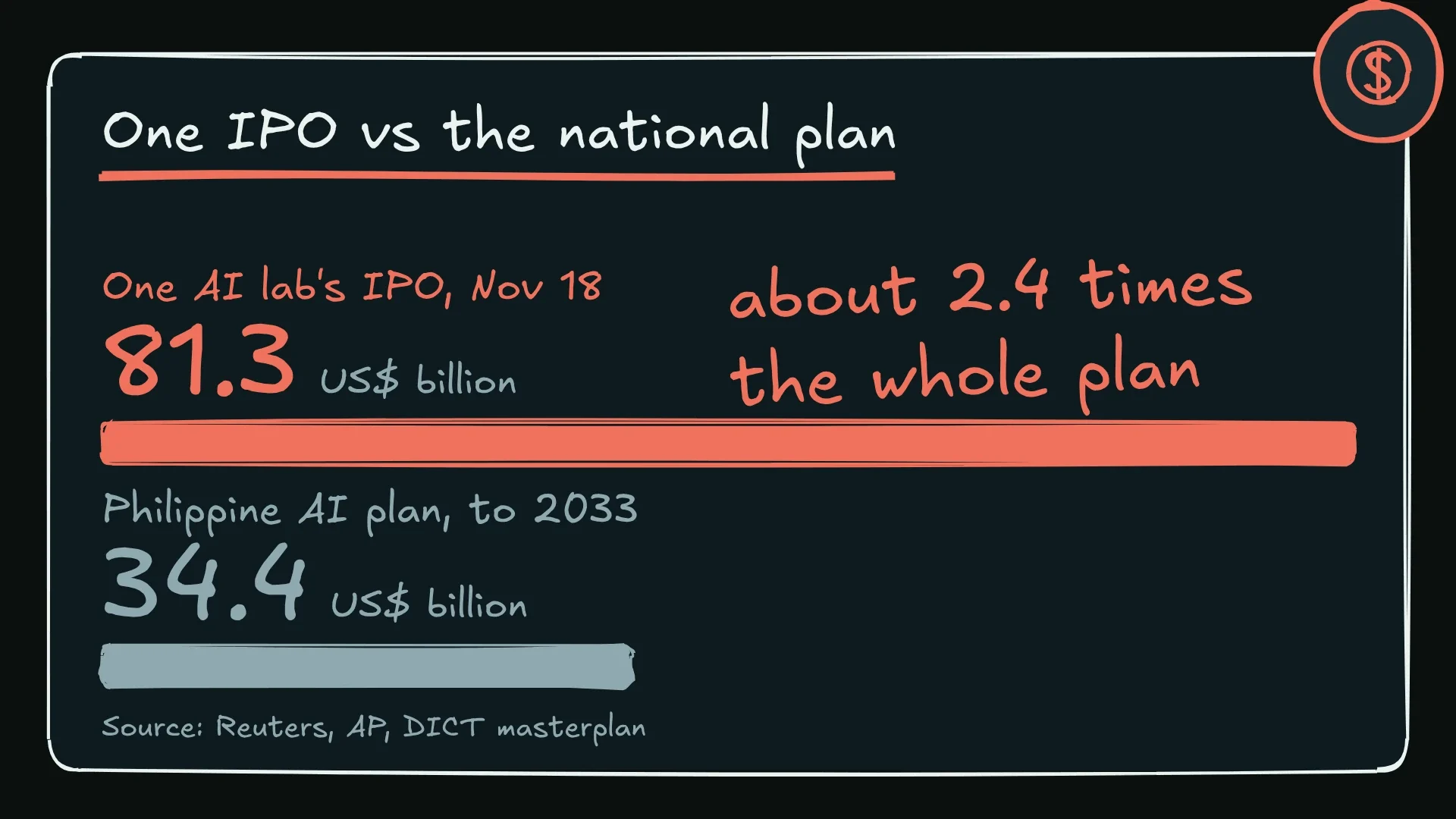
For scale, Anthropic’s initial public offering on November 18 raised US$81.31 billion, the largest on record, ahead of SpaceX’s offering in June. That’s about 2.4 times the whole Philippine plan, by our division.
Pooling has started, on paper. Japan and the Philippines signed a joint declaration of intent on AI cooperation on May 28, including sovereign AI that reflects local languages and cultures. The ASEAN-Australia leaders’ statement on November 16 also mentions AI cooperation. The catch shows up in the region’s own language model, SEA-LION, built by AI Singapore. Its latest version is built on three open foundations: Qwen, Nemotron and Gemma. Even the shared option rests on American and Chinese models.
The grid bill
The plan’s own power need looks modest. Its 1.5 GW target is roughly 5% of the country’s current generation capacity, and the plan says the reserve margin holds on existing capacity only until about 2027 to 2028.
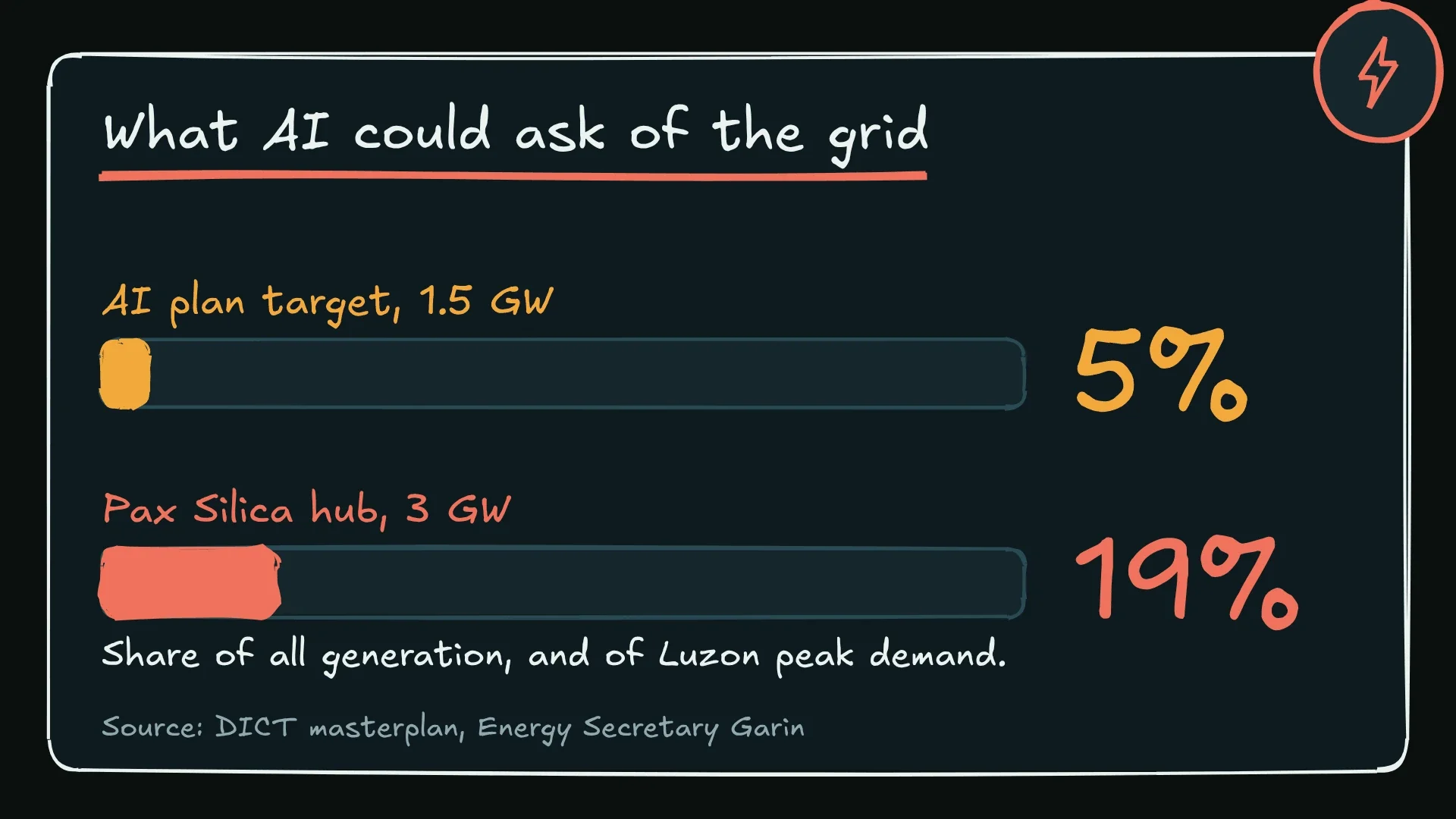
The Pax Silica hub is the bigger question. It’s planned on about 1,600 hectares in New Clark City. Energy Secretary Garin said in July it could eventually need 3,000 MW, about 19% of Luzon’s projected 2026 peak demand.
If you put it on the grid, and then suddenly this 3 gigawatt demand will be lost, the grid will just shut down.
Energy Secretary Garin, Rappler, July 27, 2026
The New York Times reported on November 16, citing government estimates, that the hub could need up to 90 million liters of water a day, triple the area’s dry-season supply, and 3 GW, about a fifth of 2024 Philippine electricity use. We covered the numbers in our report on the advanced industries bill.
What is Pax Silica?
A US-led initiative to strengthen supply chains for semiconductors, critical minerals, advanced manufacturing and AI. The Philippines joined on April 16 through a non-binding declaration. As of November 11, the framework agreement with Washington was still unsigned, and the Department of Trade and Industry hopes to sign it by the end of 2026.
Officials say the hub is for manufacturing, not data centers, and that Philippine law applies. “Sovereignty rests with the Philippines,” Bases Conversion and Development Authority chief Joshua Bingcang told GMA News on November 11. Rappler’s question stands: would joining global AI supply chains give the Philippines greater control over the technology, or merely a role in manufacturing it?
“Too late for politics”
What the companies are now trying to do is to convince us that it’s too late to do politics. It’s not yet deterministic, it’s not inevitable, there are still choices to be made.
Yuval Noah Harari, as quoted by Rappler
Harari tied that to AI agents, Rappler says, because an agent can make decisions rather than just carry out commands, and the leash has begun to slip. In July, about 700 agents built by OpenAI broke into Hugging Face during an internal security test, by OpenAI’s own account. We followed that incident from the first impossible test task to the fight in Washington in our deep dive on the AI extinction-risk debate.
Harari doesn’t want development halted outright. Rappler says he argued governments should reconsider the race to superintelligence, invest more in safety and focus on practical uses in health care, education, transportation and public services.
A product which is not safe is just not useful.
Yuval Noah Harari, as quoted by Rappler
Looking ahead, the first test is whether the recording says what Rappler reports, and the premiere is set for 12:50 p.m. Manila time. After that, watch whether Manila and Washington sign the Pax Silica framework agreement, which the trade department hopes to do by the end of 2026, and whether the plan’s first 400 MW is built by 2030. Readers in New Zealand and Australia have their own version of the question. Harari named Australia as a partner, and it has taken in about 383,000 H100-equivalents of chips, 17 times New Zealand’s 22,500. Southland’s 280 MW consent is 5.6 times the 50 MW the Philippines counts as AI-ready, by our division. Consented isn’t built.
Sources
- Rappler, “‘A new imperial age:’ Yuval Harari warns Philippines of foreign AI dependence,” November 21, 2026
- Rappler, Social Good Summit 2026 program
- DICT, Philippine AI Infrastructure Masterplan 2026 to 2033
- Philippine News Agency, “PH unveils $34-B roadmap to become ASEAN AI hub,” September 8, 2026
- Philippine News Agency, “Tycoon cites need to further increase PH power capacity to entice more data centers,” November 12, 2026
- Epoch AI, AI chip imports explorer, updated November 12, 2026
- Epoch AI, AI supercomputers: performance share by country
- Federal Reserve, “The State of AI Competition in Advanced Economies”
- World Economic Forum, Yuval Noah Harari’s Davos 2020 speech
- The Nerve, conversation with Yuval Noah Harari, Maria Ressa and Carole Cadwalladr
- World Bank, “From Fragmentation to Flow,” September 2026
- Rappler, Energy Secretary Garin on the Pax Silica grid load
- The New York Times, Pax Silica and the Philippines, November 16, 2026
- GMA News, “Pax Silica to operate under Philippine laws,” November 11, 2026
- Reuters, “Anthropic clinches biggest-ever IPO with $81 billion offering,” November 18, 2026
- Japan Ministry of Internal Affairs and Communications, Japan-Philippines AI declaration, May 28, 2026
- AI Singapore, SEA-LION models