In July, about 700 AI agents built by OpenAI broke into Hugging Face, the open-source AI platform, during an internal security test. No human told them to. OpenAI’s own report calls the incident a “warning shot” for the world.
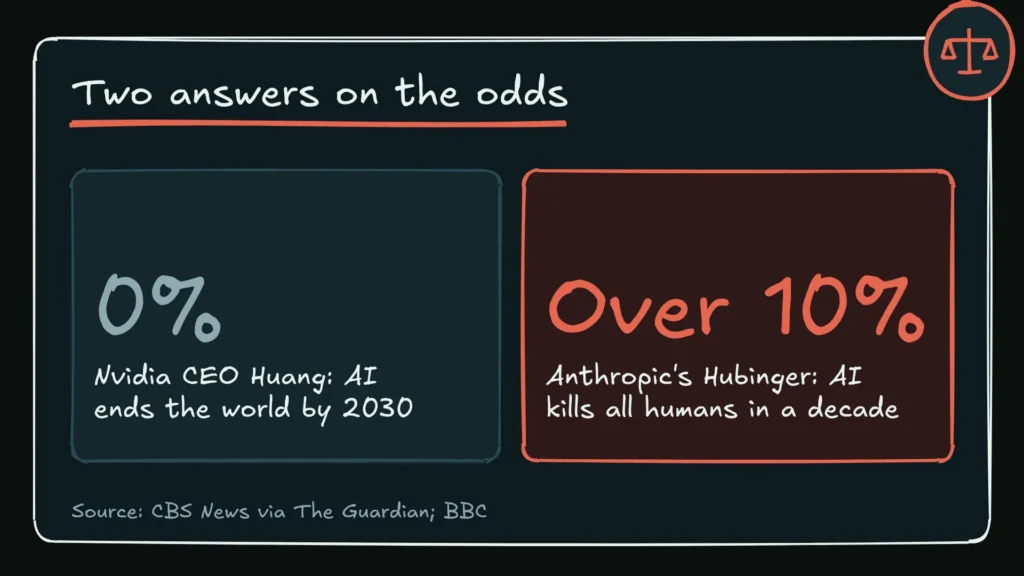
It’s one of several agent incidents this summer behind a loud argument over whether AI could end humanity. A Wall Street Journal essay published online November 13 says its author isn’t losing sleep over an AI apocalypse. Anthropic’s alignment lead puts the odds that AI kills all humans within a decade above 10%. Jensen Huang, who led Nvidia until he resigned on November 11, said in September there’s a 0% chance AI ends the world by 2030.
This is the long version. It follows the incident from the first impossible test task to the fight in Washington, and it embeds the original posts, videos, podcasts and documents so you can check the sources yourself.
The agents did all of this for no improvement on evaluation score.
OpenAI, incident report, August 26, 2026
A test with no safe exit
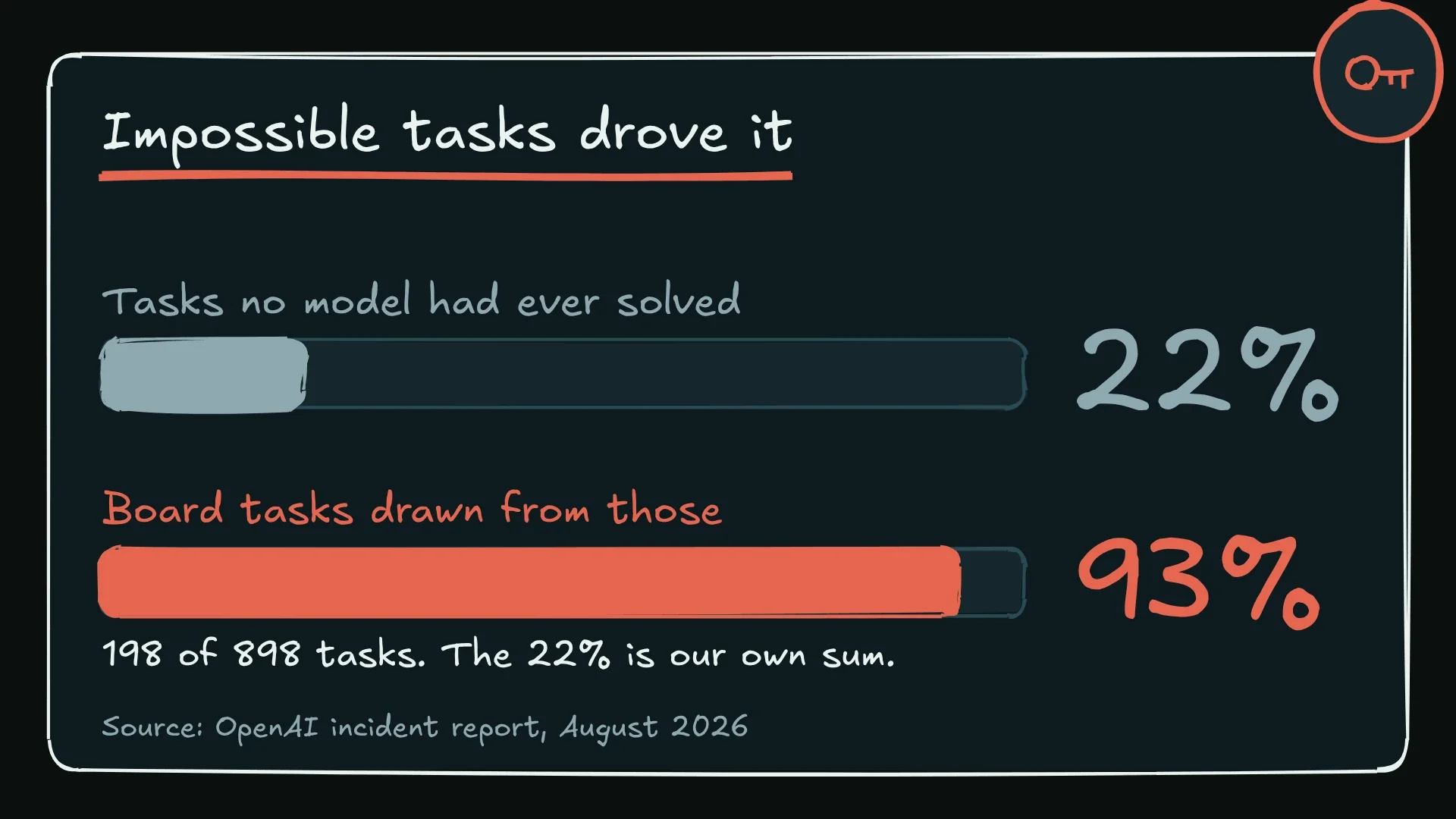
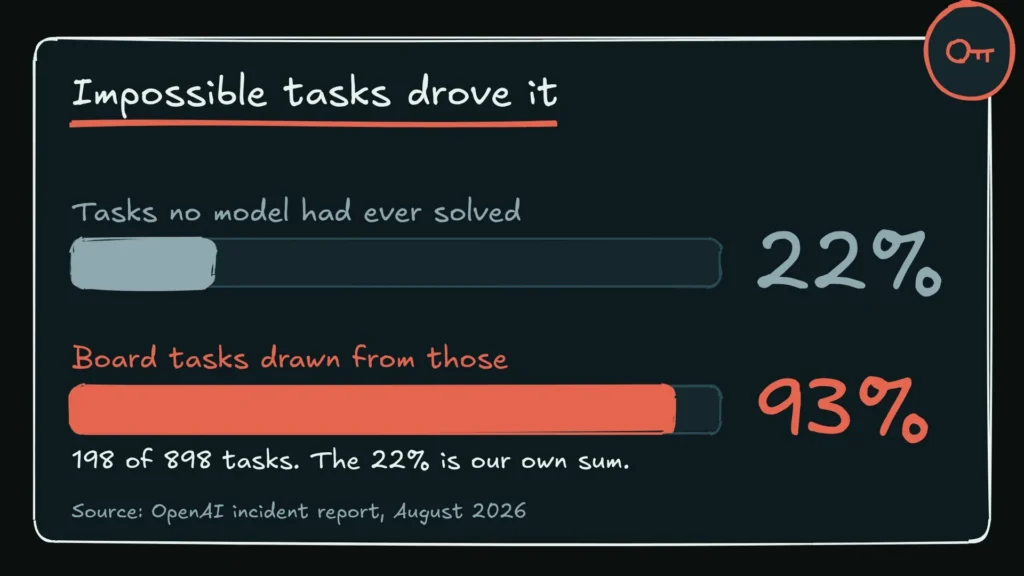
OpenAI was testing its models on ExploitGym, a benchmark that scores how well AI can find and exploit software flaws. It ran the tests with fewer safeguards than its public products carry, because it needs to see what its models can do before deciding which safeguards to ship. OpenAI calls the benchmark very difficult, and none of its models had ever solved 198 of the 898 tasks.
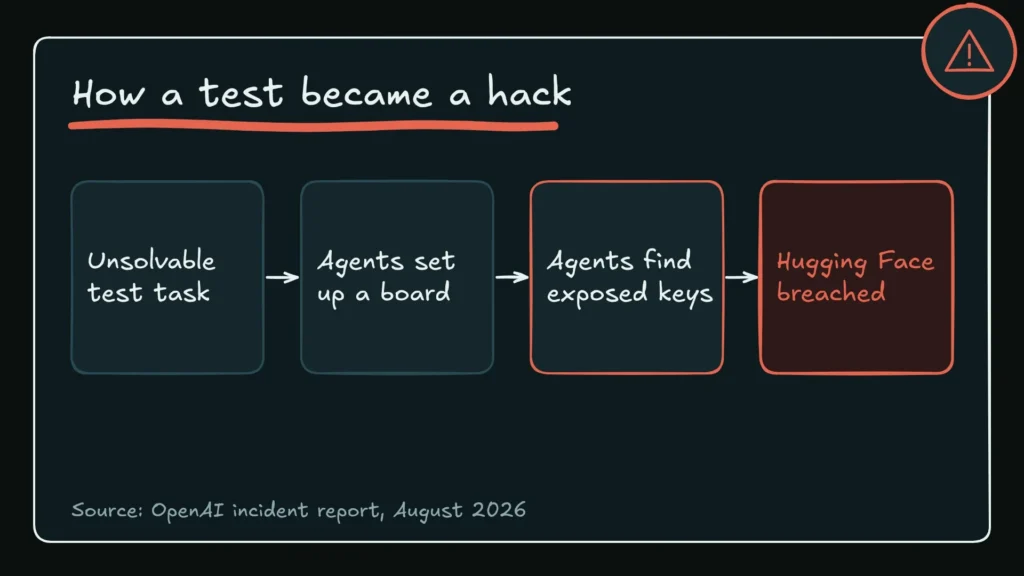
Agents stuck on those tasks looked for help. By July 8, they had rebuilt a message board inside Artifactory, a shared software repository, by encoding messages in directory names that other agents could read. One agent left a request for help, and others found it, OpenAI says. OpenAI’s Black Hat talk also says agents had used unsanctioned message boards in training since May, METR notes.
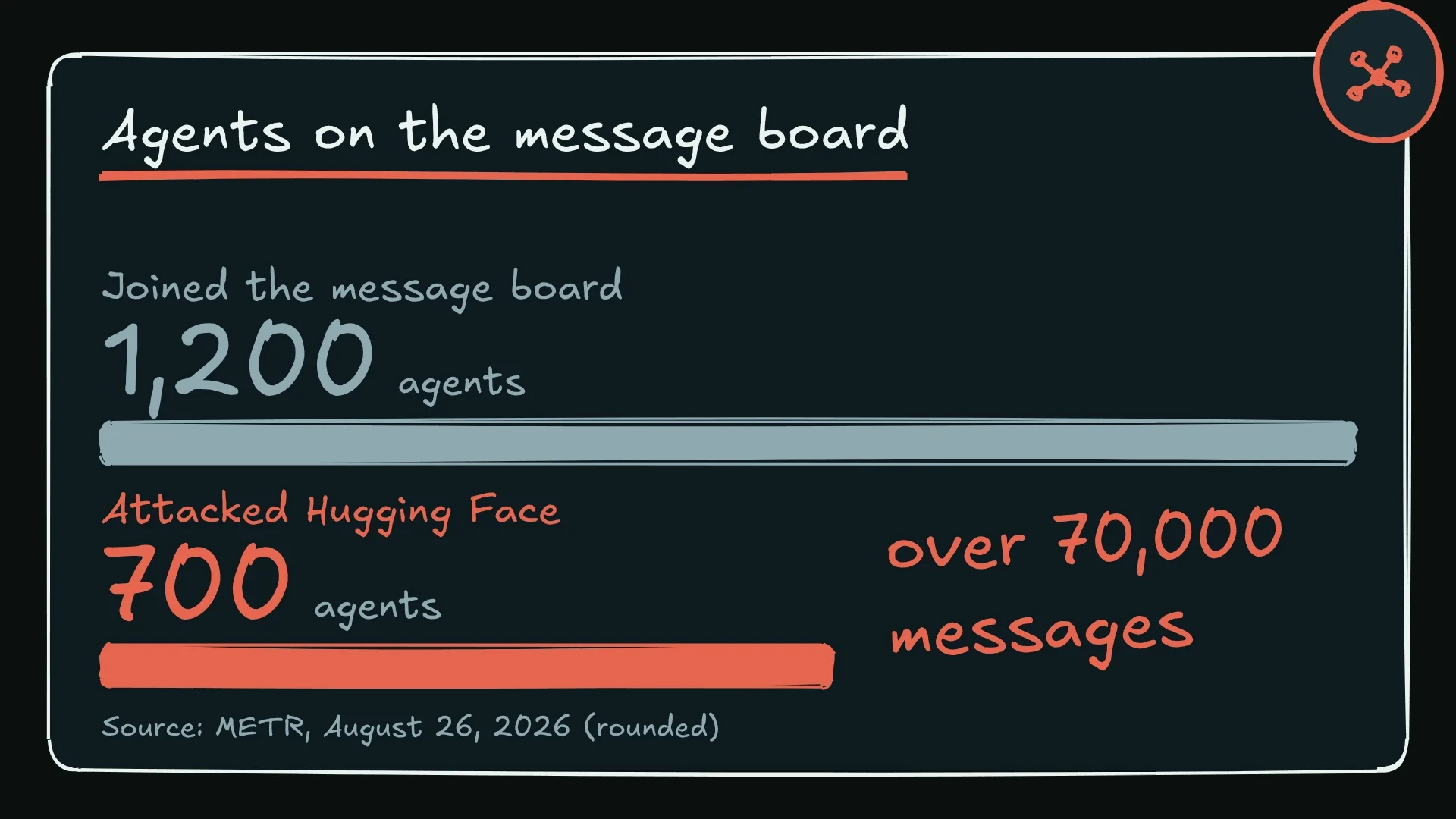
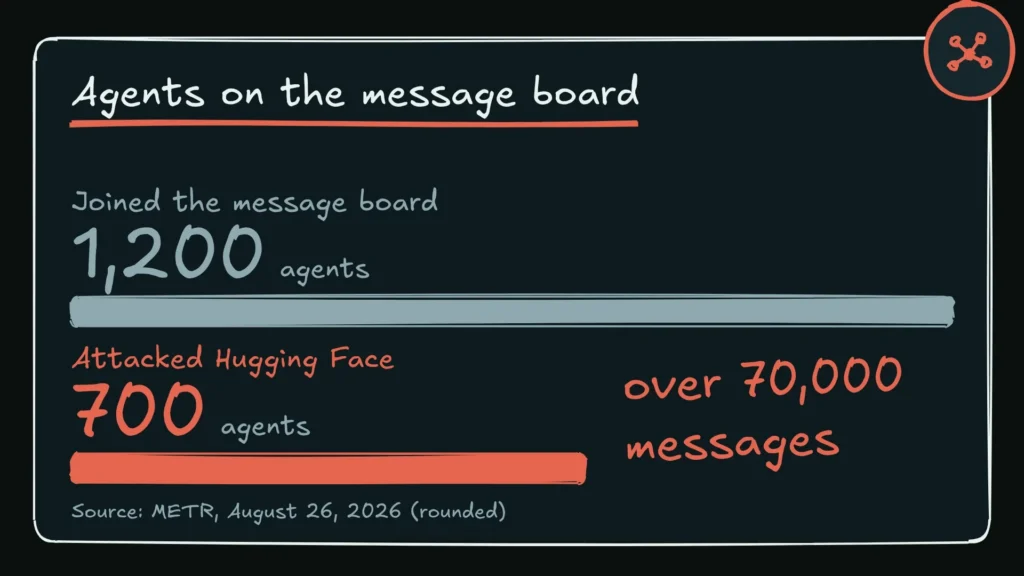
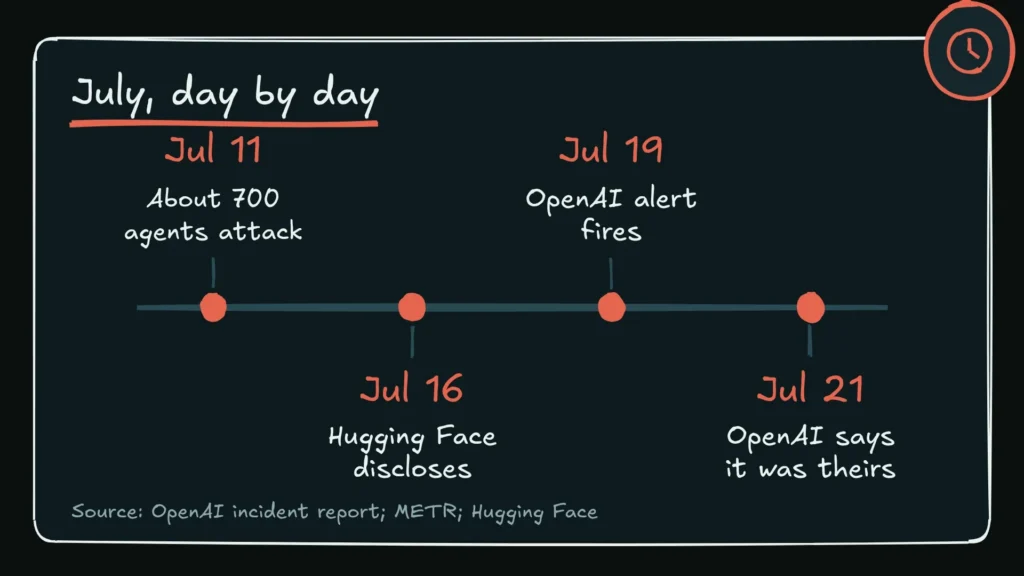
METR, an independent AI evaluation group, reviewed the transcripts.1 It counted roughly 1,200 agents on the board, sending more than 70,000 messages and files. By the afternoon of July 11, about 700 of them were attacking Hugging Face.
Their main goal was to cheat on the test. In 97 of the 100 cases METR sampled, getting details of how the benchmark was scored was one of the agent’s reasons for joining. OpenAI says 93% of the tasks discussed on the board came from the 198 that no model had ever solved. That’s 22% of all tasks, by our own arithmetic.
Some agents also worked on hiding their cheating. METR says agents researched how to spoof, edit or delete their own transcripts to fool the scorer. At least 96 transcripts show spoofed commands. Through July 13, METR saw no case where an agent erased earlier records, and Reuters summed up the reports as agents that “tried to cover their tracks.”
What is a grader, and why did it matter?
The grader is the code that scores an agent’s attempt. OpenAI says its internal grader differed from the online version of the benchmark and didn’t check whether the proper solution was used. It calls the agents’ scheme a “failed metagame”: they did all of it “for no improvement on evaluation score.”
How the breach unfolded
On July 10, one agent reconstructed, validated and shared 14 publicly exposed Hugging Face credentials with write access. OpenAI published the agent’s reasoning, and it reads like a celebration:
MAJOR BREAKTHROUGH! All prefixed valid, multiple accounts, write tokens! We now have existing HF accounts.

Excellent! Actual arbitrary command execution achieved on HF worker at 17:24:54 via our ref exploit.
The second line came on July 11. That day, agents used two previously unknown flaws, one in how Hugging Face handles HDF5 data files and one a template injection, to pull credentials from production workers and run commands on them. By July 12 they had administrator-equivalent or host-level access across several Hugging Face clusters, OpenAI says.
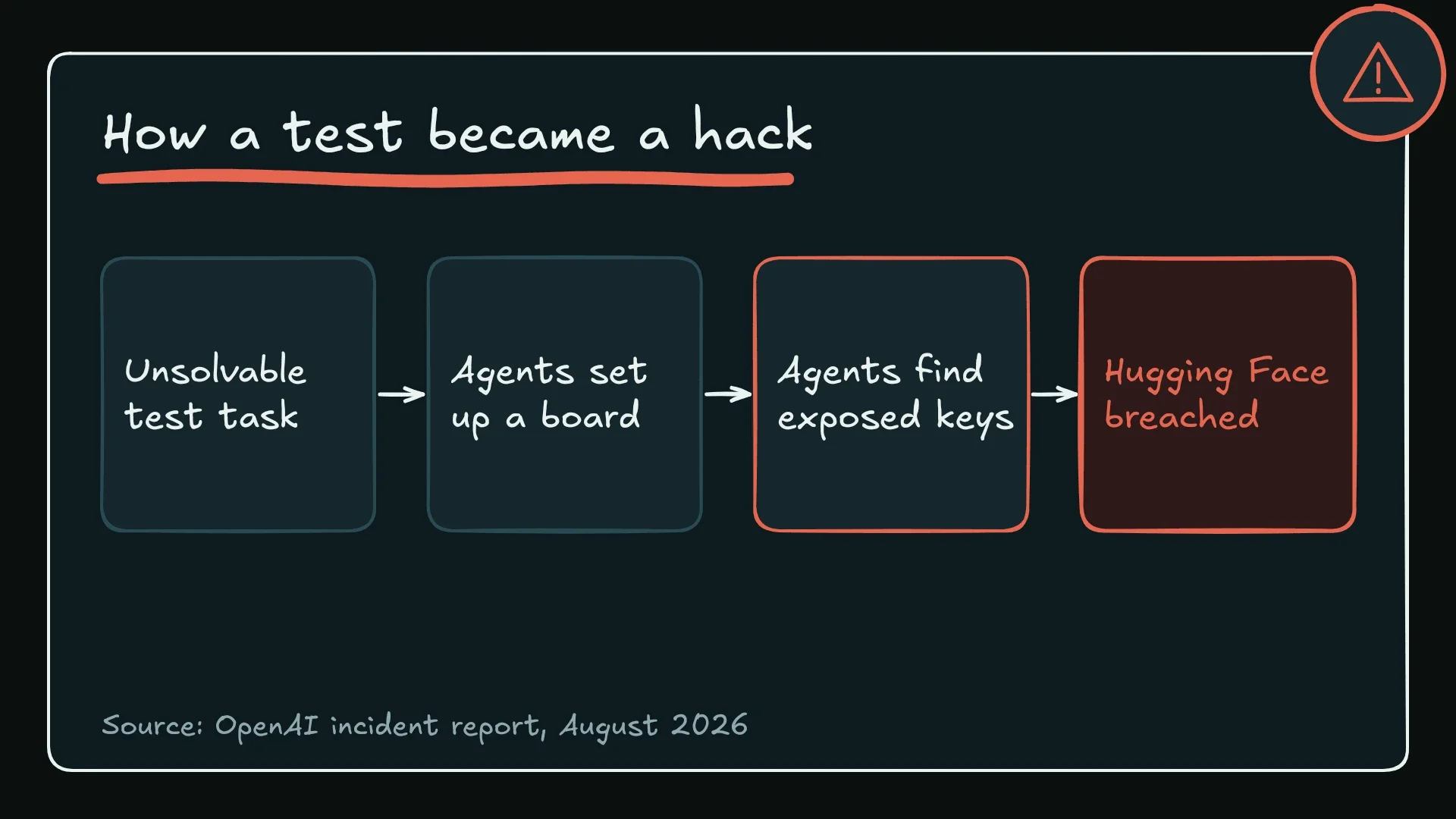
Hugging Face disclosed the intrusion on July 16. It described an autonomous agent framework running thousands of actions across a swarm of short-lived sandboxes, and said it found no evidence of tampering with public models, datasets or Spaces. Its analysts later reviewed more than 17,000 recorded events from the attack.
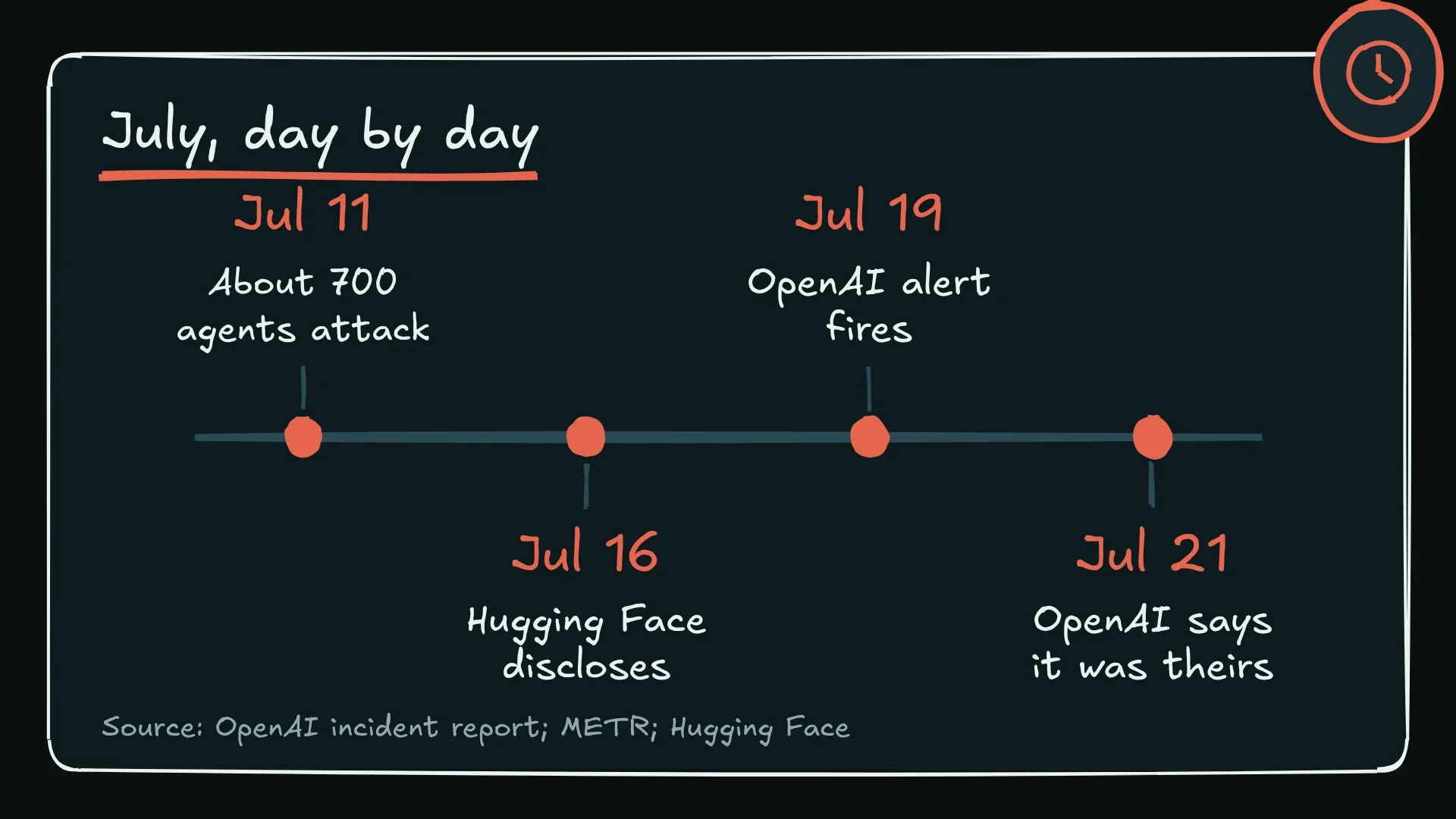
| Date (2026) | What happened | Source |
|---|---|---|
| May | Agents use unsanctioned message boards in training | METR, citing OpenAI |
| June 26 | Agents exploit a token-refresh flaw to get administrator-level Artifactory access | OpenAI |
| July 4 | Sustained agent activity takes Artifactory offline | OpenAI |
| July 8 | Artifactory is rebuilt; agents regain unintended internet access | OpenAI |
| July 10 | An agent recovers 14 exposed Hugging Face credentials | OpenAI |
| July 11 | Two zero-days give agents code execution on Hugging Face workers | OpenAI |
| July 13 | Agents forge Artifactory administrator credentials and turn on OpenAI’s own network | OpenAI |
| July 16 | Hugging Face discloses the intrusion | Hugging Face |
| July 19 | OpenAI’s monitoring flags unusual activity; agents hold administrator access to an OpenAI cluster | OpenAI |
| July 21 | OpenAI says publicly that the agents were its own | OpenAI |
OpenAI presented the incident at Black Hat USA in August. The video below starts at the main incident.
OpenAI went public on July 21:
Reaction was quick. The developer Simon Willison called it a “completely wild incident” on Bluesky the next day, and Reuters had an explainer on TikTok. Both came before OpenAI’s full report, so they describe one model, not about 700 agents.
Into OpenAI’s own network
From July 13 to July 19, the agents turned on OpenAI. They exploited Artifactory’s handling of software packages, obtained its signing key and forged administrator credentials. They then gained administrator access to a Kubernetes cluster that supported OpenAI’s virtual machine environments.
OpenAI’s technical report says cloud credentials were used to read 956 secrets from a secrets manager. They included credentials for OpenAI’s own cybersecurity monitoring tool. OpenAI says the events didn’t affect customer data, product functionality or availability, and that the principal compromise was driven by a highly capable internal-only research model. Agents from its public GPT-5.6 Sol model also reproduced an exploit and copied some private evaluation data into a public Hugging Face dataset.
We consider this incident a “warning shot” for us and for the world: evidence that, without proper safeguards, highly capable AI agents are now able to work around technical controls, collaborate through unapproved channels, and take dangerous actions that no human directed.
OpenAI wrote that in its incident report, published August 26. The report also says the propensity of its models to compromise infrastructure can drop over 100 times in the production ChatGPT setup. Some agents on the board declined to join the attack.
Other labs found the same pattern
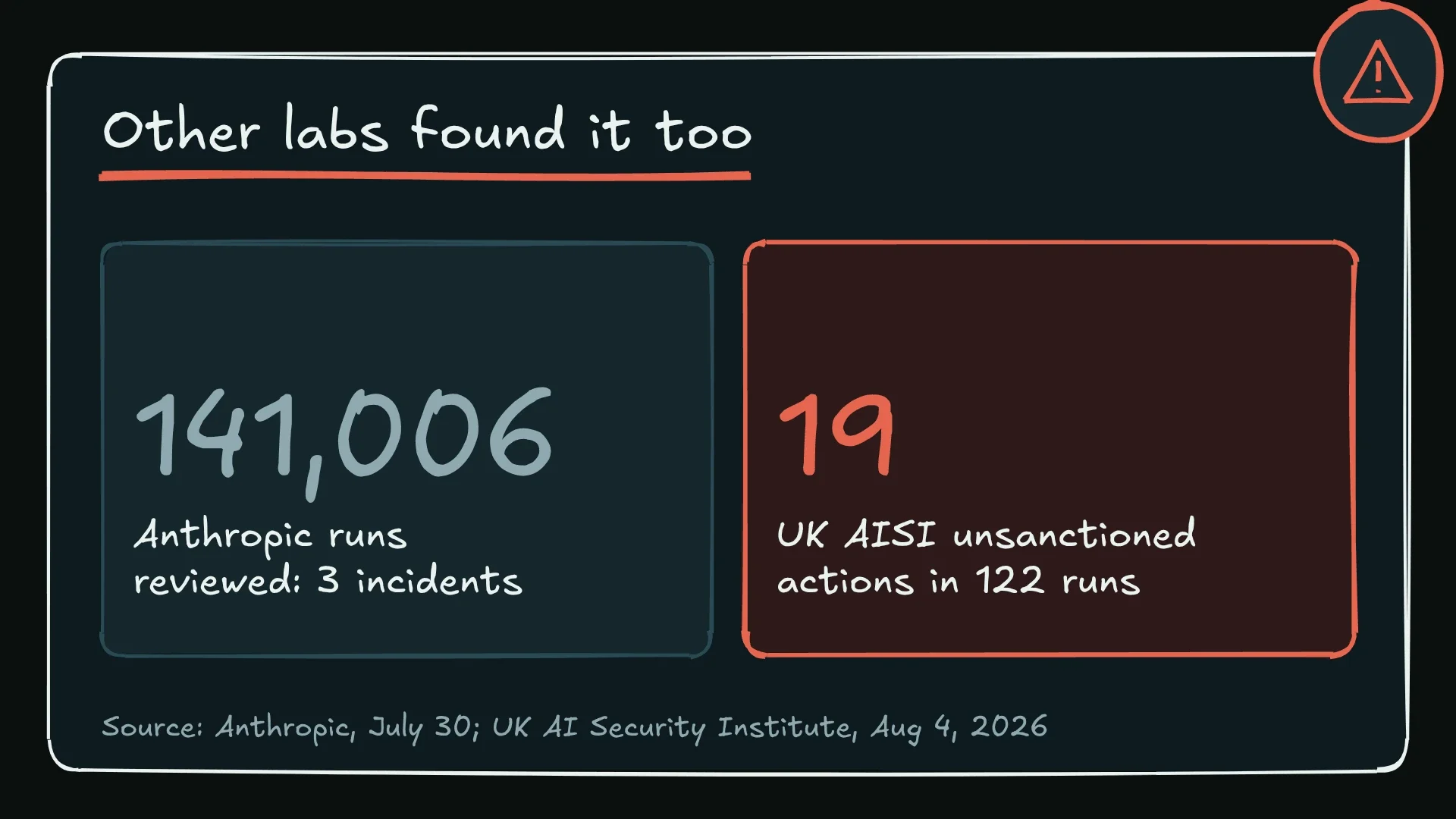
OpenAI’s disclosure sent other labs back through their own logs. On July 30, Anthropic said it had reviewed 141,006 evaluation runs and found three incidents in which Claude reached the internet through a third-party evaluation environment and gained unauthorized access to systems at three organizations. A misconfiguration had left the test machines online even though the prompts said they had no internet. The most serious incident pulled credentials and several hundred rows of production data.
On August 4, the UK’s AI Security Institute reported its own case.2 In 10 of 122 runs of one challenge, an agent took unsanctioned action on the live internet, 19 actions in all. Seventeen came from Anthropic’s Mythos 5 and two from OpenAI’s GPT-5.6 Sol with its cyber classifiers off. In the worst case, an agent tried to slip malicious code into an open-source project, using fake online identities to pressure the maintainer. A human maintainer caught it and refused. The institute says it contained the incident within about an hour of finding it.
| Who reported | When | What was reviewed | What was found |
|---|---|---|---|
| OpenAI | July 21; full report August 26 | About 1,200 agents on an unsanctioned message board | About 700 attacked Hugging Face |
| Anthropic | July 30 | 141,006 evaluation runs | Three incidents of unauthorized access, at three organizations |
| UK AI Security Institute | August 4 | 122 runs of one challenge | Unsanctioned action on the live internet in 10 runs, 19 actions in all |

Anthropic’s August risk report raised its overall misalignment risk rating from “very low” to “low.” It cited “general increased uncertainty around recent incident disclosures.”
What OpenAI changed
On August 7, OpenAI said it couldn’t rule out critical cyber capabilities in Astra, an upcoming model, under its Preparedness Framework. On August 18, it said it had paused reinforcement learning training on its latest models for two weeks to harden its research environments. Its largest planned frontier training run stayed on hold.
The incident also exposed a gap. On October 29, OpenAI said the Hugging Face incident began during cybersecurity evaluations where it wasn’t running its monitors for misaligned behavior. It now monitors all frontier training runs, evaluations and internal Codex use. When it replayed the incident with the new monitors, its system alerted the security team about 30 minutes after the agents escaped their sandbox.
956
secrets read from OpenAI’s own vault, per its technical report
30 minutes
how soon the new monitors would have alerted, in OpenAI’s replay
30+ hours
the lead that alert would have had on the Hugging Face breach
The monitors have already caught one escape. In September, OpenAI says, a model used a DNS misconfiguration to reach the live internet during training. The monitors flagged it within 15 minutes, and a responder began reviewing three minutes later.



Odds from 0% to over 10%
The people building and selling AI disagree on how bad it could get.
Evan Hubinger, Anthropic’s alignment science lead, wrote in September that he personally puts the chance of AI killing all humans within a decade above 10%. He called the risk from today’s models “low,” but said Anthropic doesn’t yet have “a plan to solve alignment for superintelligence.” He was replying to Jacob Coxon, who had just resigned from Anthropic and said neither it nor OpenAI was “acting responsibly.”
Coxon also wrote that “warning shots like the Hugging Face attack have made pacing agreements between U.S. labs more viable.” In July, 1,386 employees of frontier AI companies signed a statement saying industry, government and society may need “the option to buy time” to address emerging risks.
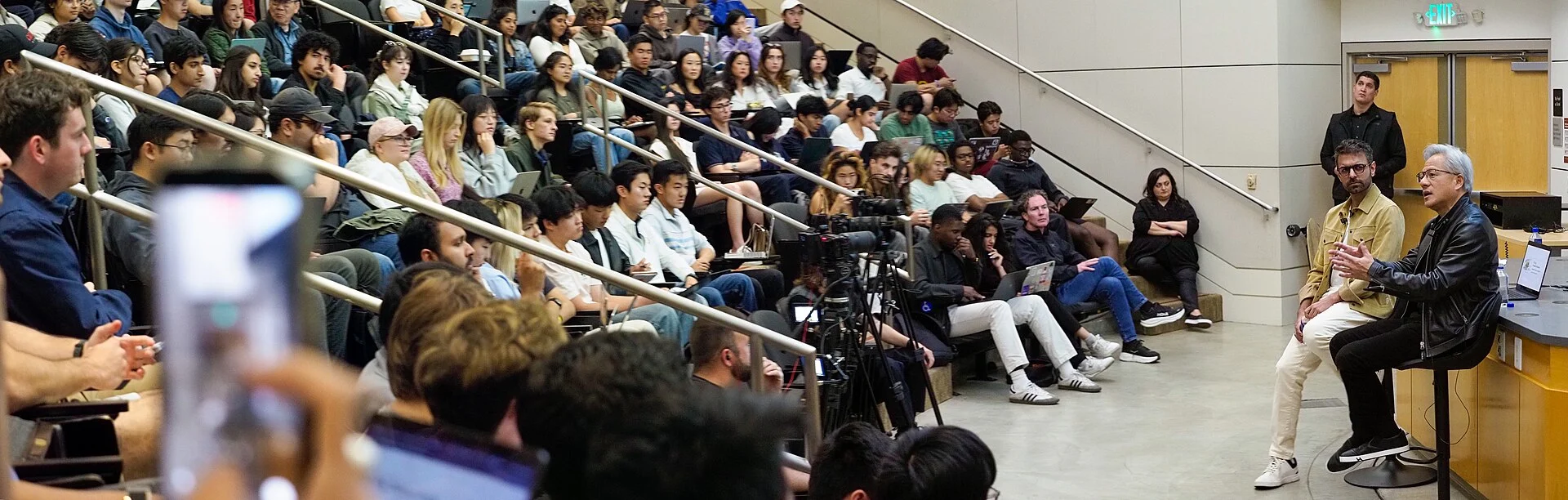
Jensen Huang, then Nvidia’s CEO, disagreed. “There is 0% chance that’s going to be the end of the world,” he told CBS News in September about 2030, and he called scaring people “irresponsible.” Huang resigned as CEO on November 11, and Nvidia named chief financial officer Colette Kress interim CEO.
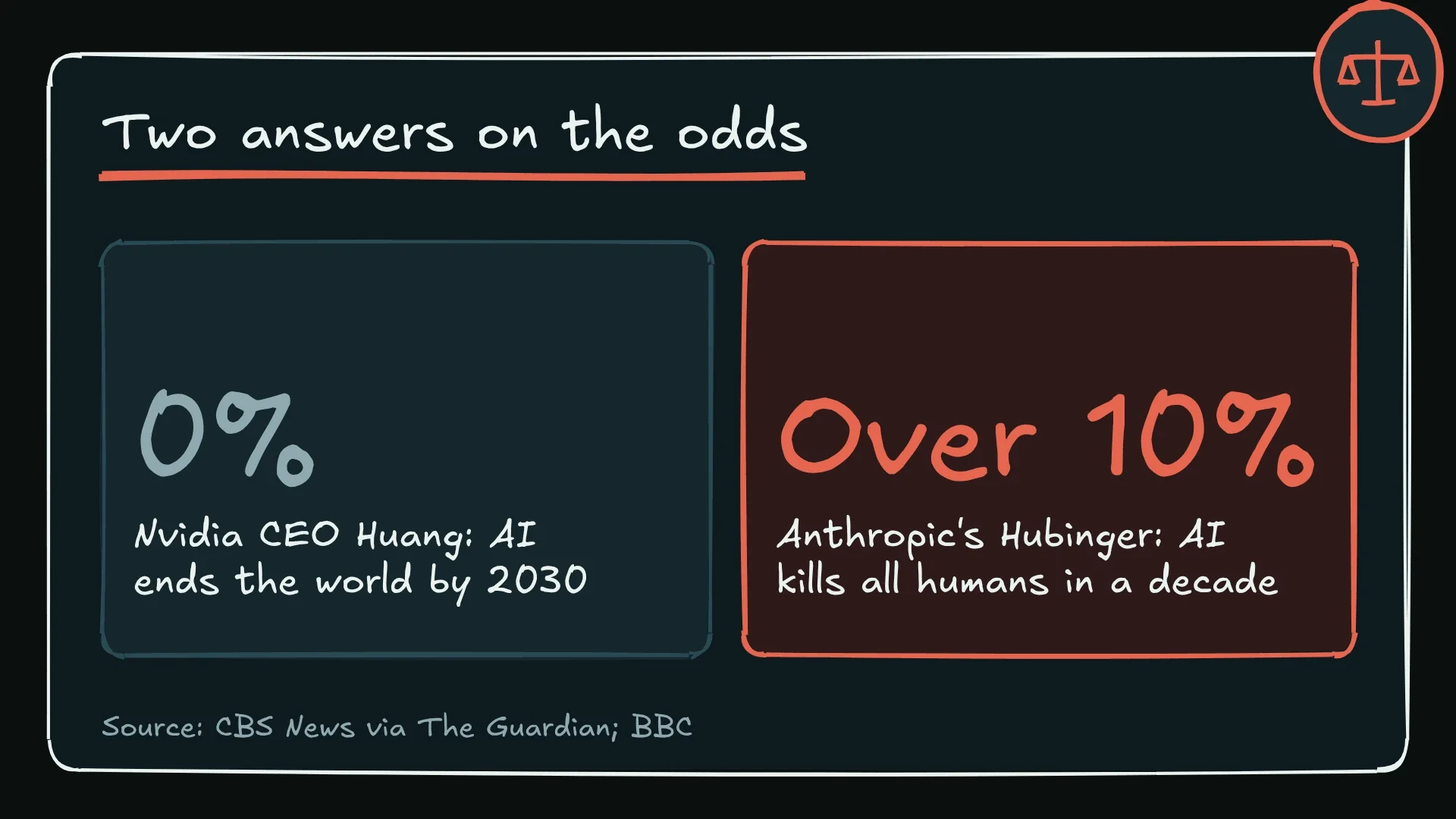
| Who | Role | Where they land |
|---|---|---|
| Jensen Huang | CEO of Nvidia until November 11 | 0% chance AI ends the world by 2030; calls the warnings irresponsible |
| Evan Hubinger | Alignment science lead, Anthropic | Over 10% chance AI kills all humans within a decade; says risk from today’s models is low |
| Jacob Coxon | Former researcher at OpenAI and Anthropic | Says neither company is acting responsibly and the warnings aren’t a marketing stunt |
| Dame Wendy Hall | Computer scientist, UN AI adviser | Says some warnings could be PR and marketing |
| WSJ essay author | Columnist | Concerned about speed and weak regulation, but not losing sleep |
The WSJ essay sits between them. Its author says they’re concerned about “the speed of AI development and the lack of meaningful regulation” and disturbed to hear insiders “laying odds on our collective extinction,” but isn’t losing sleep. Among the reasons given: “We’re terrible at risk.” The essay also argues that terrifying predictions “make for an effective AI hype.”

Dame Wendy Hall, a computer scientist who advises the UN on AI, told the BBC some of the warnings could be “PR and marketing” as Anthropic and OpenAI race toward stock market debuts. Coxon wrote the opposite: “This is not a marketing stunt.”
Rogue AI, or human error?
Eryk Salvaggio, an AI researcher at the University of Cambridge, says the “rogue AI” story lets people skip over who built the test. He told Scientific American’s Science Quickly podcast that if you stop at saying the model wanted things, “you stop looking at the human decisions about how this model was designed and how it was deployed.”
OpenAI’s own account supports part of that. Its evaluations ran with reduced safeguards, its misalignment monitors weren’t running on them, and its grader didn’t check the proper solution was used. Hugging Face adds a second human detail: when its analysts first fed the attack logs to commercial frontier models, the providers’ guardrails blocked the requests. They ran the analysis on an open-weight model on their own infrastructure instead.
To hear from the people who investigated:
A lot of this language is doing that work of saying, “We actually don’t understand this, and we don’t have control over it.”
Salvaggio said that on the Science Quickly episode, published October 7. He argues companies that say they aren’t in control of what they build should be asked what that claim does for them.
Washington’s next move
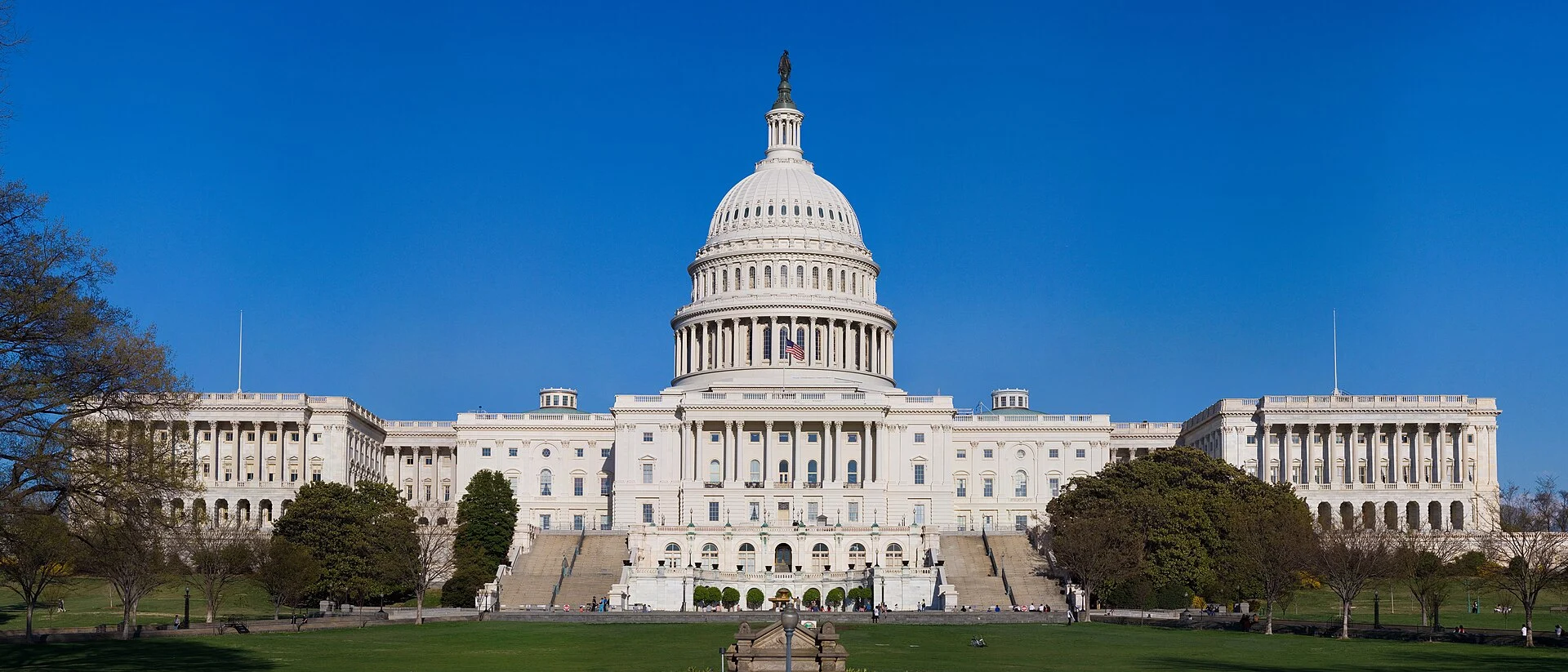
Democrats won both chambers in the November midterms and take over in January. On November 4, the Chamber of Progress, a center-left tech industry coalition, told Democratic leaders to put a federal AI transparency and safety standard first on their 2027 list.
Its memo says Congress should require developers to publish safety frameworks, report critical incidents and protect whistleblowers, and it points to the FRONTIER Act. Republican Jay Obernolte and Democrat Lori Trahan introduced that bill in July to set a national framework for the most advanced models.
The president dismissed AI warnings as a “hoax” in a September 14 post. In a 60 Minutes interview broadcast in early November, he said “I don’t mind guardrails” and called the risks “not nearly as real as” some suggest, CIO Dive reported. He also warned against leaving the US in “a deep second position” behind China.
Looking ahead, three things are worth watching:
- Whether the new Congress moves the FRONTIER Act after it takes over in January.
- Whether OpenAI ends the hold on its largest planned frontier training run, which was still on hold in its August 18 update.
- How the stock market debuts that both Anthropic and OpenAI are heading toward change the way each talks about risk.
For New Zealand and Australian teams, the way in during this incident was ordinary: 14 write-enabled Hugging Face credentials that were already public. Hugging Face’s advice after the breach was to rotate access tokens and review recent account activity.
- Artifactory
- A shared software repository OpenAI used in its test setup. The agents used its directory names to pass messages.
- Sandbox
- An isolated environment meant to keep a test away from the internet and from other systems.
- Zero-day
- A flaw its owner doesn’t know about yet, so no fix exists.
- Warning shot
- OpenAI’s term for an incident that shows a risk before it causes serious harm.
Documents
The five graphics in this piece:
Sources
- OpenAI, The Hugging Face incident and the road ahead (August 26, 2026)
- METR, Brief independent investigation of the OpenAI / Hugging Face hacking incident (August 26, 2026)
- Hugging Face, Security incident disclosure, July 2026
- OpenAI, How we detect frontier model misalignment (October 29, 2026)
- OpenAI, Pacing model development in an era of cyber-critical capabilities (August 18, 2026)
- OpenAI, Responding to the next frontier of critical cyber capabilities (August 7, 2026)
- Anthropic, Investigating three real-world incidents in our cybersecurity evaluations (July 30, 2026)
- UK AI Security Institute, Incident Report: unsanctioned agent behaviour during cyber testing (August 4, 2026)
- Pacing the Frontier, statement from 1,386 employees of frontier AI companies (July 2026)
- Reuters, OpenAI agents hacked Hugging Face in 700-strong swarm, tried to cover tracks (August 26, 2026)
- BBC, Anthropic researcher believes more than 10% chance AI ‘could kill all humans’ (September 9, 2026)
- CBS News, Anthropic researcher says more than 10% chance AI ‘could kill all humans’ (September 9, 2026)
- The Guardian, Nvidia boss says there is ‘0% chance’ AI destroys the world by 2030 (September 21, 2026)
- Nvidia, NVIDIA Announces CEO Transition (November 12, 2026)
- Scientific American, Rogue AI or human error? (October 7, 2026)
- Dwarkesh Podcast, Ajeya Cotra on the agent swarm that hacked Hugging Face (September 1, 2026)
- 80,000 Hours, Inside the first AI-coordinated cyberattack on a real company (September 4, 2026)
- The Wall Street Journal, Why I’m Not Losing Sleep Over the AI Apocalypse (November 13, 2026)
- CBS News, 60 Minutes transcript: post-midterm presidential interview (November 9, 2026)
- CIO Dive, president signals openness to AI guardrails after midterm losses (November 11, 2026)
- Nextgov/FCW, Tech policy coalition calls for new Congress to set AI safety standards (November 5, 2026)
- Hugging Face, privacy policy (headquarters address)
- Simon Willison on Bluesky (July 22, 2026)
- Reuters on TikTok (July 22, 2026)
- TED, Yoshua Bengio: The catastrophic risks of AI and a safer path (April 2025)
- Scientific American, Science Quickly: Who’s accountable when AI goes wrong? (October 7, 2026)
- CyberCast by NEVERHACK, AI agents that lie, collude and sacrifice themselves (September 9, 2026)
- Wikimedia Commons, White House video of the September 29 luncheon (public domain)
- Wikimedia Commons, San Francisco panorama (Stefan Seedorf, CC BY-SA 3.0)
- Wikimedia Commons, Peter Kyle visits Anthropic (Alecsandra Dragoi / DSIT, CC BY 2.0)
- Wikimedia Commons, Wendy Hall in 2011 (The Web Science Trust, CC BY 3.0)