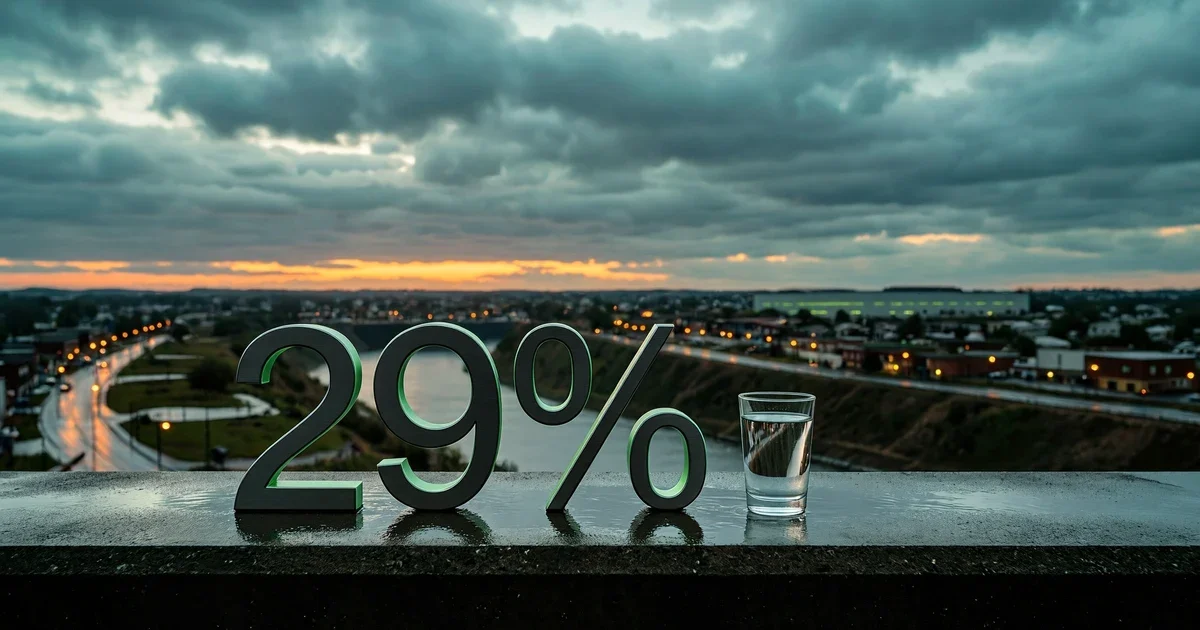
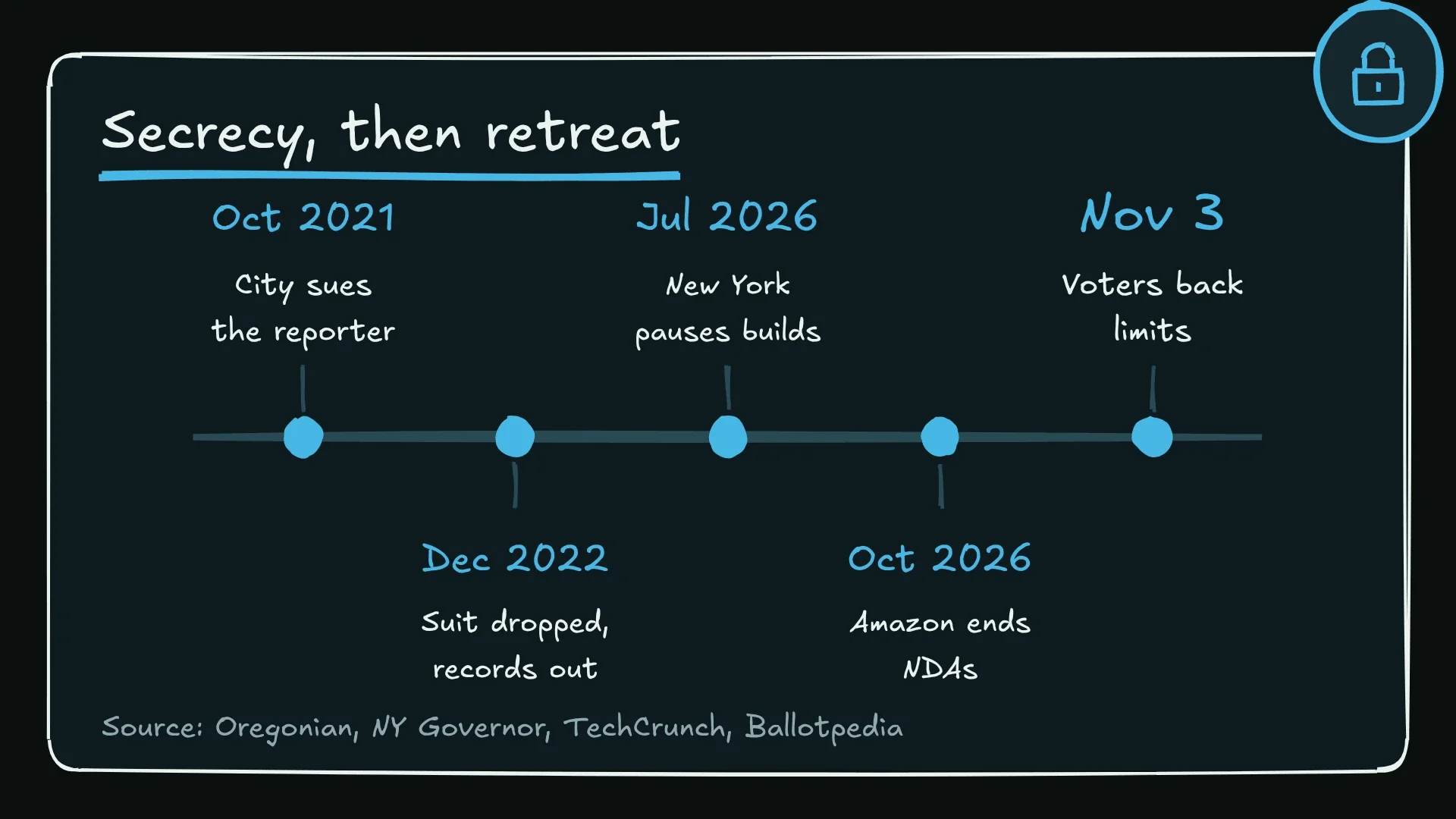
In September 2021, a reporter in The Dalles, Oregon asked the city how much water Google’s data centers use. The Wasco County district attorney ruled the answer wasn’t a trade secret and told the city to hand it over. The city sued the reporter instead, and Google agreed to cover its legal bills. When the numbers came out in December 2022, they showed Google’s data centers took 355 million gallons in 2021, or 29% of all the water the city used.
That case runs through journalist Paris Marx’s new book Hyperscale, and it explains why a backlash that helped reshape the November 3 midterms keeps coming back to one demand: show us the numbers. TechCrunch’s Anthony Ha interviewed Marx for a piece published November 22.
In this piece:
- The secret
- Two yardsticks, one industry
- Power hits the same wall
- New York pauses, voters weigh in
- The secrecy gives way
- What the evidence doesn’t show
The secret
The Oregonian’s business reporter, Mike Rogoway, filed the records request on September 24, 2021. The city denied it, saying Google’s water use was a trade secret exempt from Oregon’s public records law. Rogoway appealed to the Wasco County district attorney, who reviewed the denial and sided with the newspaper. The DA found the city hadn’t shown the figures were a trade secret and ordered it to release them.
The city didn’t comply. On October 29 it filed what’s known as a reverse public records lawsuit against Rogoway and The Oregonian, asking a court to block the release. Google had agreed to pay the city’s legal bills and ended up spending more than $100,000 on the fight. The mayor later told The Oregonian the city pushed ahead because Google “was concerned about competitors knowing how they cool their servers.”
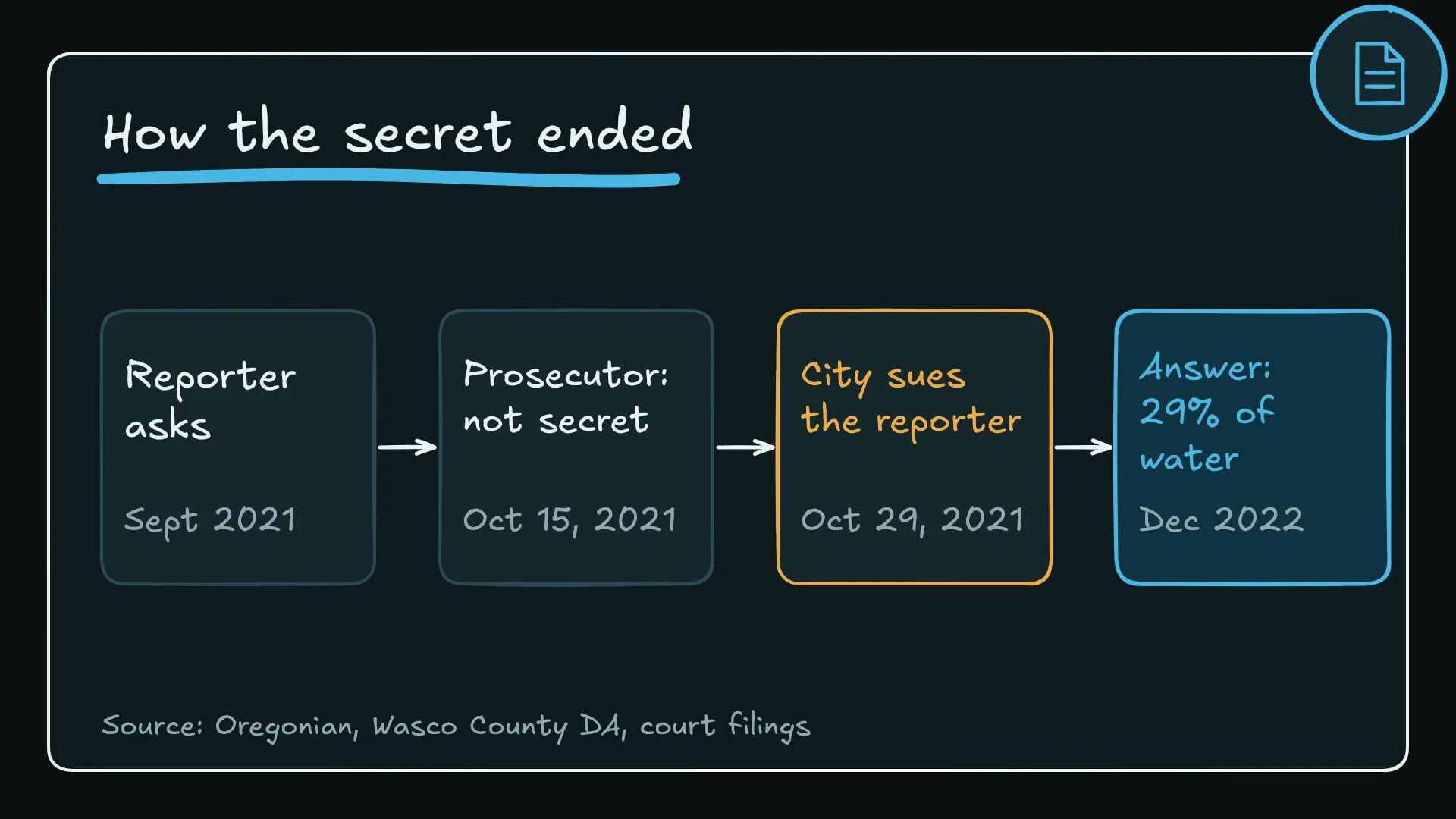
Then Google changed its mind. In November 2022 the city council authorized a settlement, and the city and the newspaper signed one on December 13. The city handed over annual water totals for 2012 through 2021 and agreed to release later years on request. It also paid the legal fees of the Reporters Committee for Freedom of the Press, which represented the newspaper. A Google spokesperson told the Associated Press the company would stop treating site-level water numbers as trade secrets at any of its data centers nationwide.
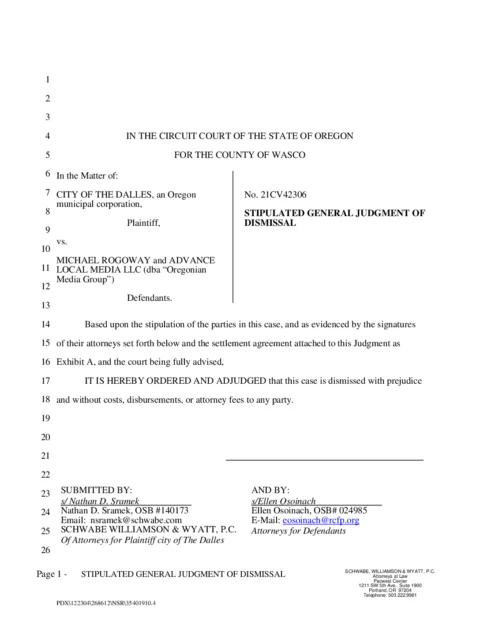 City of The Dalles v. Advance Local Media: settlement and dismissal (PDF, December 2022)
PDF 7 pages 796 KB
Download“This is a limited, communal resource and the West is in a drought. There are data centers all over the country and right here in Oregon, and the amount of water they consume is something that’s incredibly important to all water users.”
Ellen Osoinach, the Reporters Committee attorney who represented The Oregonian, in December 2022
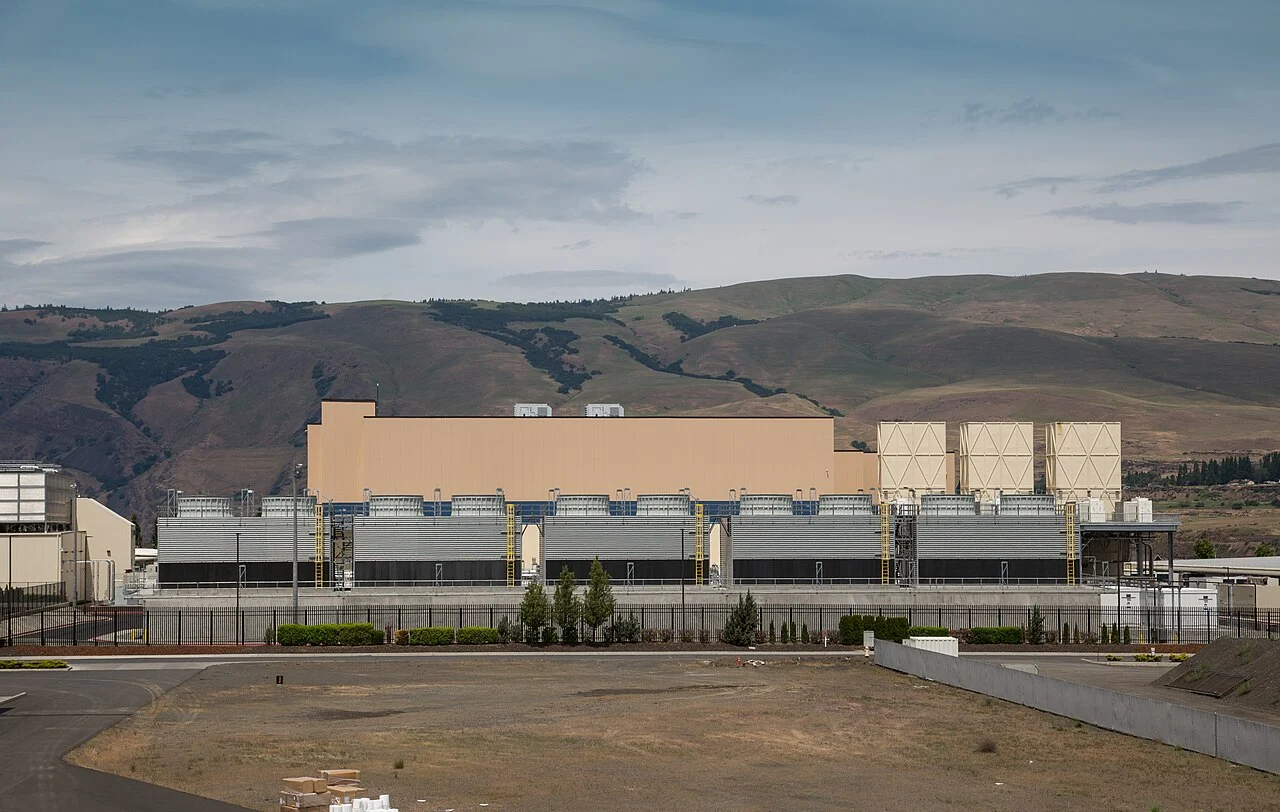
The records showed Google’s water use in The Dalles had nearly tripled in five years. The Dalles has about 16,000 people and sits in a dry stretch of the Columbia River valley, with less than half the annual rainfall Portland gets 80 miles downstream.
355 million
gallons of The Dalles’ water used by Google’s data centers in 2021
29%
share of all the water the city used
Nearly 3x
rise in Google’s use over five years
Marx says The Dalles was one of three stories that convinced him there was a book here. Google built its first company-owned data centers in the city about 20 years ago, he says, and when residents began asking how much water they used, the answer was a lawsuit. He told TechCrunch it “felt like that was going to start coming to a lot more communities.”
Two yardsticks, one industry
It’s very physical, it’s very material.
Paris Marx, on why a data center in your town is harder to ignore than an app, TechCrunch, November 22
Marx argues the industry has shifted its defense to water because it thinks national averages work in its favor.
“They have pivoted, instead, to focus on the water question, where I think that they feel that they can use more abstract national figures in order to confuse the public about what’s going on.”
Paris Marx, TechCrunch, November 22
Amazon Web Services CEO Matt Garman made that move on October 3. Pointing to an Amazon report, he said “direct data center water consumption” is 0.5% of all industrial water use in the United States, “orders of magnitude less than golf courses, almond farming, and many other industries.” We haven’t audited Amazon’s figure. Taken at face value, it still answers a different question from the one The Dalles asked. A national share and a local share don’t conflict. Only one of them is the number a town has to plan its water around.
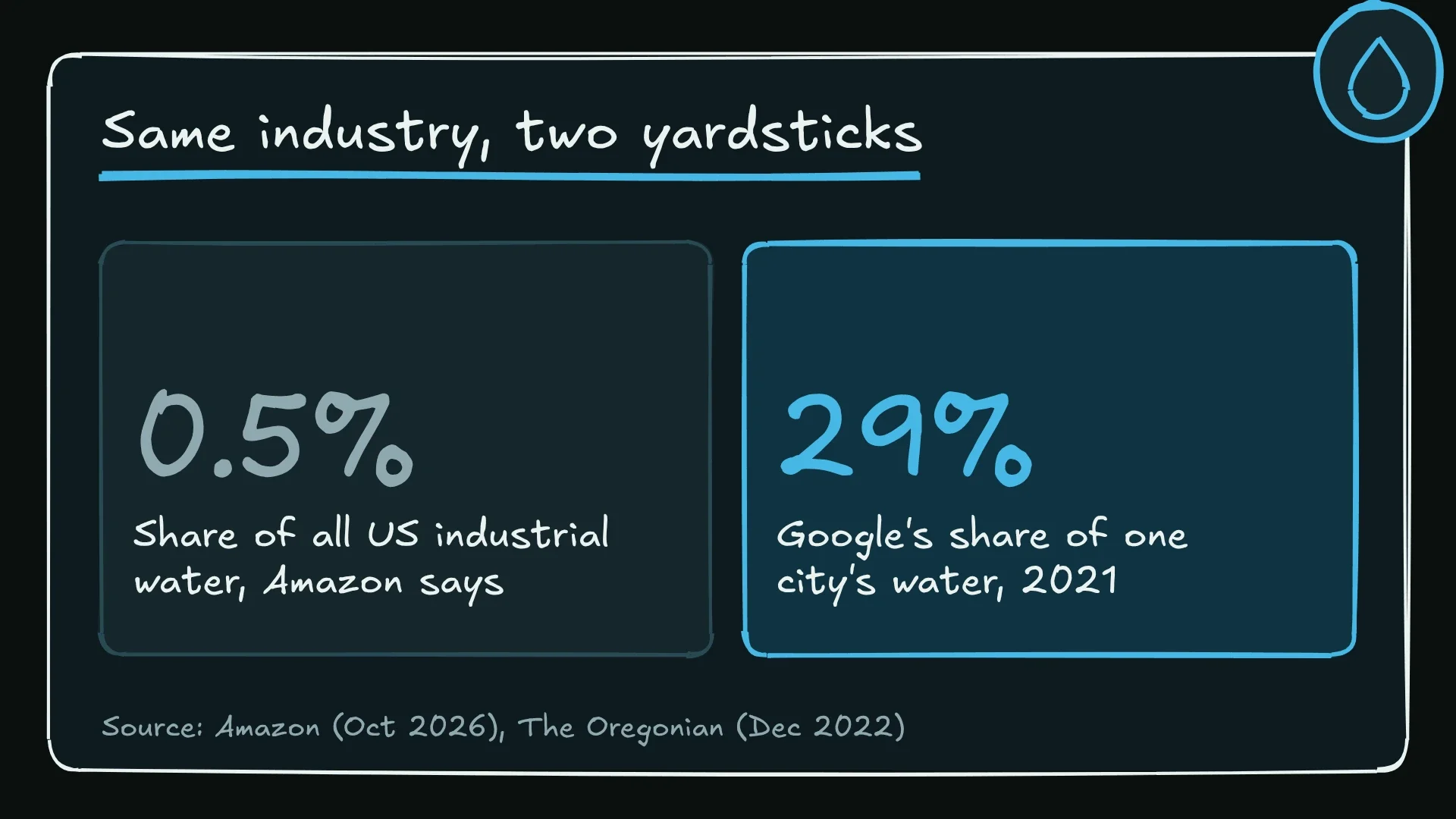
Marx’s answer is blunt: “the issue with data center water use is not a national issue. It’s a local issue.” Some communities have plenty of water and won’t notice a data center, he says, but companies are also building in places under heavy water stress.
He adds two caveats about the industry’s newer answer. Closed-loop cooling needs less water but more electricity to keep that water cool, and the electricity is often left out of the pitch. Communities near closed-loop sites are also starting to worry about coolant chemicals leaking into their water supply.
What’s a reverse public records lawsuit?
In an ordinary records fight, the requester sues an agency that refuses to release documents. In a reverse suit, the party holding the records sues the requester to get a court to block the release. The Dalles filed one against Rogoway and The Oregonian in October 2021, after the district attorney had already ordered the records released. The case ended with the December 2022 settlement.
Power hits the same wall
Ireland was the second story that tipped Marx off. The country’s Central Statistics Office reported on July 7 that data centers used 7,663 gigawatt-hours of electricity in 2025, or 23% of all metered electricity, up from 5% in 2015. By our own division that’s more than four times the share in ten years. Data center use rose 10% in 2025 alone, from 6,973 GWh. Every other user combined rose 2%. Households account for 28% of usage.
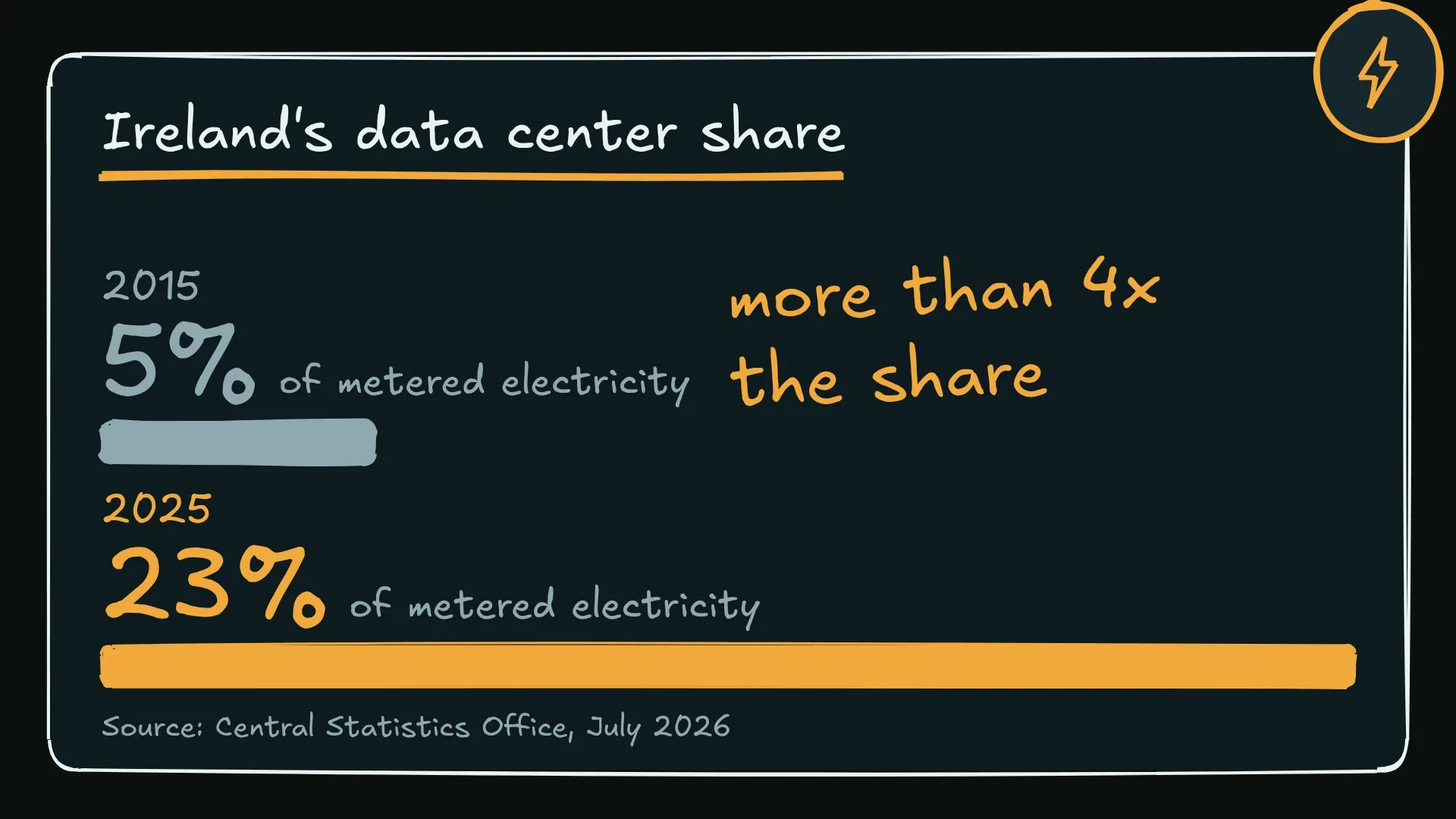
Dublin has had a de facto moratorium on new data center connections since 2022. Ireland’s energy regulator has since lifted it and replaced it with rules that require operators to provide matching on-site generation and to source at least 80% of their annual demand from new, unsubsidized renewable projects.
| Place | Pressure | What happened |
|---|---|---|
| The Dalles, Oregon | Water | Google’s data centers used 29% of the city’s water in 2021. The city sued to keep that secret until December 2022. |
| Santiago, Chile | Water | A court partly reversed a Google data center’s approval over water use. In September 2024 Google paused the project and said it would revise it and change its water-intensive cooling system. |
| Ireland | Electricity | Data centers used 23% of metered electricity in 2025, up from 5% in 2015. Dublin connections were effectively frozen from 2022, then the rules were rewritten. |
| New York | Grid | Nearly 12 gigawatts of data center load requests were in the grid operator’s queue as of May 2026. The state paused environmental permits for new hyperscale data centers on July 14. |
New York pauses, voters weigh in
On July 14, New York Gov. Kathy Hochul signed Executive Order 62, the first statewide moratorium on new hyperscale data centers. It pauses state environmental permits for up to one year while the state builds a regulatory framework. The order cites nearly 12 gigawatts of data center load requests in the state grid operator’s queue as of May 2026, with more than 8 GW arriving in 2025 alone.
Voters weighed in at the polls on November 3. In the NBC News exit poll, with data from SSRS, 76% of voters said they opposed building a data center in their community and 24% favored it. Asked how important AI data centers were to their vote for Congress, 23% said crucial and 33% said a major factor, for 56% combined. That put it below the other four issues the poll asked about, led by government corruption (90%) and the cost of living (89%).
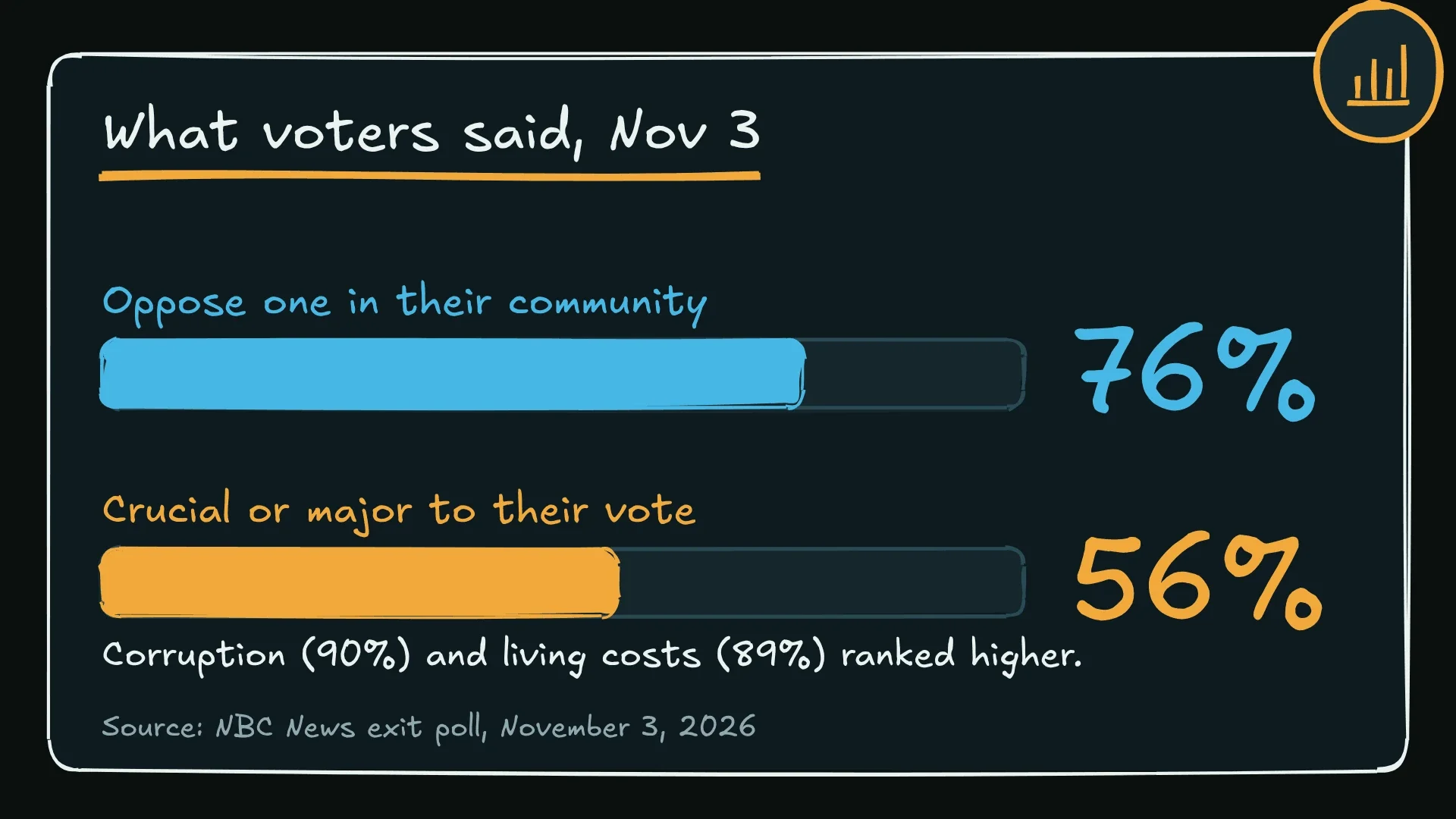
Ballotpedia counted 47 local data center ballot measures on November 3. Voters favored limits in 46 of them. The one exception was Harwood, North Dakota, where voters rejected an added review requirement for large industrial projects.
Did the issue favor one party?
It leaned Democratic but wasn’t confined to one party. Of the voters who called AI data centers crucial to their vote, 67% backed Democrats and 30% backed Republicans, according to Data Center Dynamics’ read of the NBC results. Among those who called it a major factor, the split was 61% to 37%. Marx makes the cross-party point too: “It doesn’t matter what side of the political spectrum that you’re on,” because the effects land in your power bill and your water.
The secrecy gives way
The Dalles case set a pattern that keeps repeating. On October 3, Garman said Amazon has stopped using nondisclosure agreements in its dealings with government agencies when it seeks approval for new data centers, and that more than 100 data center moratoriums are under consideration across the US. TechCrunch’s Ha notes that Microsoft and OpenAI have made similar commitments.
Marx isn’t impressed. Asked how much difference the pledges make, he said, “Not a huge difference.” The change helps residents get information, he says, but it came in response to opposition, and the old approach had stopped working for the companies.
“People know what a data center is now, and if people find out that a data center is coming to town and they have questions and they’re not getting answers, that’s only going to further fuel the opposition to those data centers.”
Paris Marx, TechCrunch, November 22
What the evidence doesn’t show
What the records settle
The Dalles sued to keep Google’s water use secret, a prosecutor had already ruled it wasn’t a trade secret, and the records showed 29% of the city’s water went to Google’s data centers in 2021. All of that is in court filings and in The Oregonian’s reporting.
What they don’t
- The 29% is a 2021 figure. We found no newer published number for Google’s use in The Dalles.
- Marx’s judgments, including that the buildout is “fundamentally unsustainable,” are his own. We haven’t read the book, so everything here from it comes through his TechCrunch interview.
- Amazon’s 0.5% is the company’s own figure and we haven’t checked it.
- The poll measures opposition to a new data center in the respondent’s own community, not to data centers in general, and exit polls are survey estimates.
Looking ahead, New York’s pause runs for up to a year from July 14, 2026, so it expires around mid-July 2027 unless the state extends it. Ballotpedia lists four more local data center ballot measures on December ballots. And under the 2022 settlement, anyone can file a request for Google’s water use in later years.
Related on GREEENER.ai:
Sources
- TechCrunch, Why data centers are at the center of the Big Tech backlash (November 22, 2026)
- Hyperscale, the book by Paris Marx
- Reporters Committee for Freedom of the Press, Google uses a lot of water in Oregon’s city of The Dalles (December 15, 2022)
- The Oregonian, The Dalles settles public records lawsuit over Google’s data centers (December 14, 2022)
- The Oregonian, Google’s water use is soaring in The Dalles, records show (December 17, 2022)
- City of The Dalles v. Advance Local Media, settlement and dismissal (December 2022)
- TechCrunch, Amazon responds to data center backlash, says it no longer uses NDAs (October 3, 2026)
- Central Statistics Office, Data Centres Metered Electricity Consumption 2025 (July 7, 2026)
- Data Center Dynamics, Data centers in Ireland consumed 23% of national electricity in 2025
- PBS NewsHour, Google to pause plans for big data center in Chile over water worries (September 2024)
- New York Governor’s Office, Executive Order 62 (July 14, 2026)
- Governor Kathy Hochul on YouTube, First Statewide Moratorium on New Hyperscale Data Centers
- NBC News, 2026 exit polls
- Data Center Dynamics, NBC exit poll: 56% say AI data centers were a crucial or major factor (November 4, 2026)
- Ballotpedia, Data center-related ballot measures, 2026
- OpenStreetMap, The Dalles, Oregon
- Wikimedia Commons, Google Data Center, The Dalles, Oregon, by Tony Webster (CC BY 2.0)