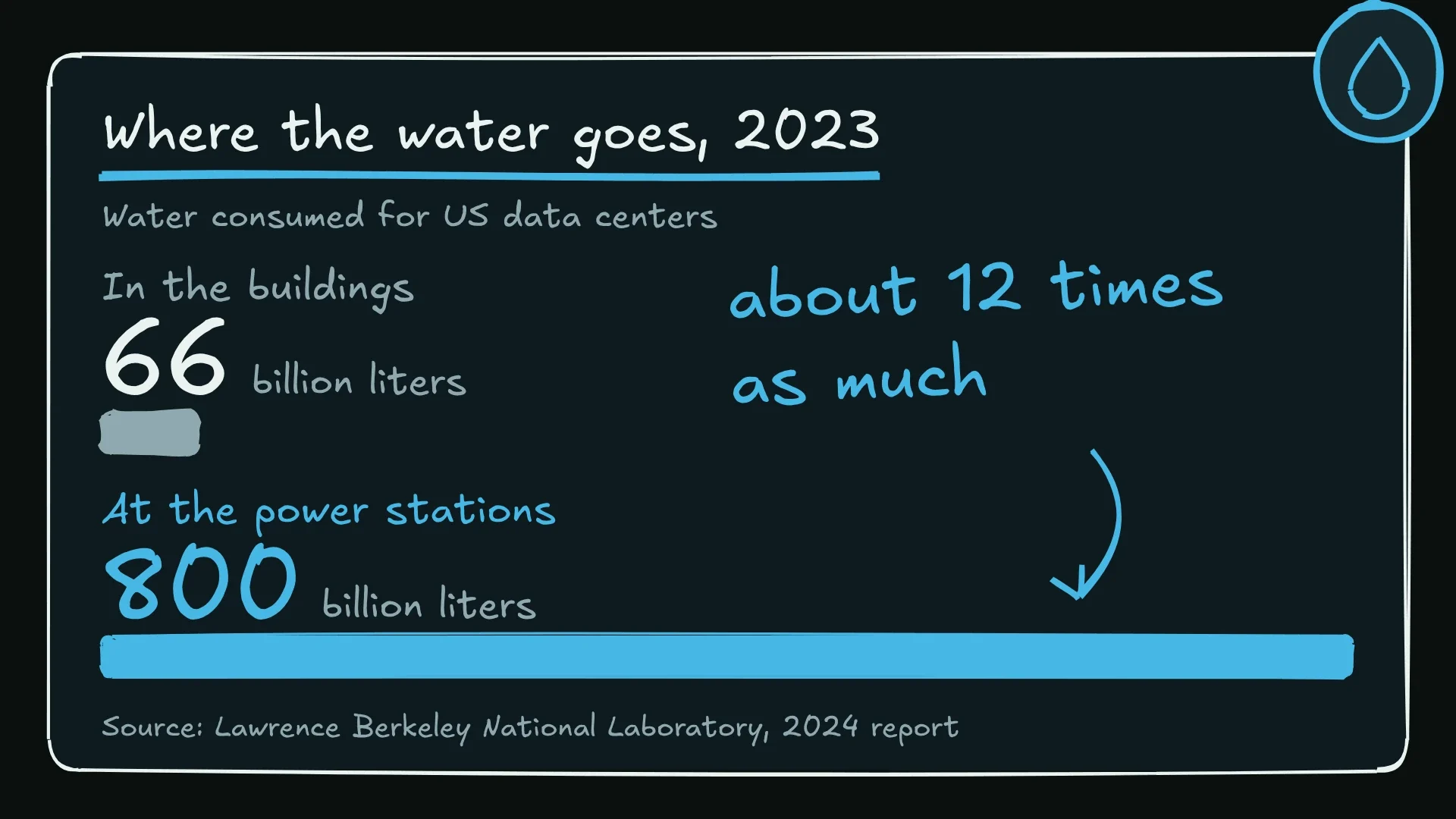
In 2023, US data centers consumed about 66 billion liters of water (17 billion gallons) on site. The power stations that supplied them consumed nearly 800 billion liters (211 billion gallons). That’s about 12 times as much.
Lawrence Berkeley National Laboratory, a US Department of Energy lab, produced those figures. It got the second number by multiplying 176 terawatt-hours of electricity by about 4.5 liters of water per kilowatt-hour. Company water reports often leave that number out, according to the Pacific Institute, a California water research group.
Two kinds of water use
Direct use is water that cools servers inside the building. Indirect use is water consumed at power plants. Gas, coal and nuclear plants turn water into steam and use more to cool it back down. Solar and wind use little, the Pacific Institute says.
The institute’s September 2026 brief found indirect use runs 2.4 to 12 times direct use across the studies it reviewed. The Berkeley lab’s national figure sits at the top of that range. The local grid sets the ratio.
The direct side is concentrated. Hyperscale and colocation facilities accounted for 84% of 2023 direct use, and Berkeley Lab expects hyperscale facilities alone to use 60 to 124 billion liters directly by 2028. The Pacific Institute says hyperscale operators went from 20% of US data center capacity in 2018 to 48% in 2025, and it projects 67% by 2031.
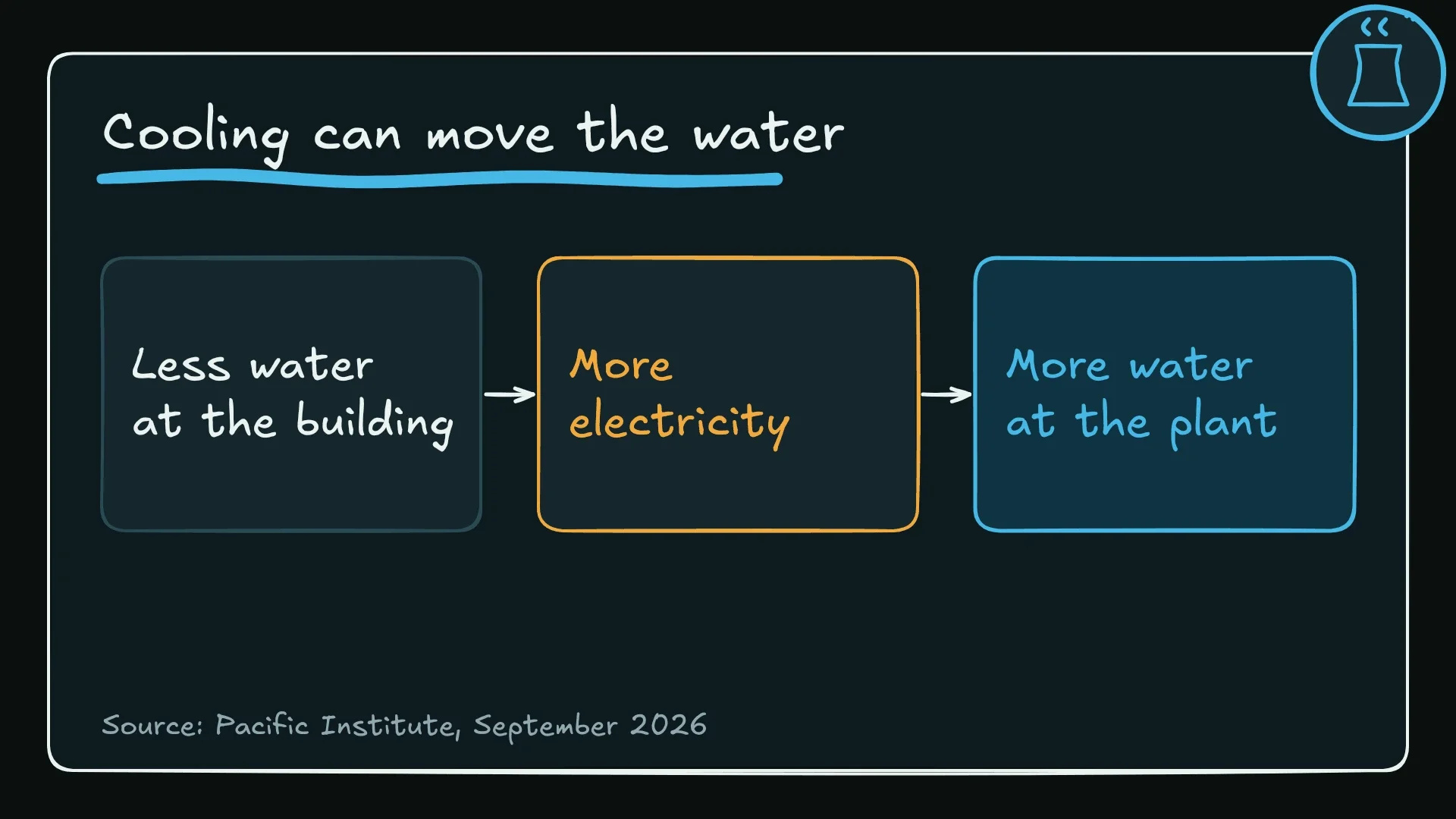
Cooling choices move the burden. Some technologies cut on-site water but use more electricity, and the Pacific Institute says that raises indirect water use. It puts average on-site use in 2023 at about 0.36 liters per kilowatt-hour, and at about 1.8 for AI-specific data centers.
What 65 facilities show
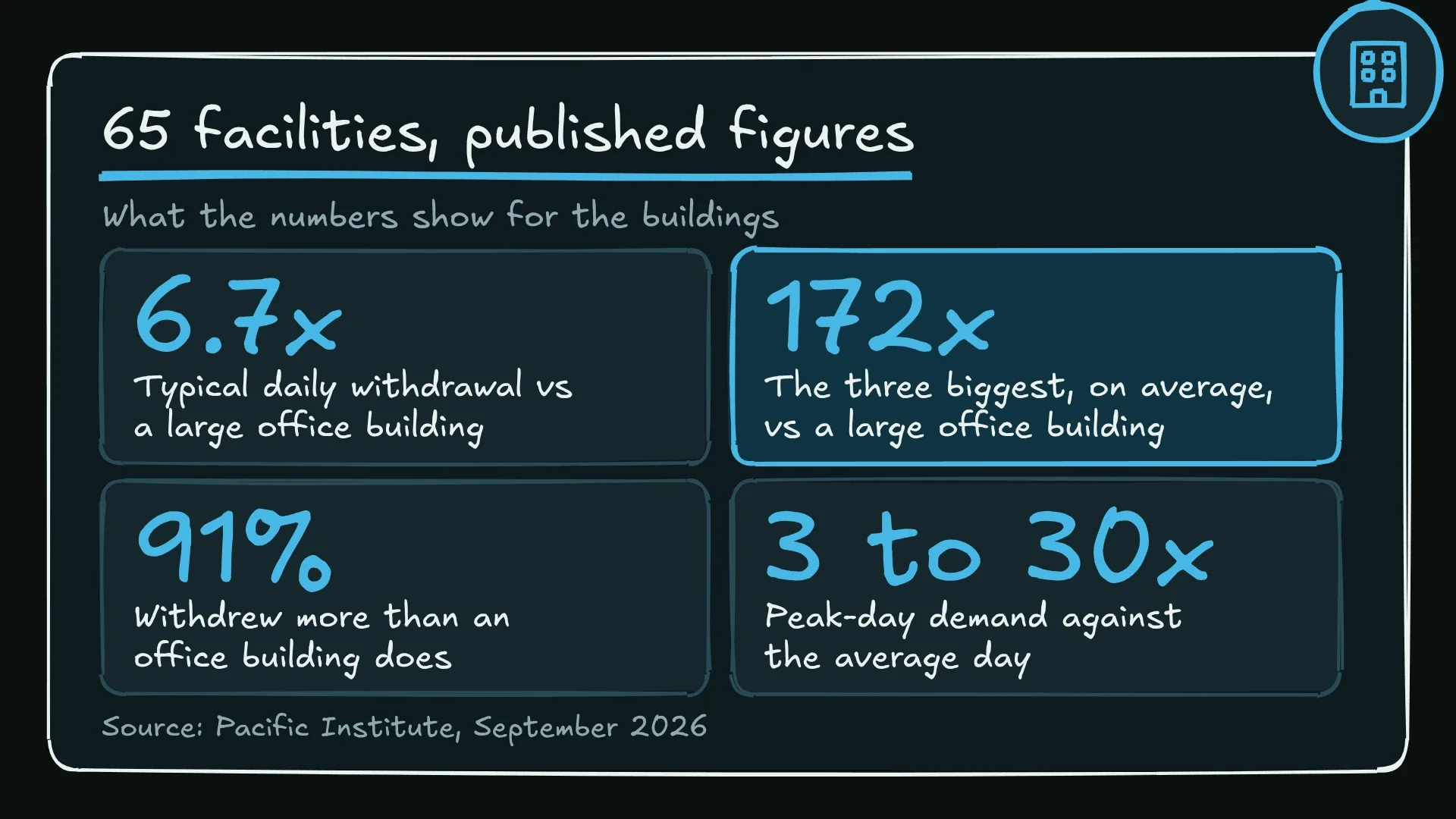
The buildings still matter locally. The Pacific Institute collected published figures for 65 US facilities. The typical one withdrew about 121,000 gallons a day, 6.7 times what a large office building uses. The three biggest averaged 3.1 million gallons a day, 172 times as much. Average daily withdrawals ran from 270 gallons to 3.9 million, and 91% of the 65 withdrew more than an office building does.
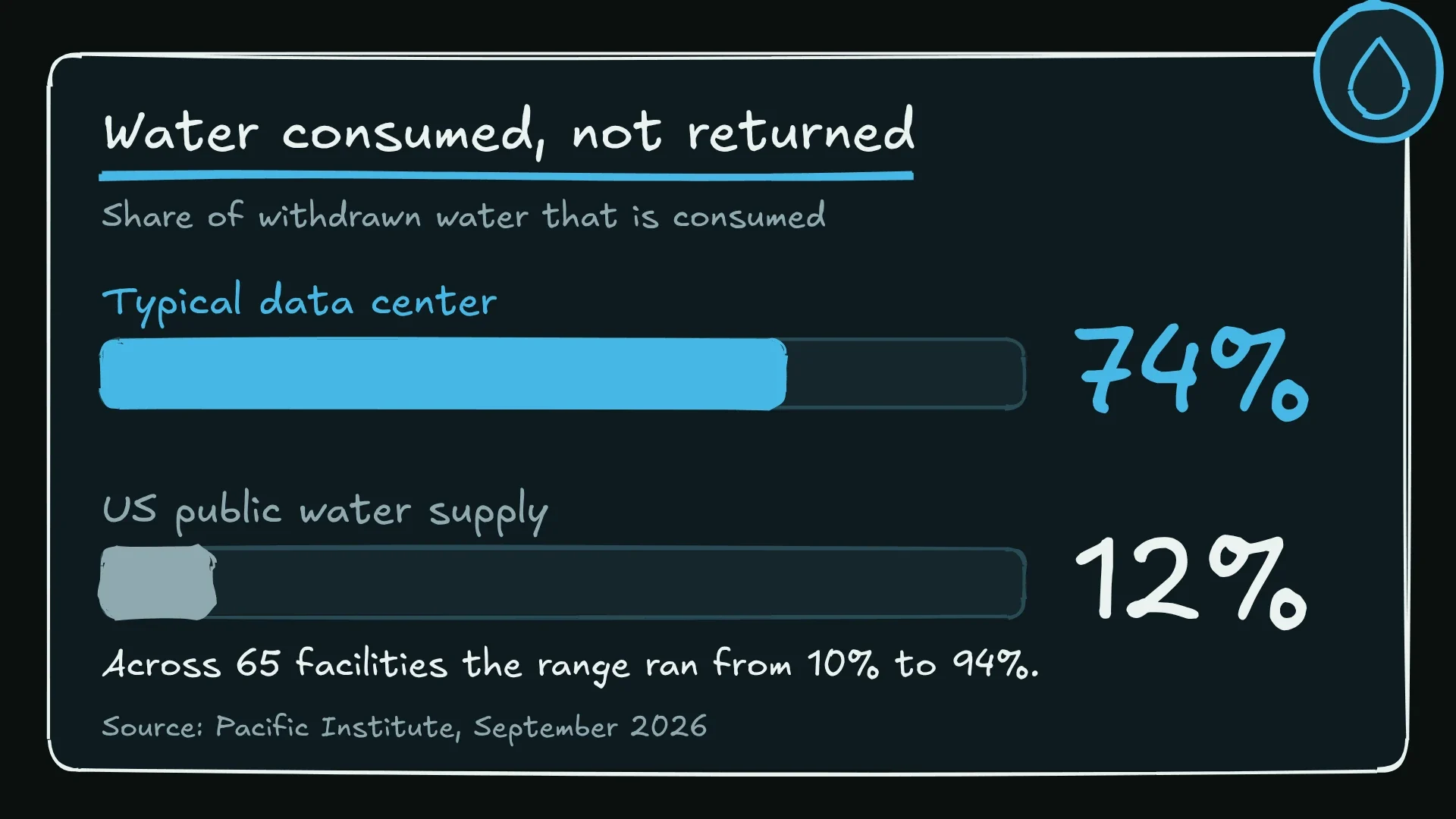
Most of that water doesn’t come back. The typical facility consumed 74% of what it withdrew, and the range ran from 10% to 94%. US public water supplies average about 12%. Of the roughly 11 billion gallons the 65 facilities withdrew, 76% was potable.
Demand also spikes. Peak days run 3 to 30 times the average, against 1.5 to 2 times for hospitals, because cooling works hardest in the heat. Nearly one-third of US data centers sit in areas of high water stress, the institute says.
The view from Arizona
KJZZ in Phoenix reported on October 28, 2026 that researchers see data centers there using less water on site than people assume. Aligned Data Centers told the station its facilities need no water for operational cooling. Phoenix has required any new user of 250,000 gallons a day or more to apply to the city since 2024.
“So I think absolutely the most sustainable way to meet the water demands of these data centers is with municipal tap water.”
Kathryn Sorensen, director of research at Arizona State University’s Kyl Center for Water Policy and a former head of Phoenix’s water department, said that in the KJZZ report.
The power side is harder to see. Ceres, a sustainability nonprofit, estimated in 2025 that Phoenix-area data centers use 385 million gallons a year for cooling, rising to 3.3 billion gallons once power generation is counted. It expects water use tied to Phoenix-area data center electricity to rise as much as 400% as planned centers open, and KJZZ put the total at 14.5 billion gallons a year.
Nationally, Ceres projects power generation will account for 72% of US data center water consumption by 2030. It found 66% of the water-using power plants it examined face medium-high to extremely high water stress, and 75% of Arizona’s generation is exposed to both water stress and drought.
Arizona’s utility regulator doesn’t require utilities to report water use at their power plants, Keriann Conroy of the Energy and Policy Institute told KJZZ. The Kyl Center’s February 2026 report found no evidence that electricity suppliers’ water use has risen in central Arizona, Cronkite News reported. Agriculture accounts for 72% of the state’s water use, Cronkite News added.
Tucson shows the pattern in one project. The city council refused to approve Project Blue in August 2025, and developer Beale Infrastructure is building just outside the city. It says the campus will be air-cooled. State regulators approved wells capped at about 96 acre-feet, or 31 million gallons, a year. In December 2025, the Arizona Corporation Commission approved Tucson Electric Power’s agreement to supply up to 286 megawatts, on a 4-1 vote. The utility says it can cover that with existing resources plus solar and storage projects under development.
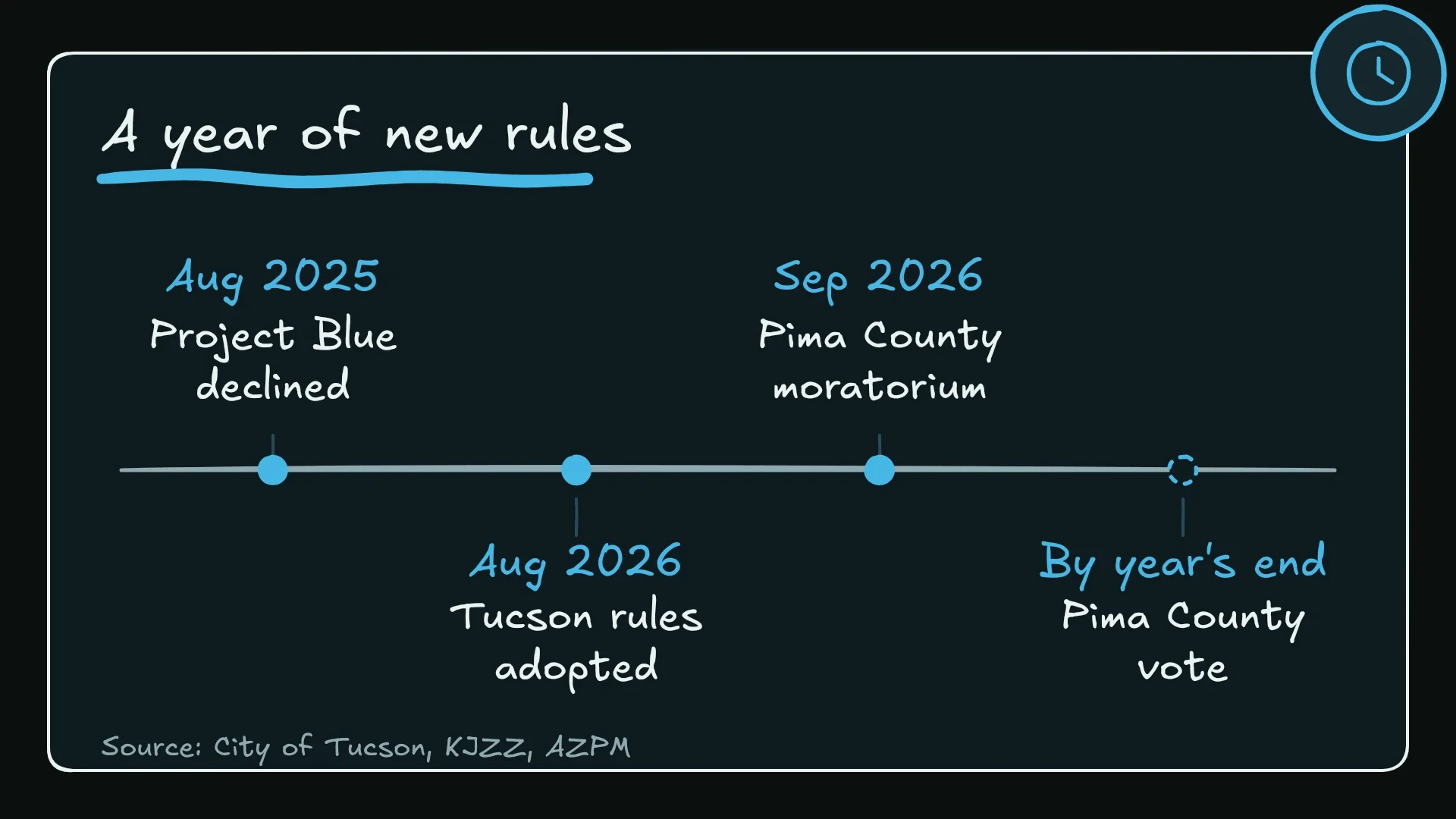
Rules have followed. Tucson adopted data center zoning rules on August 5, 2026, by a 6-1 vote. They prohibit potable water for cooling unless a project falls under the city’s large-quantity water user ordinance. Pima County’s supervisors approved a 120-day moratorium on September 22, by 3-2, though it doesn’t touch Project Blue. On October 28 the county planning commission voted 8-1 to send proposed rules to the board. They would require a conditional use permit, ban open-loop cooling and demand written guarantees of water and power service, KJZZ reported.
Looking ahead, Pima County’s supervisors are expected to vote on the rules by the end of the year, and the moratorium ends January 20. The Pacific Institute wants facility-level reporting of monthly withdrawals and consumption, peak daily demand and cooling technology. For readers in New Zealand and Australia, the question for any proposed data center is what powers it, not just what cools it.
Sources
- Lawrence Berkeley National Laboratory, 2024 United States Data Center Energy Usage Report
- Pacific Institute, How Much Water Do Data Centers Use? And Why Does It Matter? (September 2026)
- Ceres, Water Behind the Watts (August 2026)
- KJZZ, Arizona data centers drive up water demand, but not the way you might think
- Cronkite News via KJZZ, Don’t blame data centers for Arizona’s Colorado River cuts
- Tucson Sentinel, Project Blue’s 2 new Tucson wells
- Arizona Corporation Commission, TEP energy supply agreement (December 5, 2025)
- Tucson Electric Power, Data Center Campus Proposal
- City of Tucson, Regulations for Large-Scale Data Centers
- KJZZ, Pima County passes 120-day moratorium on future data center projects
- KJZZ, Communities across Arizona consider stronger rules for data center development
- KOLD 13 News, Pima County planners advance changes to data center rules