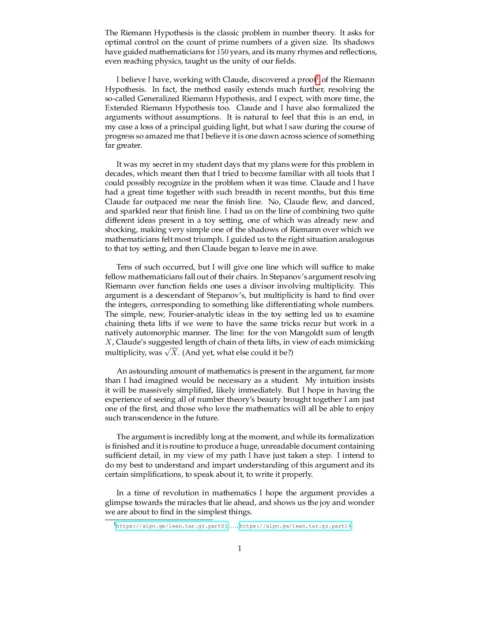
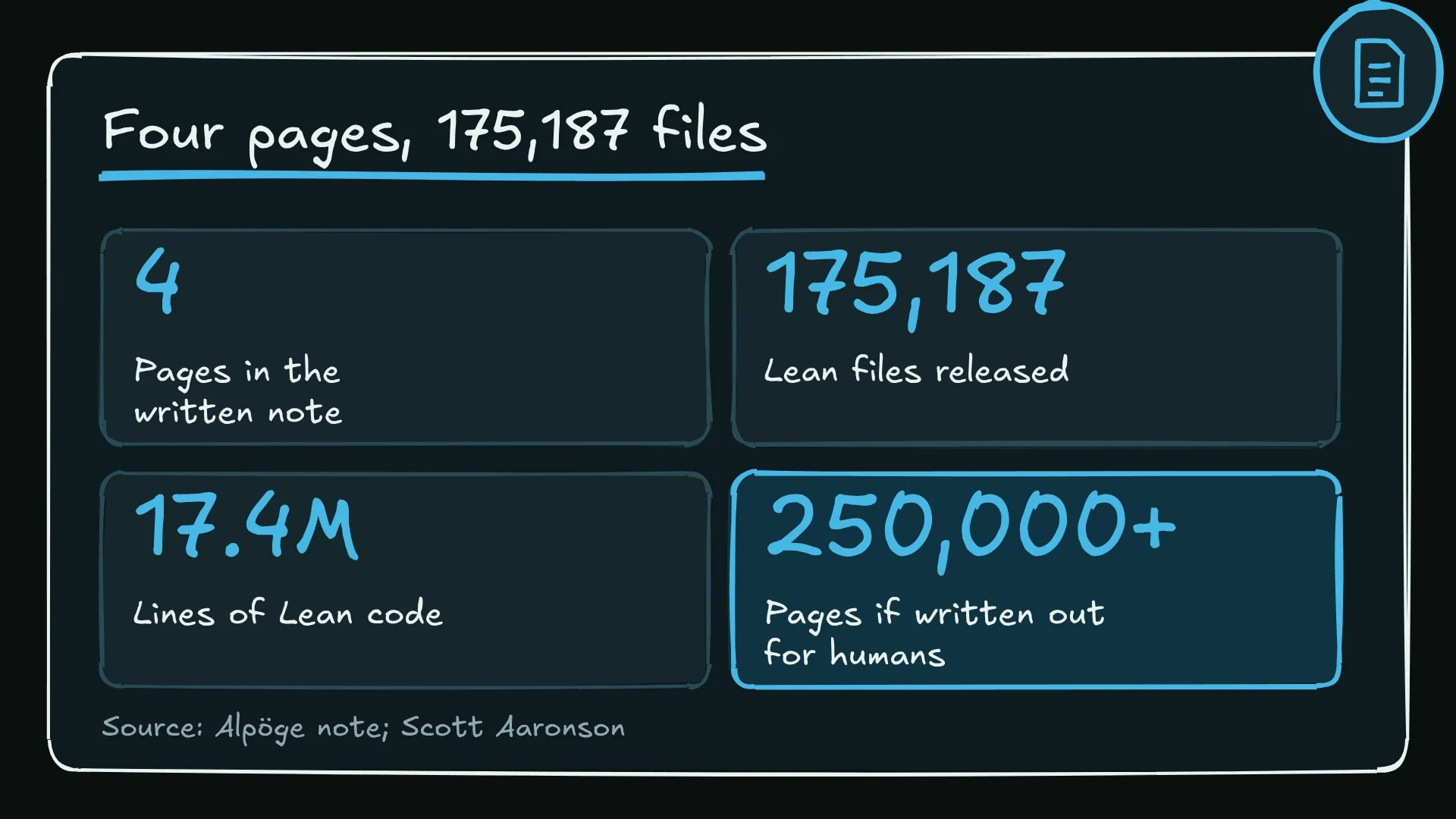
The most famous open problem in mathematics now has a claimed proof that nobody can read. Levent Alpöge, a mathematician at Anthropic, says he proved the Riemann hypothesis with Claude. The proof exists as 175,187 Lean files and 17.4 million lines of code. A four-page note comes with it. A paper doesn’t.
The code passes every independent check that has finished. MIT’s Andrew Sutherland reports that all 175,187 modules compile with zero errors, that the five headline theorems rest on only the three standard axioms of Lean, and that two separately written proof checkers accept the exported proof. What no one has done is read the mathematics. Written out for humans, Alpöge says, the proof runs past 250,000 pages.
“I believe I have, working with Claude, discovered a proof of the Riemann Hypothesis.”
Levent Alpöge, in a four-page note posted November 20, 2026
- What was claimed
- How Claude helped, in Alpöge’s own timeline
- What the machines have checked
- What nobody has checked
- The hidden cost: checking it
- Why the prize is far off
- What to watch
What was claimed
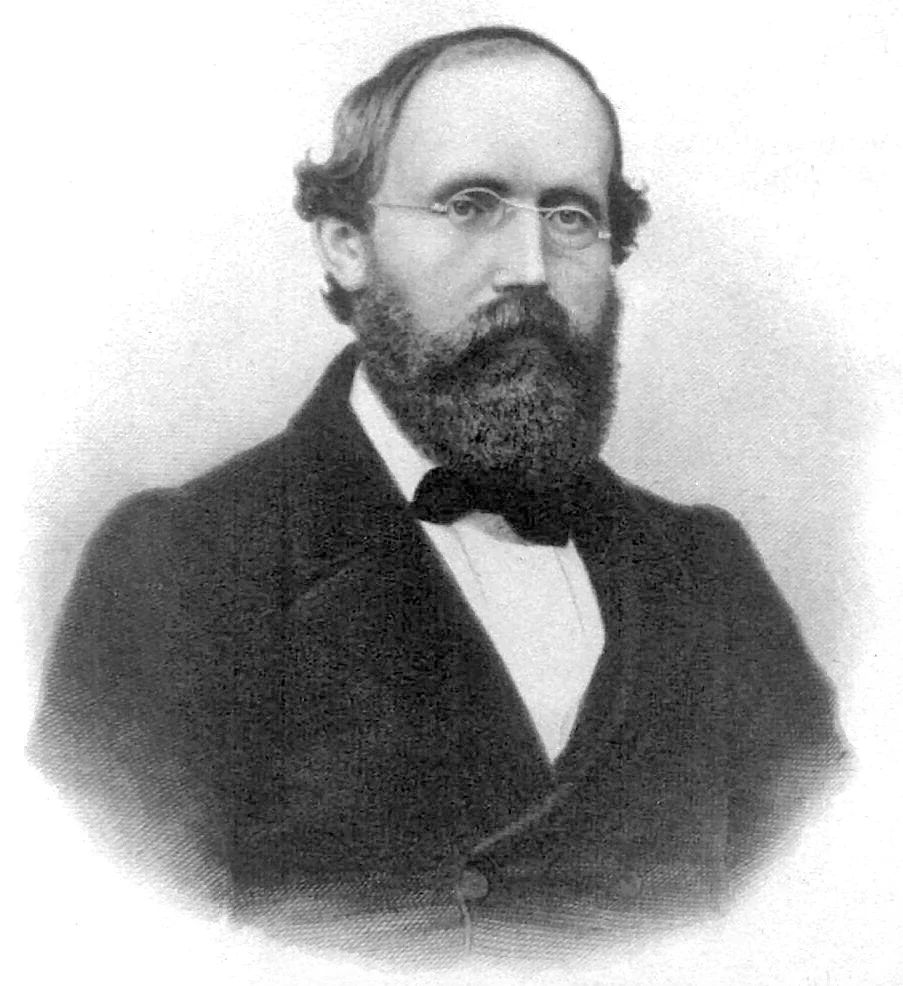
The Riemann hypothesis dates to 1859 and concerns how evenly the prime numbers are spread. It says every nontrivial zero of the Riemann zeta function lies on one vertical line in the complex plane. As Chris Daw of the University of Reading puts it, a lot of theorems begin “assume the Riemann hypothesis.” A proof would turn all of them from conditional to unconditional.
Alpöge’s note makes three claims, and the Lean code backs two of them.
| Claim | What the Lean code states | Status |
|---|---|---|
| Riemann hypothesis | Mathlib’s own definition of RiemannHypothesis | Compiles; accepted by independent kernels |
| Generalized Riemann hypothesis | Every Dirichlet L-function, every modulus and character | Same checks. Dedekind zeta and other L-functions are not covered |
| Extended Riemann hypothesis | Not stated in the code | Alpöge expects it “with more time” |
| A written proof | Four-page note, no paper | Alpöge says he intends to “write it properly” |
Bernhard Riemann raised the question in an 1859 paper and never proved it. The Clay Mathematics Institute lists it among its Millennium Prize Problems, with a US$1 million prize attached.
818,755
theorem and lemma declarations in the Lean source
242,067
definitions, structures and instances
0
comments anywhere in the 175,187 files
Those figures come from the Lean community’s verification notes, which describe the source as about 1 GB of text. Every file sits in the import chain of one file, Main.lean, which proves the headline theorem.
How Claude helped, in Alpöge’s own timeline
Alpöge says he spent his student years preparing for this problem and then spent recent months working with Claude. His account of the finish is blunt: “Claude far outpaced me near the finish line.” He says he steered the pair toward combining two quite different ideas from a toy setting, and that Claude then “began to leave me in awe.”
The one line he singles out is technical. Over function fields, Stepanov’s argument settles the Riemann hypothesis using a divisor with multiplicity. Over the integers, multiplicity is hard to find. Alpöge says the pair chained theta lifts, a tool from automorphic forms, to stand in for it. For a sum of length X, Claude’s suggested length for the chain was the square root of X. His comment: “And yet, what else could it be?”
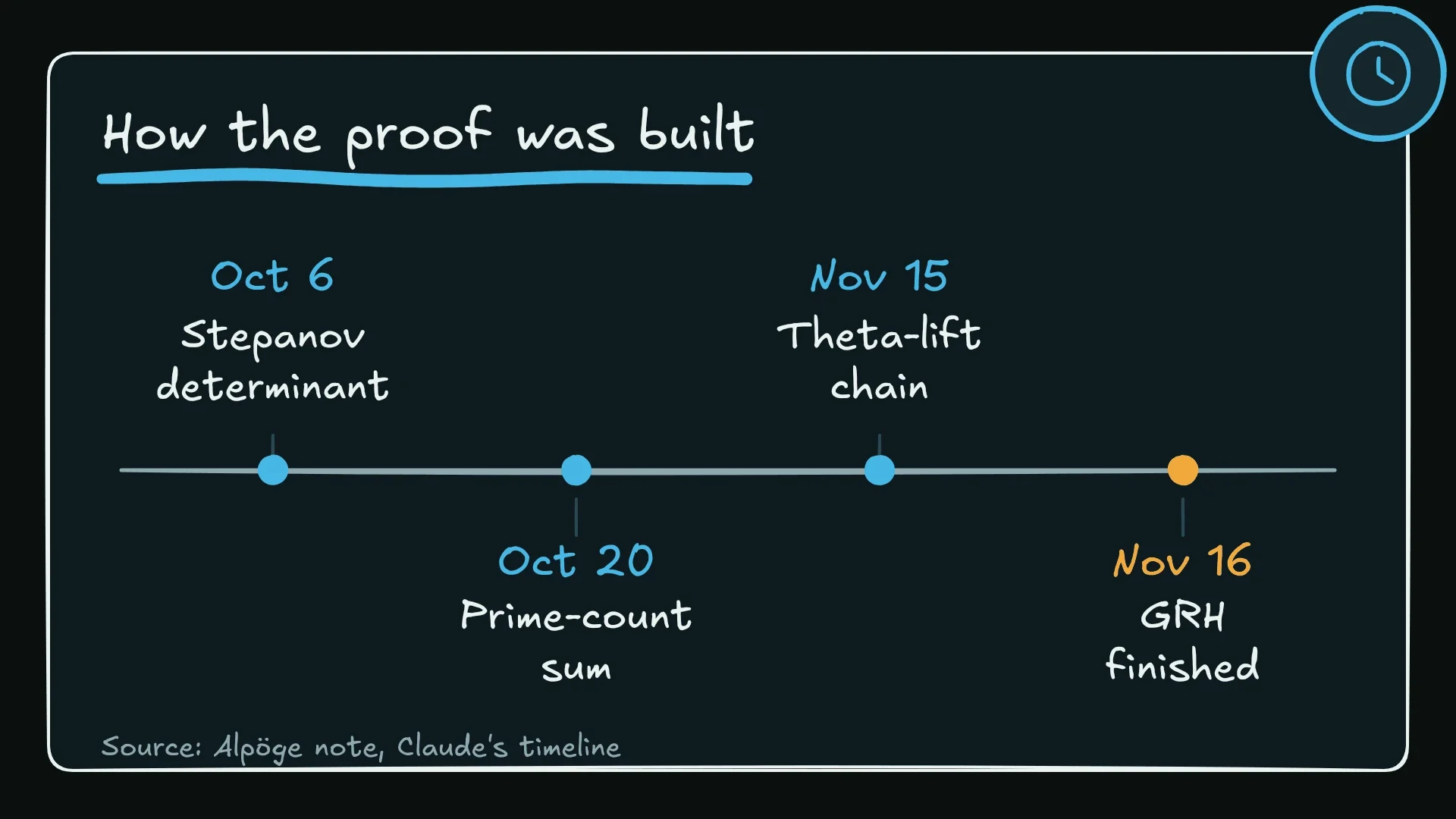
The note includes a long timeline that Claude produced after what Alpöge calls a thorough search. It runs from a Stepanov determinant on October 6 to the finished generalized hypothesis on November 16. Alpöge warns that for the parts where Claude is the expert, he is paraphrasing a summary that “might make zero sense,” and that he may have “baked lots of strange suboptimal choices into the argument.” He expects shorter arguments to follow fast.
The timing drew fire. Alpöge posted the note days after Anthropic’s stock market debut, which Nature says initially valued the company at US$1.5 trillion before the valuation dropped on November 19. Andrew Granville of the University of Montreal told Nature that Alpöge should have prepared a clearer write-up first. “What he released is garbled,” Granville said, and he cited the share price as the reason for the timing. The note answers the charge directly: “There is an obvious cynical view, to do with the timing, but it is false.” Alpöge says he told Anthropic’s leadership late on Sunday night, November 15, and then asked about announcing.
What the machines have checked
Sutherland’s verification page, last updated at 22:05 UTC on November 20, lists what passed. The list is long because a Lean proof can fail in more than one way: the code might not compile, it might lean on an extra assumption, or the checker itself might have a bug. Independent checkers cover each of those.
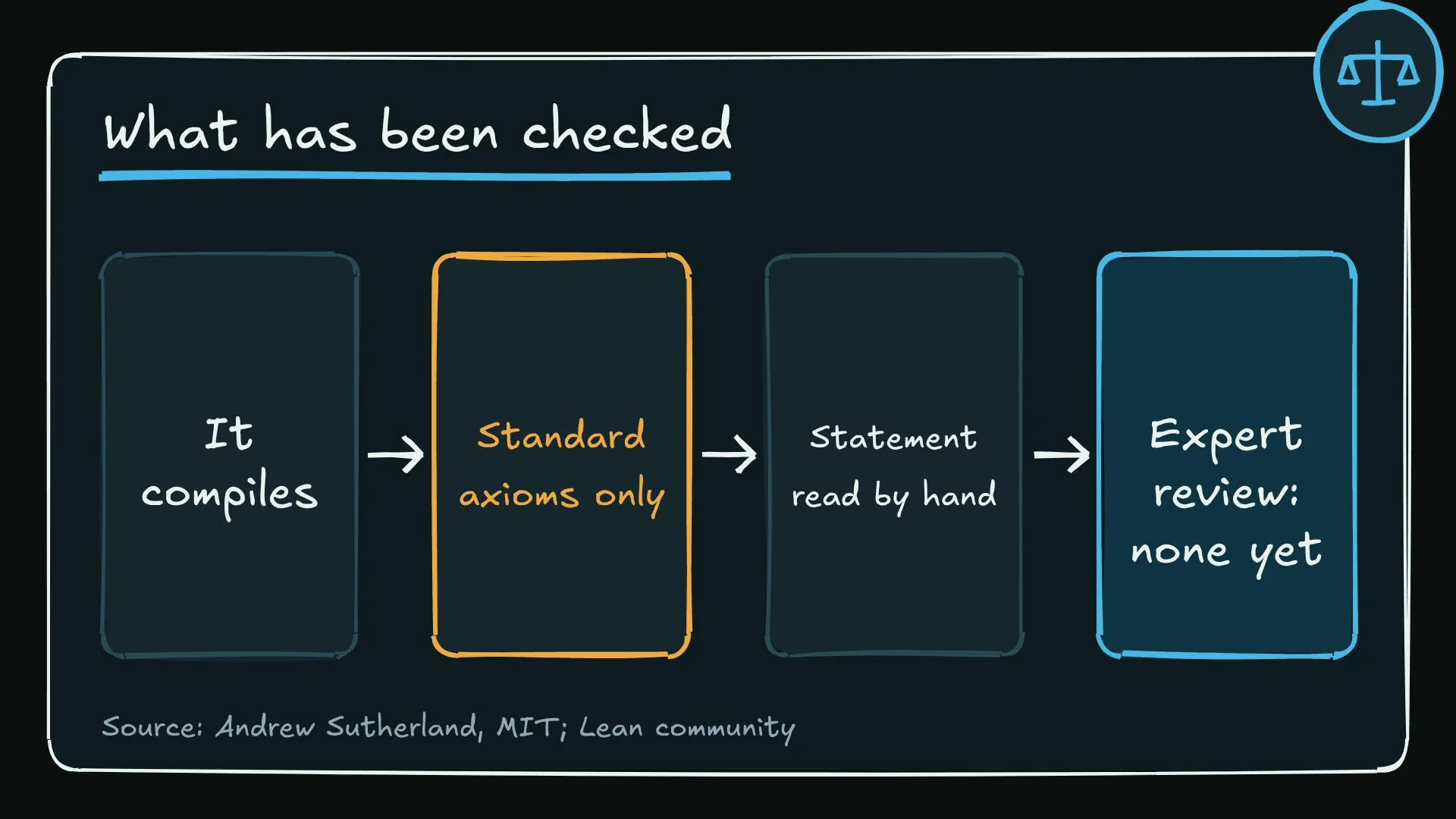
- All 175,187 modules compile with zero errors on Lean v4.33.1 and Mathlib v4.33.1.
- The five headline theorems depend only on propext, Classical.choice and Quot.sound. No axioms are declared outside Lean core.
- Lean’s own checker replayed all 175,187 modules with zero rejections.
- Two independently written kernels, nanoda and con-leche, accept the full exported proof. A third, lean4lean, passed every module, with five needing a raised step limit.
- con-leche matched all five theorem statements against a challenge file that imports only Mathlib.
The Lean community’s own scan of the source found no axiom, sorry, admit or native_decide anywhere, and nothing that reads files or starts processes. Still running when the page was last updated: the full comparator run, which re-checks the export end to end, and Lean’s default and hardened kernels.
- Lean
- A programming language and proof assistant. It accepts a proof only if every step follows from the rules.
- Mathlib
- Lean’s shared library of formal mathematics. The Riemann hypothesis is defined there, so the claim is judged against a definition Alpöge didn’t write.
- Kernel
- The small program at the core of a proof assistant that checks each step. A bug in a kernel is the main way a false proof could pass.
- Axiom
- A starting assumption. Lean proofs normally use three standard ones. An extra axiom would be a red flag.
- Comparator
- A tool that confirms the proof proves exactly the stated theorem and then runs several independent kernels over it.
- Generalized Riemann hypothesis
- The same claim for a wider family of functions. Here it covers Dirichlet L-functions only.
What nobody has checked
A compiled proof shows that the Lean statement follows from the axioms. It doesn’t show that the statement matches the problem, and it doesn’t show anyone understands why it’s true. Kevin Buzzard, a Lean specialist at Imperial College London, puts the first test plainly: does the statement in the code match the statement in words? A statement can compile and still be wrong. Defining Fermat’s Last Theorem over numbers that include zero gives a statement that is trivially false, and it still compiles.
Here that test has been run by hand. The verification notes confirm that Mathlib’s definition excludes the trivial zeros and the point s equals 1, and that the Dirichlet statements cover every modulus and character. Mathematician Elliot Glazer separately reported that the formalized statement is the generalized Riemann hypothesis. A published expert audit of the mathematics is a different matter, and none exists.
James Maynard, the Oxford Fields Medal winner, told IBM Think the proof is probably right but understanding it is the hard part. “I suspect that the proof will turn out to be correct, although even checking the Lean verification will take some time,” he said. Understanding it is slower: “So somewhat frustratingly, it looks like it will require quite a lot of work to really gain this understanding.”
Why a clean build isn’t the end
The source uses custom tactics, including one called kexactB in 67 files, that assign a proof term to a goal without the elaborator checking its type. That’s sound, because Lean’s kernel checks every declaration. It also means the kernel is the only check on those steps, which is why the independent kernels matter.
The project is pinned to Lean v4.33.1, which predates later runtime fixes. The release notes for those fixes say a deliberately crafted input could potentially be turned into a proof of False in the official kernel. They say kernels not built on the Lean runtime are unaffected, and nanoda is one of those.
Sutherland’s build ran on cloud machines without a sandbox and called lean directly instead of using lake build. A 77-module sample matched a real build byte for byte. The full set hasn’t been compared yet.
The hidden cost: checking it
A proof that no human can read has to be checked by machines, and the machines need to be big. Sutherland’s instructions for re-running the final check call for about 100 GB of RAM and 70 GB of disk. The exported proof is 7.7 GB compressed and 61.6 GB unpacked. The fastest independent kernel, nanoda, took 27 minutes 42 seconds on 80 threads. Lean’s own kernels are single-threaded and take much longer. The community estimates about four hours each, with an uncertainty of a factor of two to three.

Building the code is heavier still. The community team’s machine has 48 cores and 503 GB of RAM, and its estimate for the build was 7 to 10 hours. The build tool writes a setup file per module that averages about 6 MB. Across 175,187 modules that adds up to roughly a terabyte unless the files are deleted as the build runs. Exporting the proof took about 80 minutes on one thread and peaked at 163 GB of memory.
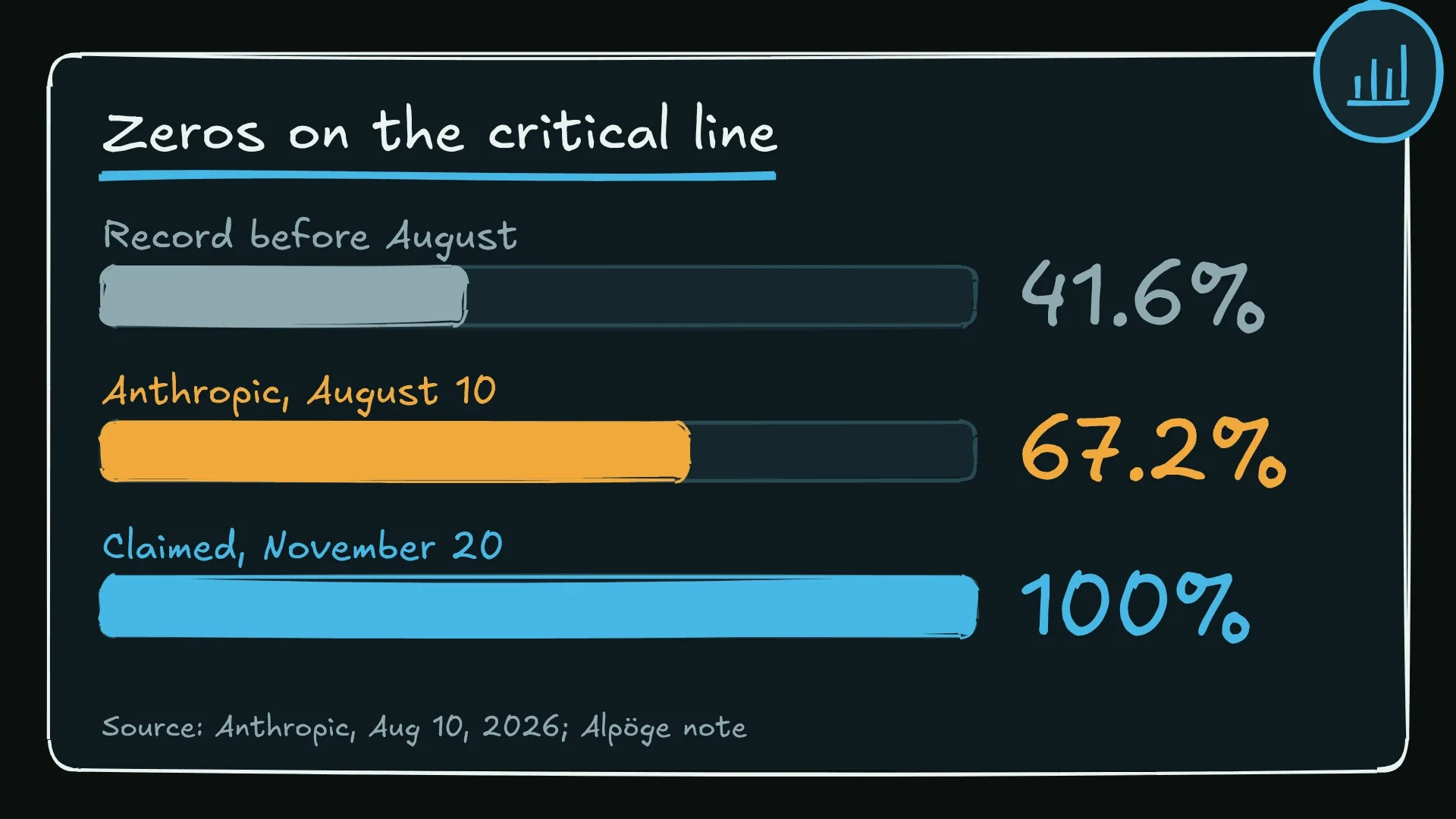
The cost of finding the proof is unknown. The note doesn’t say how much compute the November work used, and Anthropic hadn’t responded to Nature’s or New Scientist’s requests for comment when they published. One reference point exists. In August Anthropic reported that an unreleased research version of Claude raised the proven share of zeta zeros on the critical line from 41.6% to 67.2%, using 31 million output tokens over two Claude Code sessions. Anthropic said then that it didn’t expect those techniques to lead to a proof of the Riemann hypothesis. Three months later the claim is 100%.
Why the prize is far off
The US$1 million won’t be paid on a blog post or a code archive. The Clay Mathematics Institute’s rules set three conditions that must all be met before it will even consider a solution. The proof must be published in a qualifying outlet. At least two years must pass after publication. And the global mathematics community must have generally accepted it. The institute doesn’t take direct submissions.
No paper exists, so the two-year clock hasn’t started. If one appeared tomorrow, the earliest the second condition could be met is November 2028.
Alpöge isn’t the only one with a claim. On November 20, Stanford mathematician Ravi Vakil posted a human-written draft by Alessandro Masullo that claims a proof of the generalized Riemann hypothesis. Vakil says it uses no AI, that Brian Conrad has examined it closely for months, and that it’s “so far looking good.” He asked people to check it and formalize it. It is as unverified as Alpöge’s claim, but it arrives as a written draft instead of code.
What to watch
- The comparator verdict: the full end-to-end run and the Lean default and hardened kernel replays.
- A paper. Alpöge says he intends to write one, and says shorter arguments should follow quickly.
- The first expert audit of the mathematics, as opposed to the code.
- A sandboxed rebuild whose export matches Sutherland’s checksum.
- Checks of the Masullo draft, including any Lean formalization.
The note and the verification pages are all public. Read them in this order.