In April, Province Group told the council in Perry, Ohio, that its planned data center would pay US$326 million in property taxes over 31 years and employ about 200 people. On November 3, voters decided a company making promises like that should have to back them with a bond.
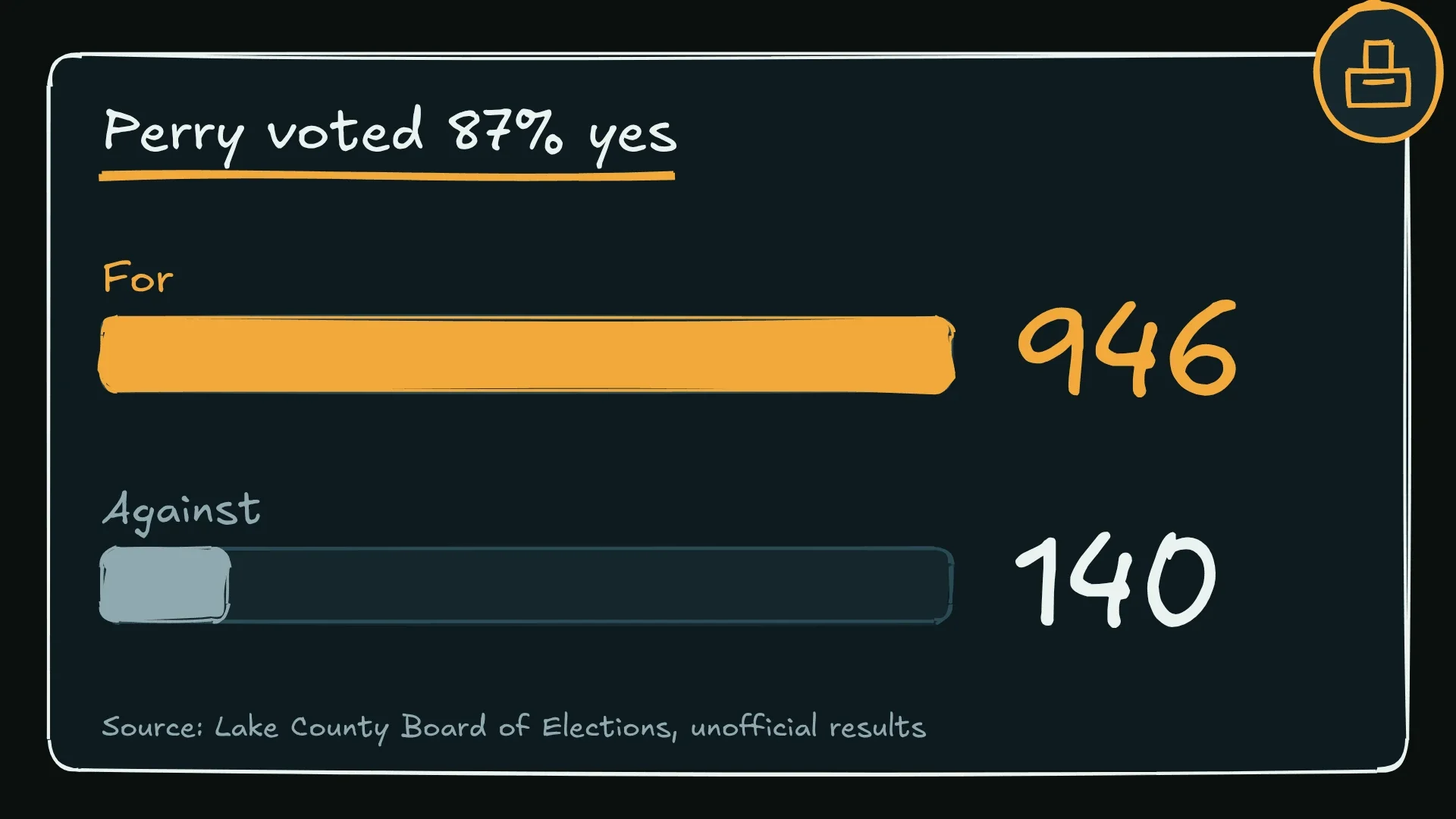
Issue 16 passed 946 votes to 140, or 87%, in unofficial results from the Lake County Board of Elections. It doesn’t ban data centers. It puts a price on a tax break.
What Issue 16 requires
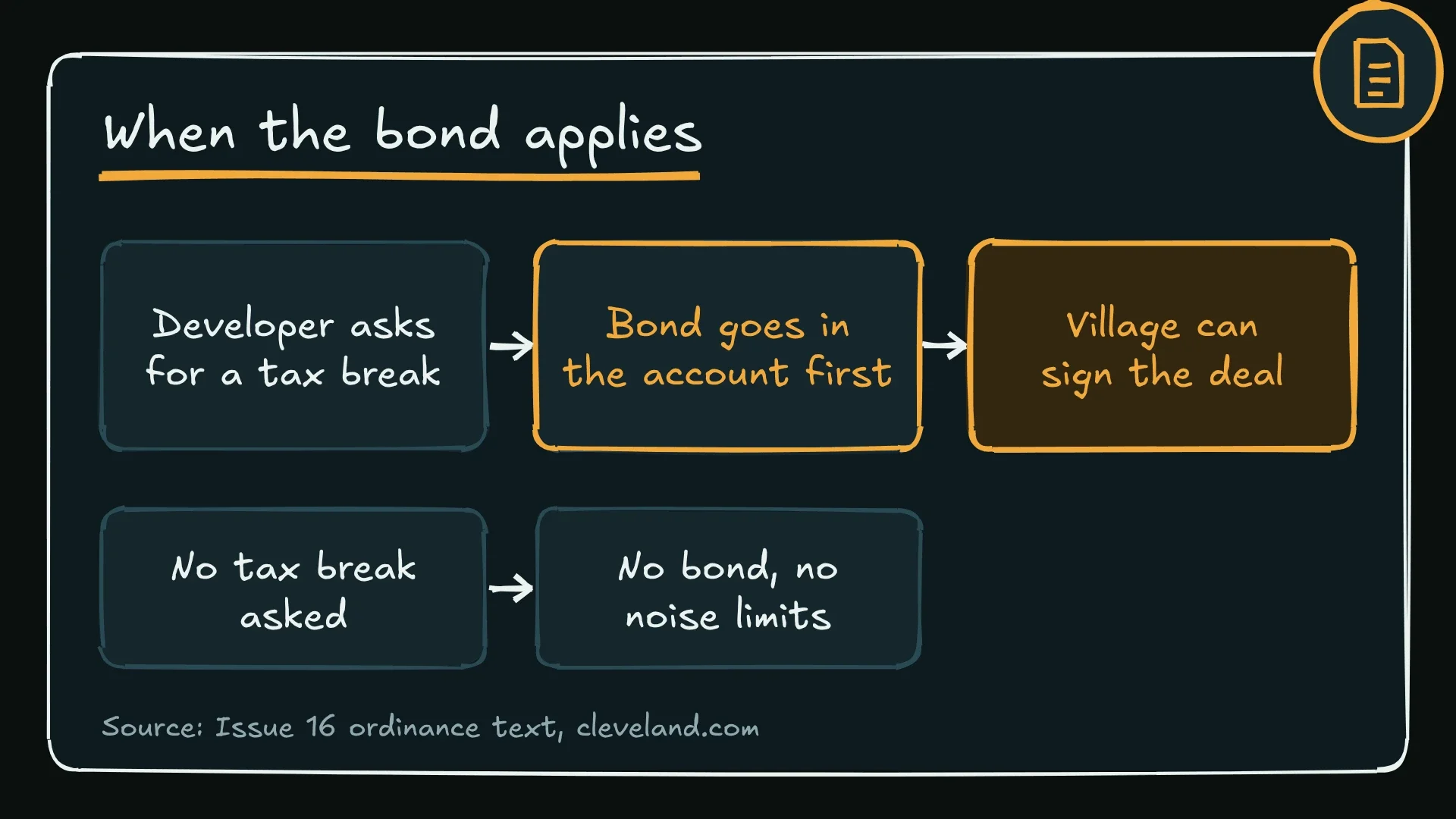
The ordinance applies to “hyperscale” data centers, which it defines by three thresholds: 10,000 square feet, 5,000 servers and 50 megawatts of power. Before Perry signs a tax abatement, a payment in lieu of taxes (PILOT) or any other special tax deal with one, the developer must deposit a bond in an account the village approves.
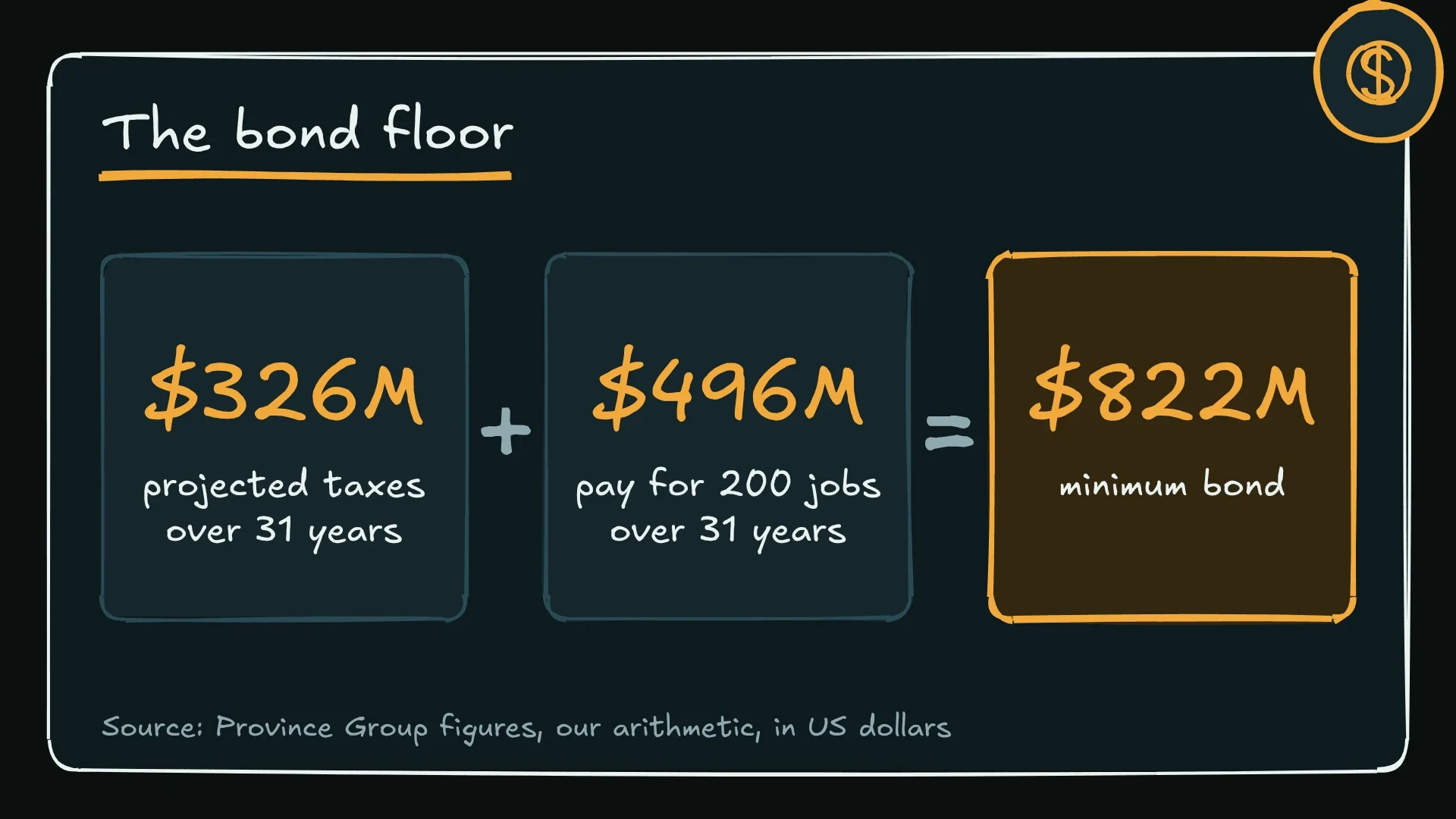
The bond’s minimum equals the tax revenue the developer projects over 31 years plus the pay of 200 full-time employees over the same period, according to cleveland.com. It’s meant to cover shortfalls against the developer’s promises, environmental harm and lower property values. The village fiscal officer calculates those costs each year. Whatever is left after 31 years goes back to the developer, the News-Herald reports.
Province’s own figures show the scale. Its CEO, Mark Kerslake, projected US$326,279,949 in taxes over 31 years, a figure that already assumes the tax break and leaves out PILOT payments. The company projects about 200 permanent jobs paying at least US$80,000 on average, which comes to US$496 million over 31 years. Added together, the minimum bond is about US$822 million, by our arithmetic. The ordinance prices pay from comparable jobs in the developer’s home state, so the final figure would differ.
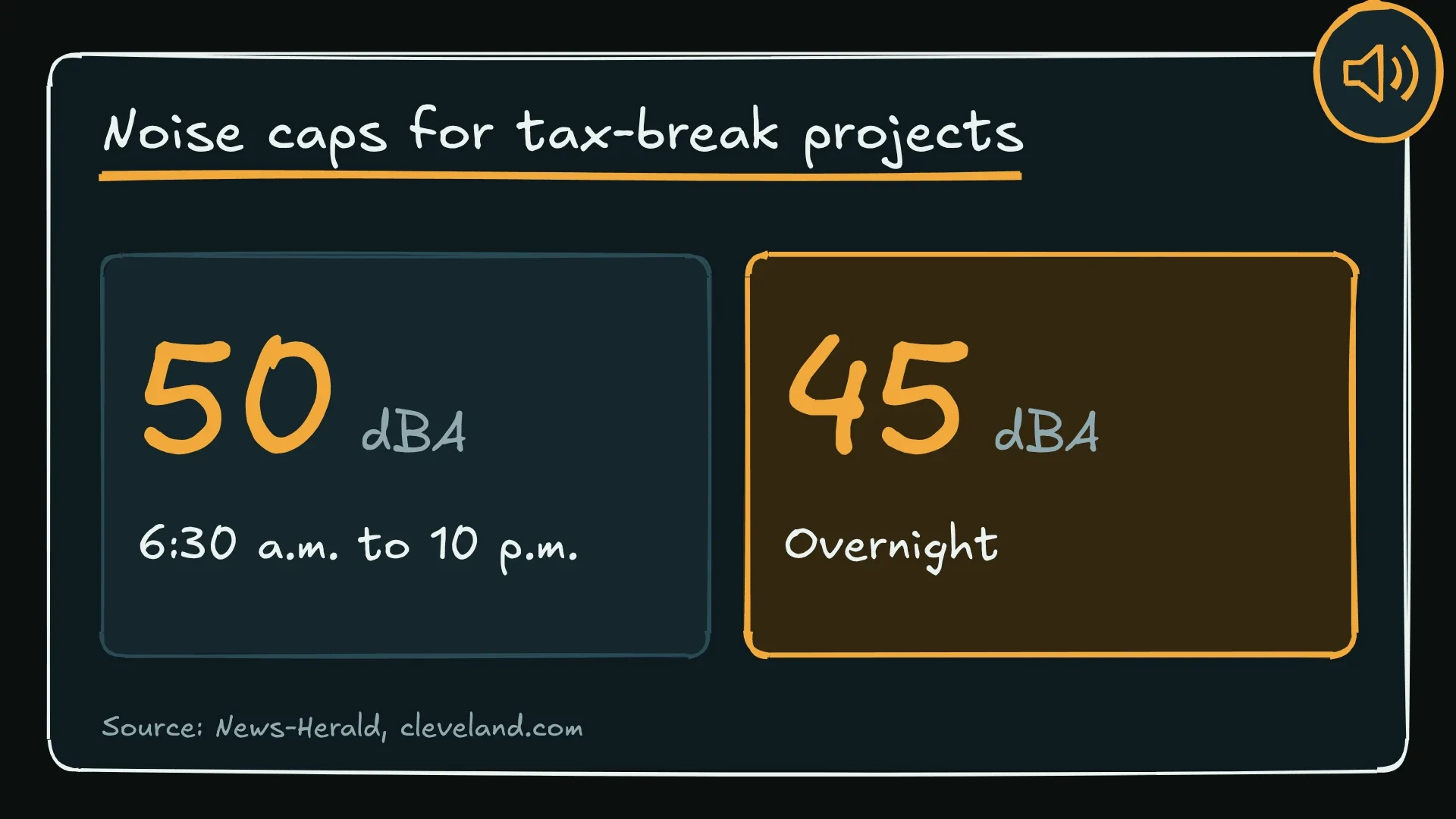
The measure also sets noise rules. Developers seeking a tax break must guarantee sound levels no higher than 50 decibels from 6:30 a.m. to 10 p.m. and 45 decibels overnight, and the village council would set fines for violations, cleveland.com reports.
The deal Perry turned down
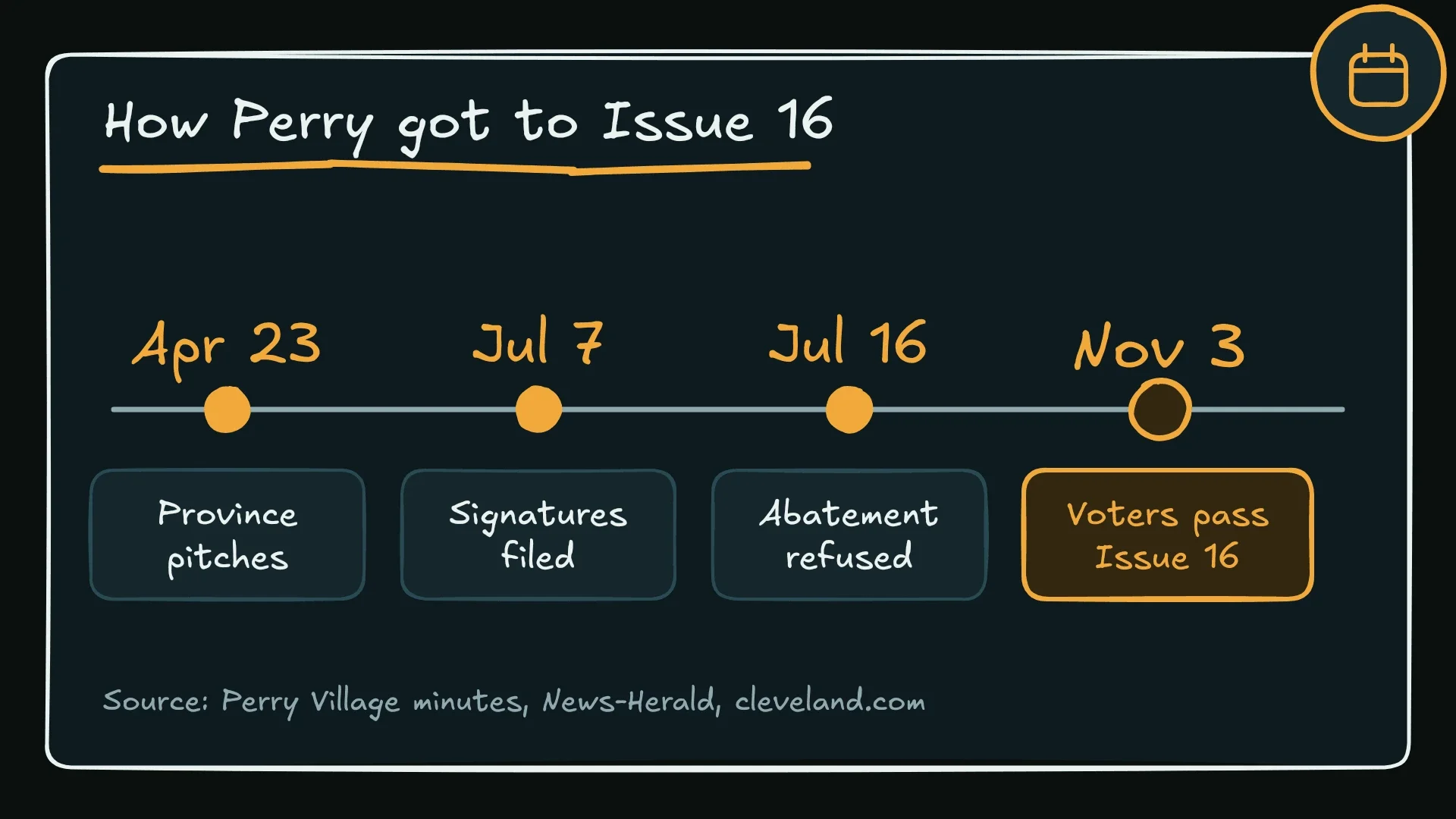
Province pitched its plan at an April 23 special council meeting, according to the village’s minutes. The California-based developer asked for a 15-year, 75% abatement on improvements for six data center buildings, with schedules starting between 2030 and 2032, and promised about US$8 million in PILOT payments to local bodies, the News-Herald reports.
The village fiscal officer delivered the petition signatures to the Lake County elections board on July 7. Nine days later, Acting Mayor Elias Coss said Perry wouldn’t offer an abatement, and so no PILOT, after talking with Perry Township, the Perry Joint Economic Development District and Perry Schools. Voters passed the rules for any future request 110 days later, by our count.
What it leaves out
Issue 16 only applies when a developer asks for a tax break. A company that asks for none faces neither the bond nor the noise limits. The village’s one-year moratorium on data center applications also exempts Champion Farm, where Province holds a purchase agreement. cleveland.com reports the campus must still go through the village’s development process.
It is totally fair to say that if you want us to give you something, give us something in return and guarantee that you really want to be here.
Kasia Tarczynska, a senior research analyst at Good Jobs First, a group that studies government subsidies, told Vox.
Why Perry
The ordinance itself says developers are drawn by “proximity to a reliable source of energy, a nuclear power plant.” Vistra’s 1,268-megawatt Perry plant is nearby. In January, Vistra agreed to sell Meta 2,176 megawatts from Perry and its Davis-Besse plant under 20-year contracts, and says that power continues to go to the grid for all customers.
Some residents distrust big promises for a reason. Vox notes Ohio passed HB 6, a billion-dollar bailout of the plant funded by surcharges on energy bills, in 2019, and it was later tied to the largest bribery scandal in Ohio history, which sent former House Speaker Larry Householder to federal prison. The village isn’t refusing money on principle either. Councilman John Nicely, who helped put Issue 16 on the ballot, told Vox that “Perry needs the money,” with its newest fire truck a decade old and its ambulances “in dire need of replacement.”
CNBC counted 41 data center ballot measures in 10 states on November 3, and voters backed restrictions or rejected pro-development measures in nearly every contest with results by Wednesday. The exception was Harwood, North Dakota. Vox notes most of the measures that passed elsewhere ban data centers or limit construction. Perry’s sets terms instead, and Georgia and Texas have required bonds similar to Perry’s for large subsidies in recent years.
Looking ahead, watch whether Province asks for a tax break under the new rules, and whether it fights them. Nicely says the rules don’t breach Province’s purchase agreement, which runs out in summer 2027, because voters passed them rather than the village. He also says a voter-passed ordinance can’t easily be overturned by the council, Spectrum News reports. Elias Coss, the council president and acting mayor, declined to comment, Ideastream reports. For readers in New Zealand and Australia, the idea to note is a bond sized to the promise, posted before the tax break is signed.
Sources
- Lake County Board of Elections, Perry Village initiative petition and proposed ordinance
- cleveland.com, Perry Village voters approve financial guarantees, noise limits for data centers
- The News-Herald, Perry Village to vote on rules for data center developers
- The News-Herald, Data center initiative in Perry Village moves closer to November ballot
- Village of Perry, special council meeting minutes, April 23, 2026
- The News-Herald, Perry Village won’t grant tax abatement to data center developer
- Spectrum News 1, Ohio community holds data center accountable with passage of ballot initiative
- Vox, A tiny Ohio town just found a way to make data centers pay
- Ideastream Public Media, Northeast Ohio communities approve guardrails for data centers
- CNBC, Voters rebuff data centers in every ballot measure except one
- Vistra, agreements with Meta, January 9, 2026