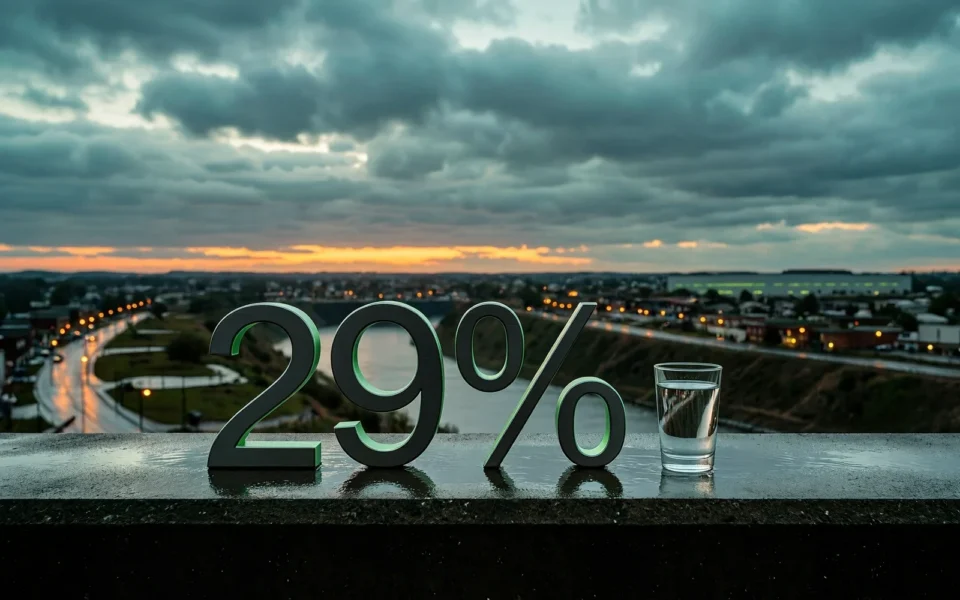
House Bill 11758 gives companies in a planned New Clark City zone seven years without income tax. After that, they’d choose a 5% tax on gross income or a 20% rate with extra deductions, for up to 20 years in all. The same bill lets a new authority set the zone’s electricity and water rates.
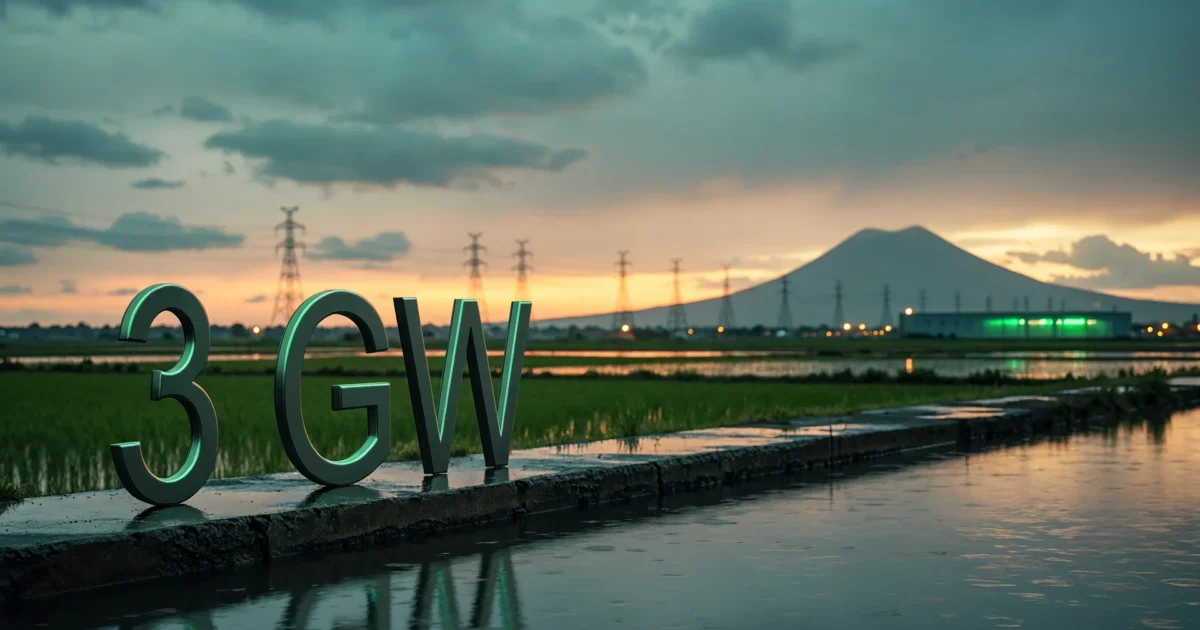
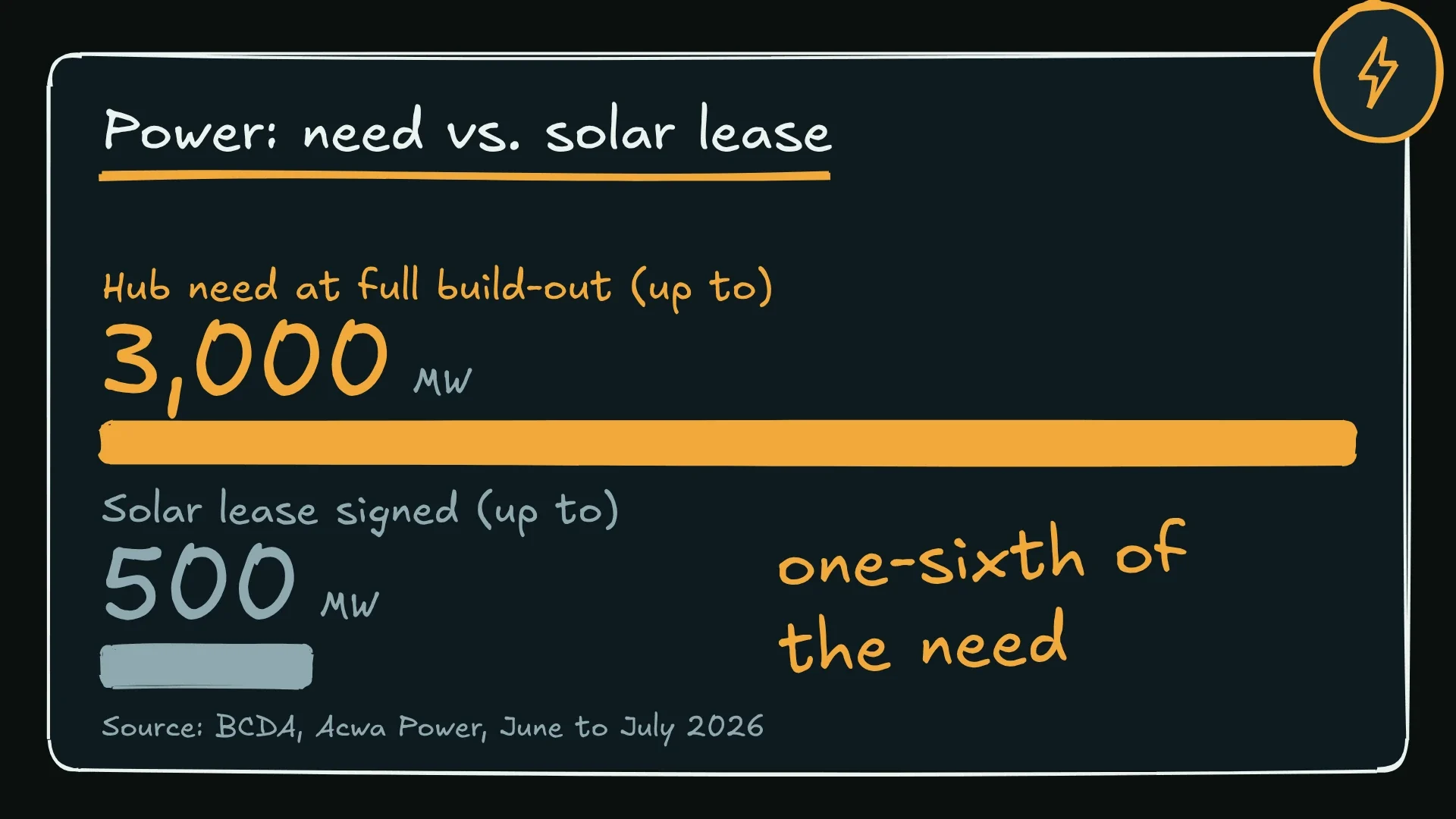
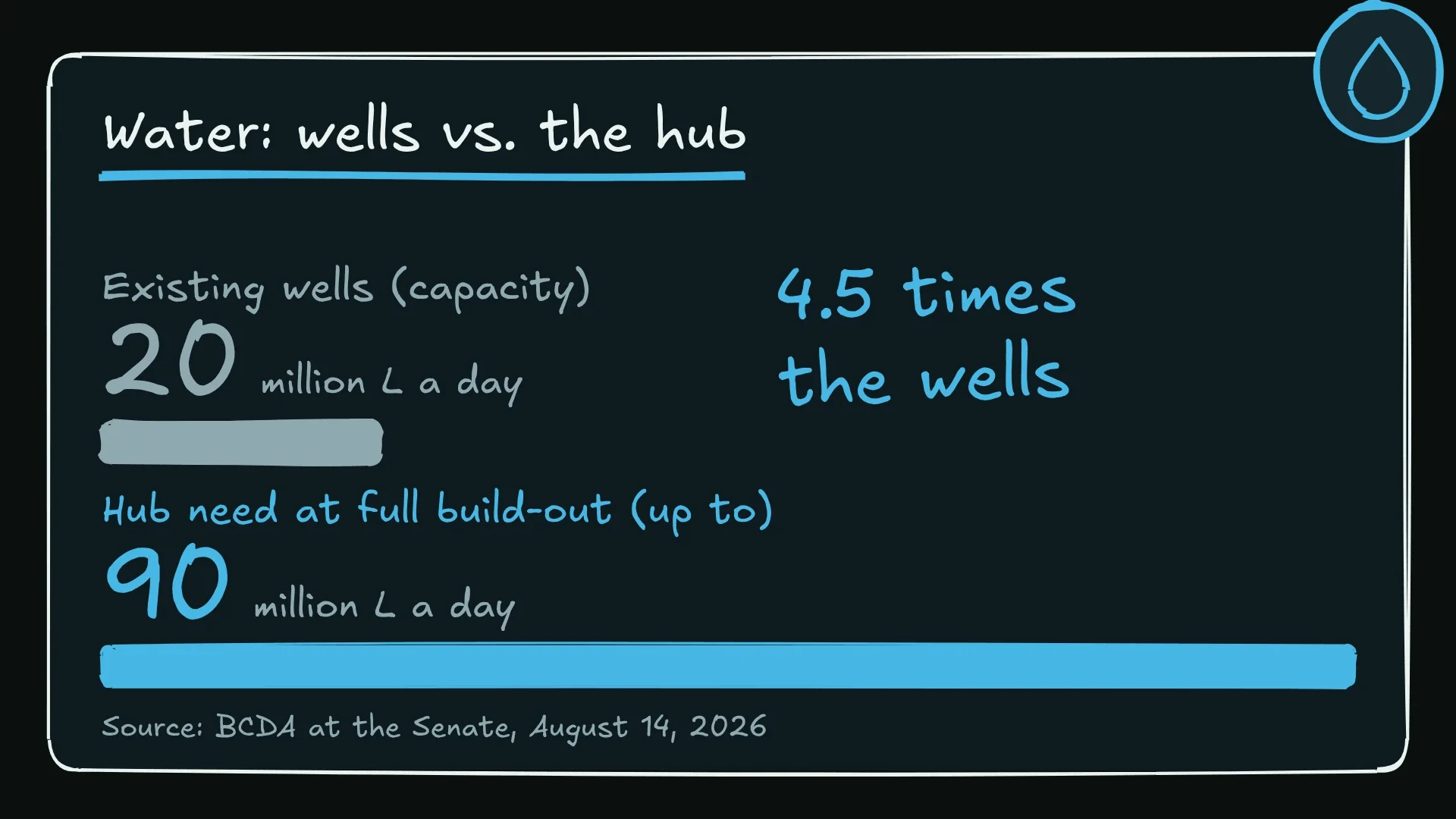
The Bases Conversion and Development Authority (BCDA), the state agency building New Clark City, estimates the hub the zone is meant to host would need up to 3 gigawatts of power and up to 90 million liters of water a day. A signed solar lease covers up to 500 megawatts. The bill doesn’t cap power or water use, and it names no energy mix or water source.
What the bill offers
Deputy Speaker Ronaldo Puno and five other National Unity Party members filed the Advanced Industries Development Act on October 26. The House referred it to its committees on economic affairs and on trade and industry on November 10. Its explanatory note cites the Pax Silica Declaration, the US State Department’s supply-chain initiative that the Philippines joined in April. The bill is separate from the US-Philippine framework agreement, which hasn’t been signed.
The bill creates the Advanced Industries Zone in Capas, Tarlac, as a free zone and separate customs territory. Foreign goods enter without duties, VAT or excise. Qualified activities include semiconductors, critical minerals, energy facilities and “the establishment and operation of data centers and computing infrastructure for artificial intelligence and high-performance computing.” Qualifying investments start at 15 billion pesos, not counting land.
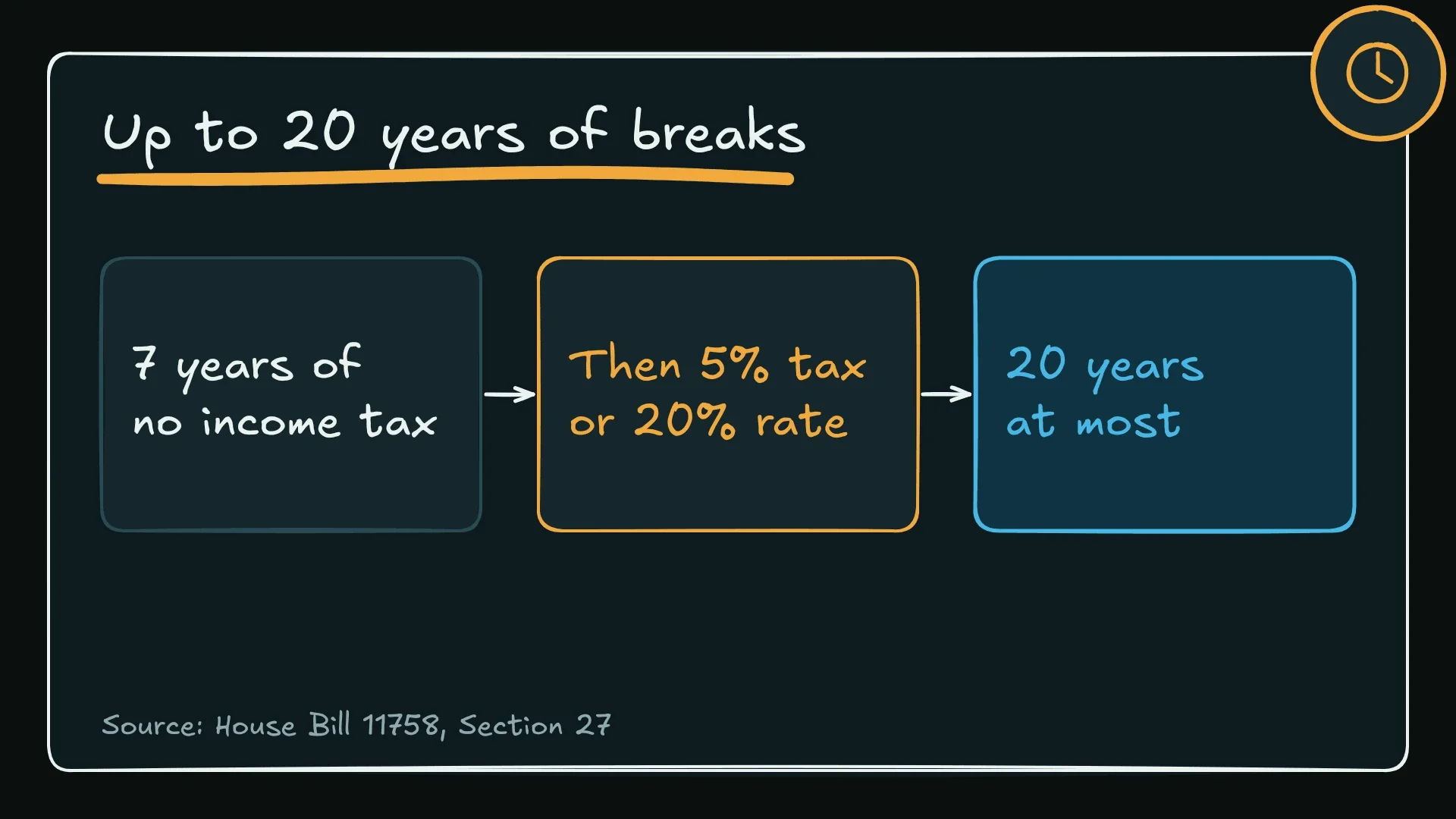
Registered firms get a seven-year income tax holiday. Then they choose once, and can’t reverse it. One option is a 5% tax on gross income, meaning sales less direct costs and before operating expenses, in place of all national and local taxes except real property tax on land. The other is a 20% income tax with extra deductions, including an additional 100% on power expense. The total can’t run past 20 years from registration.
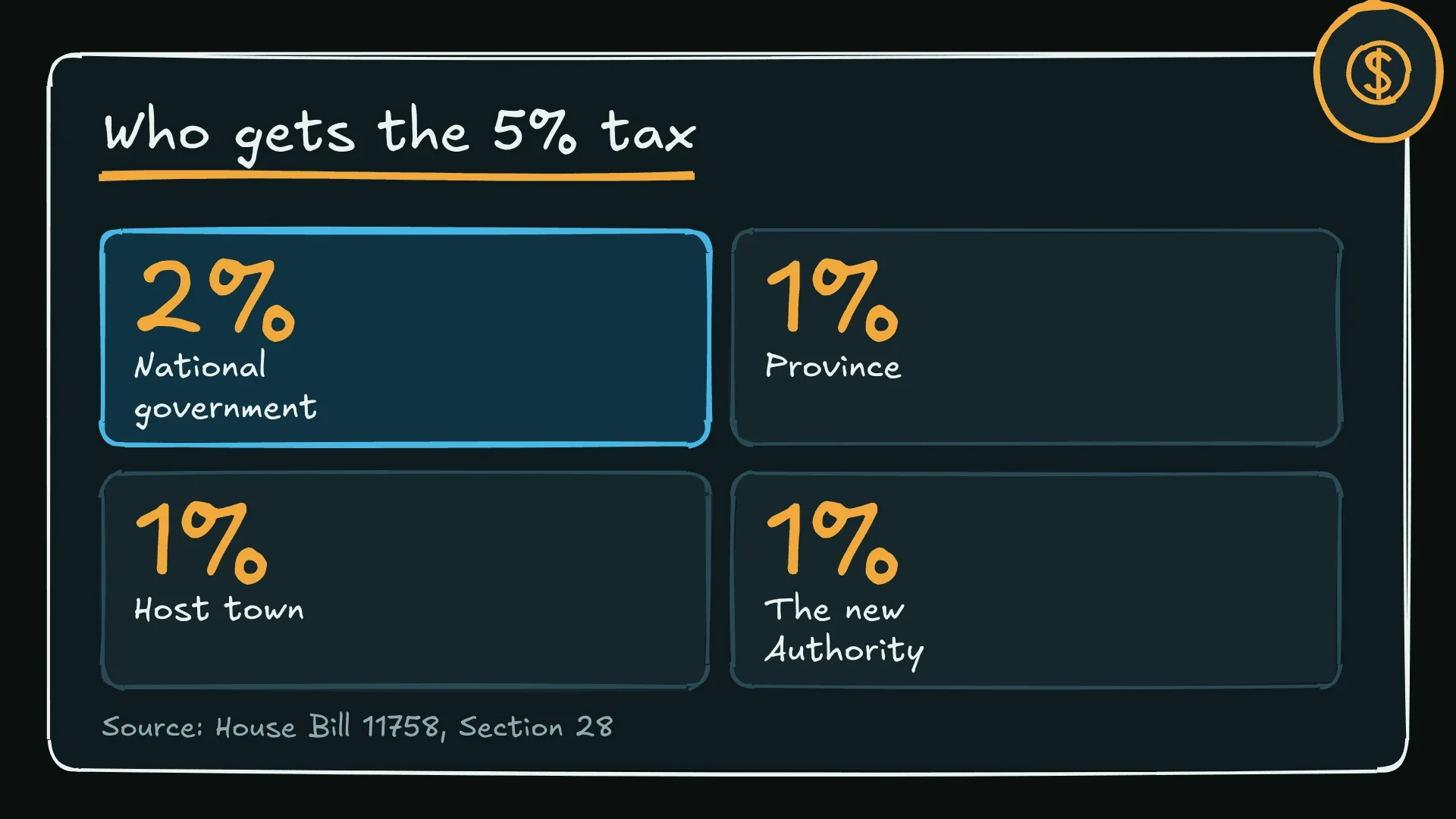
The 5% tax is shared. The national government keeps 2 points, the province 1, the host town 1 and the new authority 1.
Most of that menu isn’t new. Republic Act 12066, known as CREATE MORE, and Bureau of Internal Revenue Regulations 7-2025 already offer registered export enterprises a 5% gross-income tax or a 20% rate with a 100% extra deduction for power costs. The regular corporate rate is 25% of net taxable income. The bill doesn’t estimate the revenue it gives up.
What the public puts in
The Treasury would pay the authority 1 billion pesos a year for five years, or 5 billion pesos. Authorized capital is 50 billion pesos, paid in through land at appraised value plus that cash. BCDA transfers the land without compensation, and title transfers are exempt from taxes.
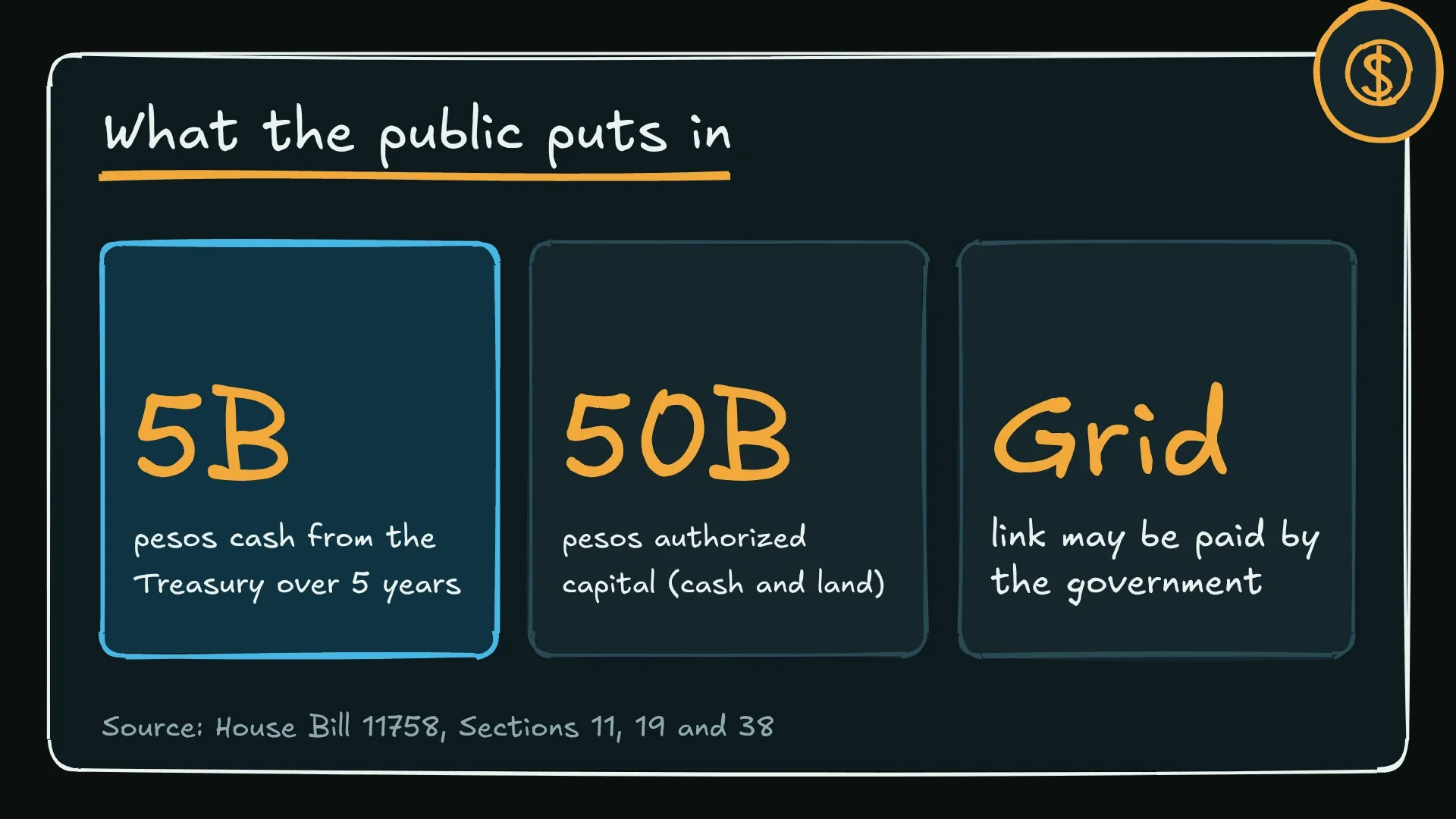
Section 19 says the national grid is unaffected. It also lets the national government fund the grid interconnection, subject to appropriation, and lets the authority pay locators’ transmission charges from its retained income. Joshua Bingcang, then BCDA’s president, said tenants would carry the power costs:
“They will shoulder the costs. This will not be sourced from the electricity of the general population.”
Bingcang said that at a Senate committee hearing on August 14, the Daily Tribune reported.
Power and water
The New York Times, citing government estimates, reported that 3 gigawatts equals roughly a fifth of Philippine electricity consumption in 2024 and that 90 million liters a day is triple the area’s available supply in the dry season.
On power, BCDA signed a lease on June 2 with Acwa Power for up to 500 megawatts of solar and batteries on 500 hectares. That’s one-sixth of 3 gigawatts, by our own division. Bingcang acknowledged that solar and batteries may not meet the hub’s 24-hour needs, and said BCDA is looking at liquefied natural gas.
BCDA says the hub is a manufacturing zone, not a data center complex, and that only one or two of at least 30 interested companies are data center operators. Acwa’s release says its plant will serve “data centers and advanced manufacturing tenants.” The bill lists data centers as a qualified activity.
On water, the wells can supply up to 20 million liters a day against demand today of under 3 million, Bingcang told Sen. Kiko Pangilinan. The 90 million estimate is 4.5 times that capacity, by our own division. BCDA’s plan relies on surface water, with detention tanks capturing flow from the Bangut River and other rivers as possible sources, and a preliminary deal to pipe treated seawater about 70 kilometers from Subic.
Who decides
The authority would have exclusive control over environmental compliance certificates, tree-cutting permits and water permits inside the zone. The usual rule that an application is deemed approved after 20 working days doesn’t apply to environmental certificates. The authority could also adopt supplemental environmental standards, as long as they’re consistent with national ones.
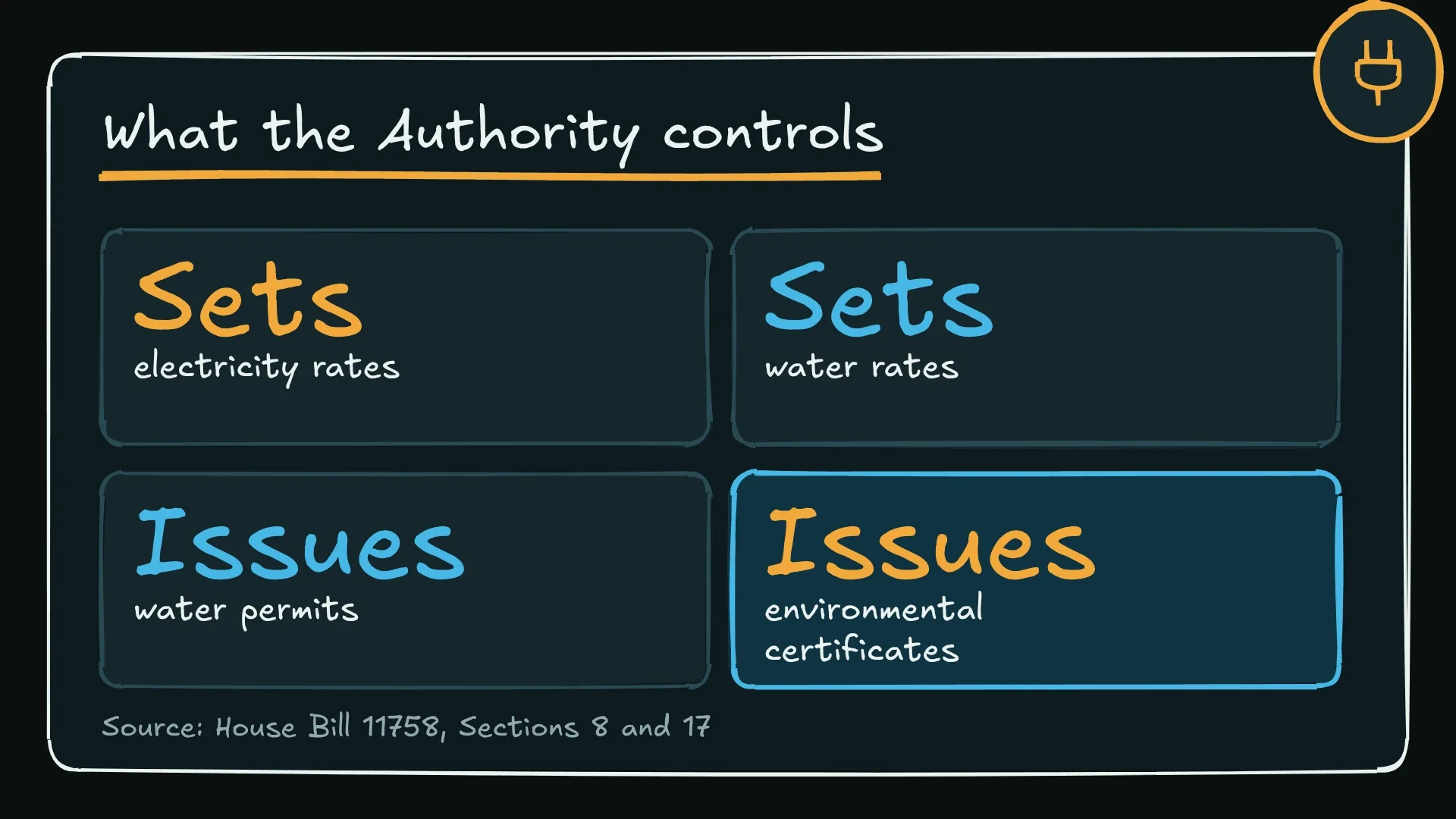
It would also hold a 25-year franchise, renewable for another 25, to distribute electricity and supply water. Every end user would be a contestable customer. The authority would fix rates using the methodologies of the Energy Regulatory Commission and the National Water Resources Board as minimum standards. Those regulators could review rates on an end user’s complaint where the authority operates directly, and keep their monitoring and penalty powers. The authority’s 11-member board has a chair, three Cabinet secretaries, BCDA’s chief, three independent governors, two locator representatives and one labor representative.
About 200 people, including 40 Aeta Hungey households, face relocation, Human Rights Watch reported on November 16. The relocation site is 3 kilometers away and has no stream access, according to the report. The Aeta Hungey have sought recognition of their ancestral domain since 1994 and hold no title. The bill excludes land covered by an ancestral domain title from its declaration of available land. Tech Policy Press reported that no environmental impact assessment has been released and that construction is scheduled for 2028.
Looking ahead, the bill waits in committee. President Trump said on November 19 that no Pax Silica agreement has been signed, and the Department of Trade and Industry expects a signing by the end of 2026. The bill would require the authority to file an annual report and Congress to review it after five years.
Sources
- House of Representatives, House Bill 11758, Advanced Industries Development Act
- House of Representatives, Additional Reference of Business (November 10, 2026)
- GMA News, Bill filed establishing ecozone for Pax Silica ops, other critical industries
- Daily Tribune, NUP seeks creation of govt agency for New Clark City economic zone
- Daily Tribune, Up to 90 million liters of water per day needed for US-backed Pax Silica, says BCDA
- Philstar, AI manufacturing hub in Clark would need 90 million liters of water daily
- GMA News, Explainer: Where will Pax Silica get its water?
- GMA News, Pax Silica AI hub to consume 3 gigawatts at full development, BCDA says
- Presidential Communications Office, BCDA says Pax Silica project could generate over 130,000 high-quality jobs
- ACWA Power, ACWA and BCDA advance 500 MW solar-plus-storage project in New Clark City
- The New York Times, Trump’s plan for A.I. supremacy fuels resistance in the Philippines
- Human Rights Watch, Philippines: US tech hub to displace hundreds
- Tech Policy Press, Trump’s Philippines visit sparks protests over US-led Pax Silica project
- The Manila Times, Anti-Pax Silica network welcomes non-signing of agreement
- US Department of State, Pax Silica
- Bureau of Internal Revenue, Revenue Regulations No. 7-2025