Datagrid’s first stage at Makarewa, north of Invercargill, is consented for 280 megawatts (MW) of power, according to a July 2 briefing from the Ministry of Business, Innovation and Employment (MBIE) to Economic Growth Minister Nicola Willis. The same briefing puts the demand of every data center in New Zealand at 104 MW in 2025.
The consents weren’t publicly notified. Many Southlanders say that left them without a say on a project that will change the region’s power and water use for decades.
The size of it
MBIE says Datagrid also has Overseas Investment Office approval to expand to 1 gigawatt (1,000 MW). That’s twice the demand of the Tiwai Point aluminum smelter, the country’s largest power user, which accounts for about 12% of national electricity consumption, according to MBIE’s Energy in New Zealand report.
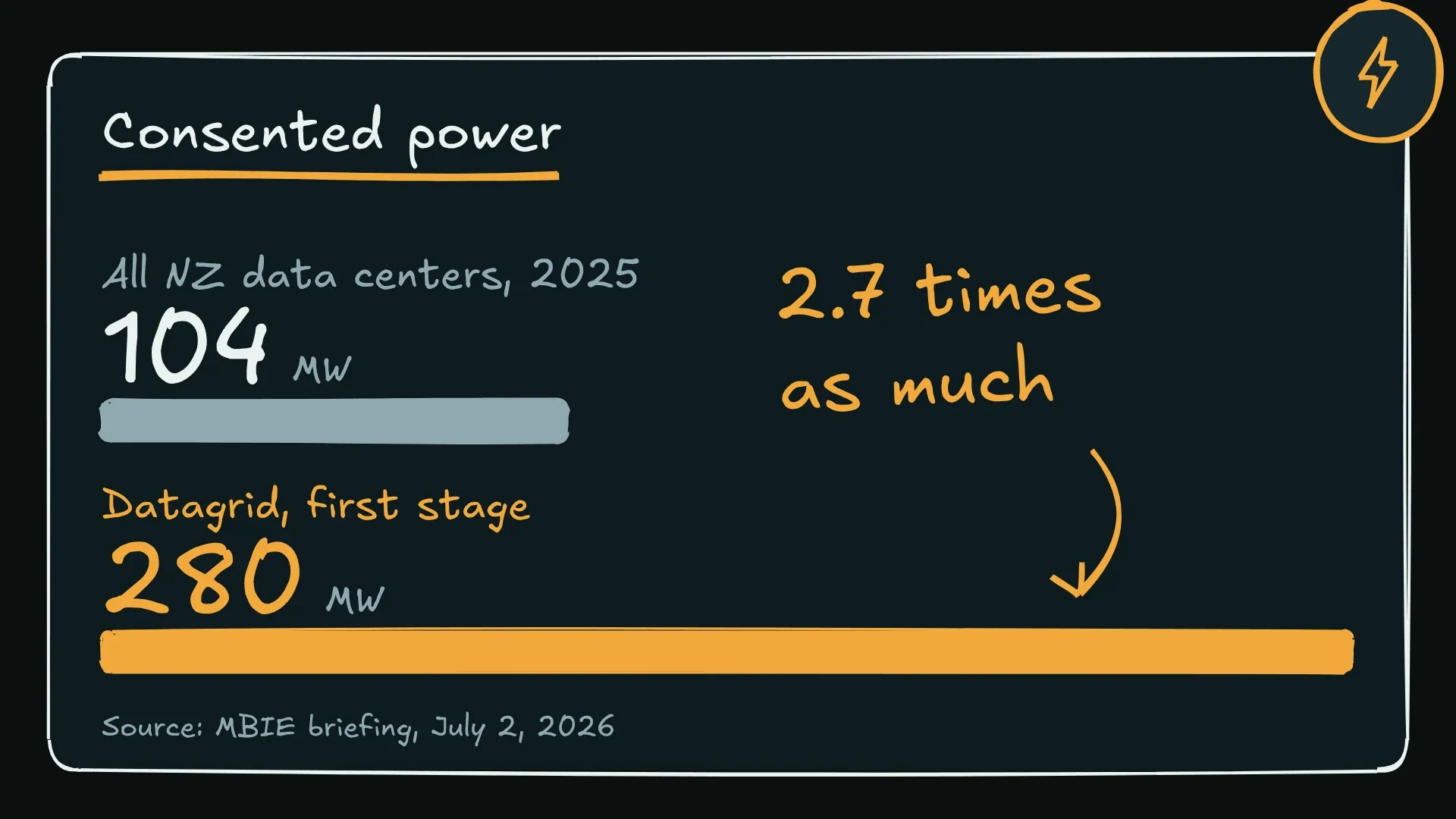
MBIE expects New Zealand’s data center demand to reach over 400 MW by 2035, and says that projection may be too low if investment arrives. Datagrid’s first stage alone equals about 70% of that 400 MW.
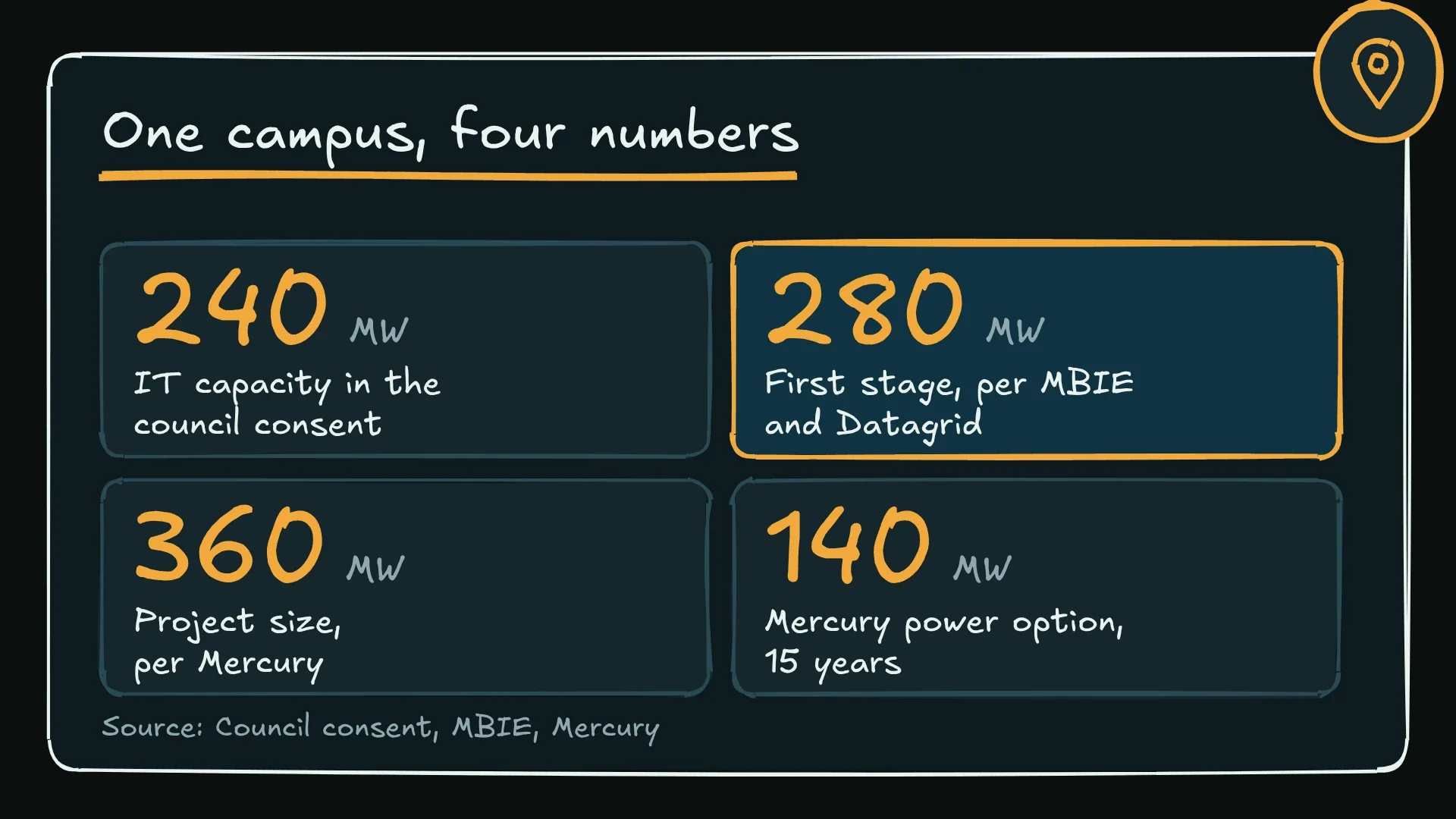
The megawatts depend on who’s counting. The council consent describes up to 240 MW of IT capacity, which is the computing equipment alone. Mercury, the power company behind the project, calls it a 360 MW project in its NZX announcement. Mercury holds a 15-year option on 140 MW of supply, which Datagrid says is 1.2 terawatt-hours a year, or 3% of national demand. In July, Mercury paid NZ$53 million (US$30 million) for 12.7% of Datagrid and said a final investment decision is due later this year.
The project has also grown. An earlier estimate put it at NZ$700 million and up to 100 MW, Newsroom reported. Datagrid’s March fact sheet now says about NZ$3.5 billion, and press reports have said $5 billion. We haven’t found a confirmed figure, so we don’t use one.
Who was asked
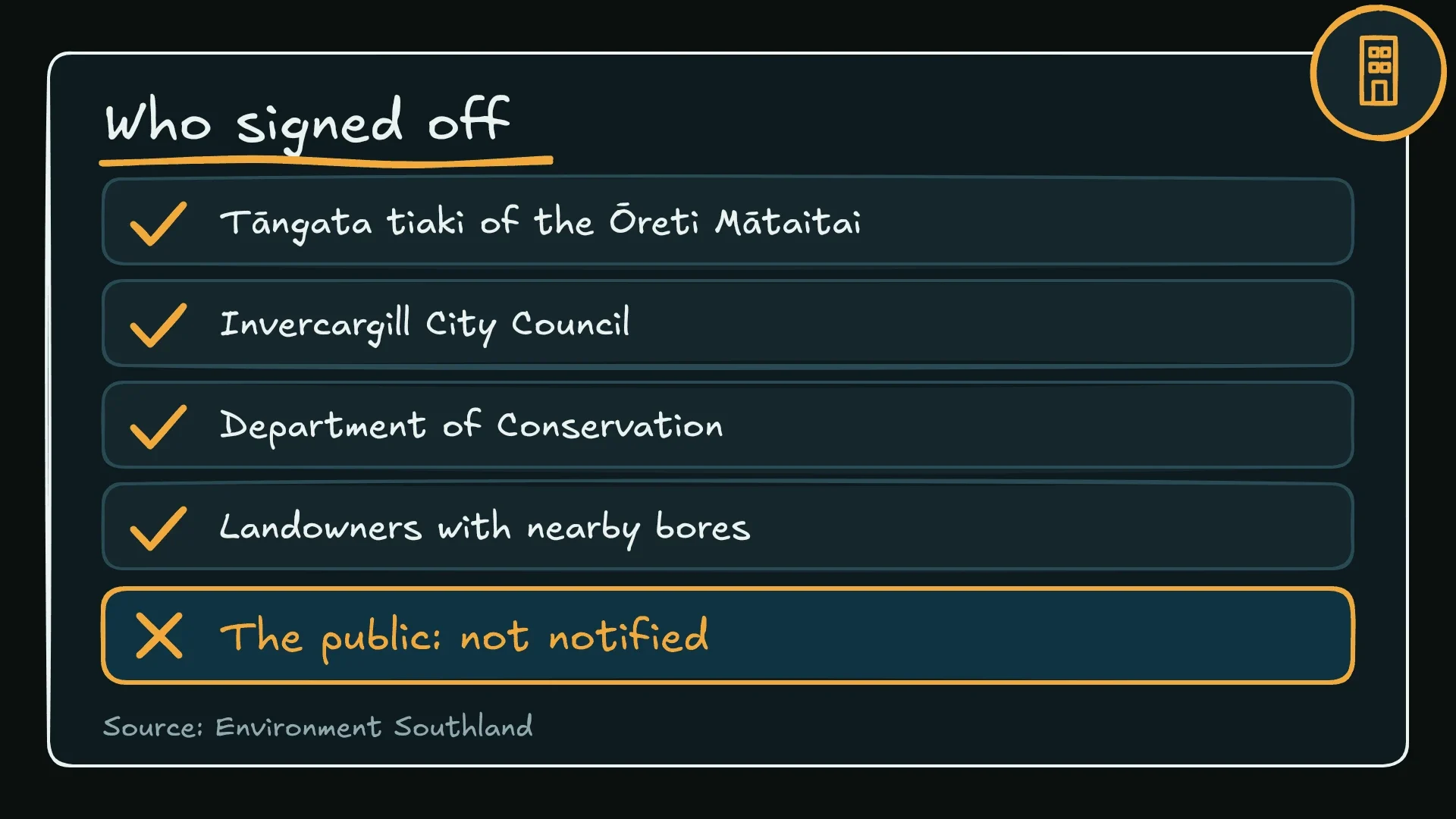
Southland District Council and Environment Southland granted the main consents in March, and an independent commissioner decided the council’s. Invercargill City Council granted one for the subsea cable, Newsroom reported. Environment Southland says the applications weren’t notified because their effects were assessed as no more than minor under the Resource Management Act. Written approvals came from the tāngata tiaki (customary guardians) of the Ōreti Mātaitai, Invercargill City Council, the Department of Conservation and landowners with nearby bores.
MBIE’s briefing tells the minister that new data centers can be seen coming, because grid connections take years and resource consents are publicly notified. Datagrid’s weren’t. Chief executive Rémi Galasso told RNZ the government offered him its Fast-track process and a consent in six months. He said he declined and chose the standard process.
The water question
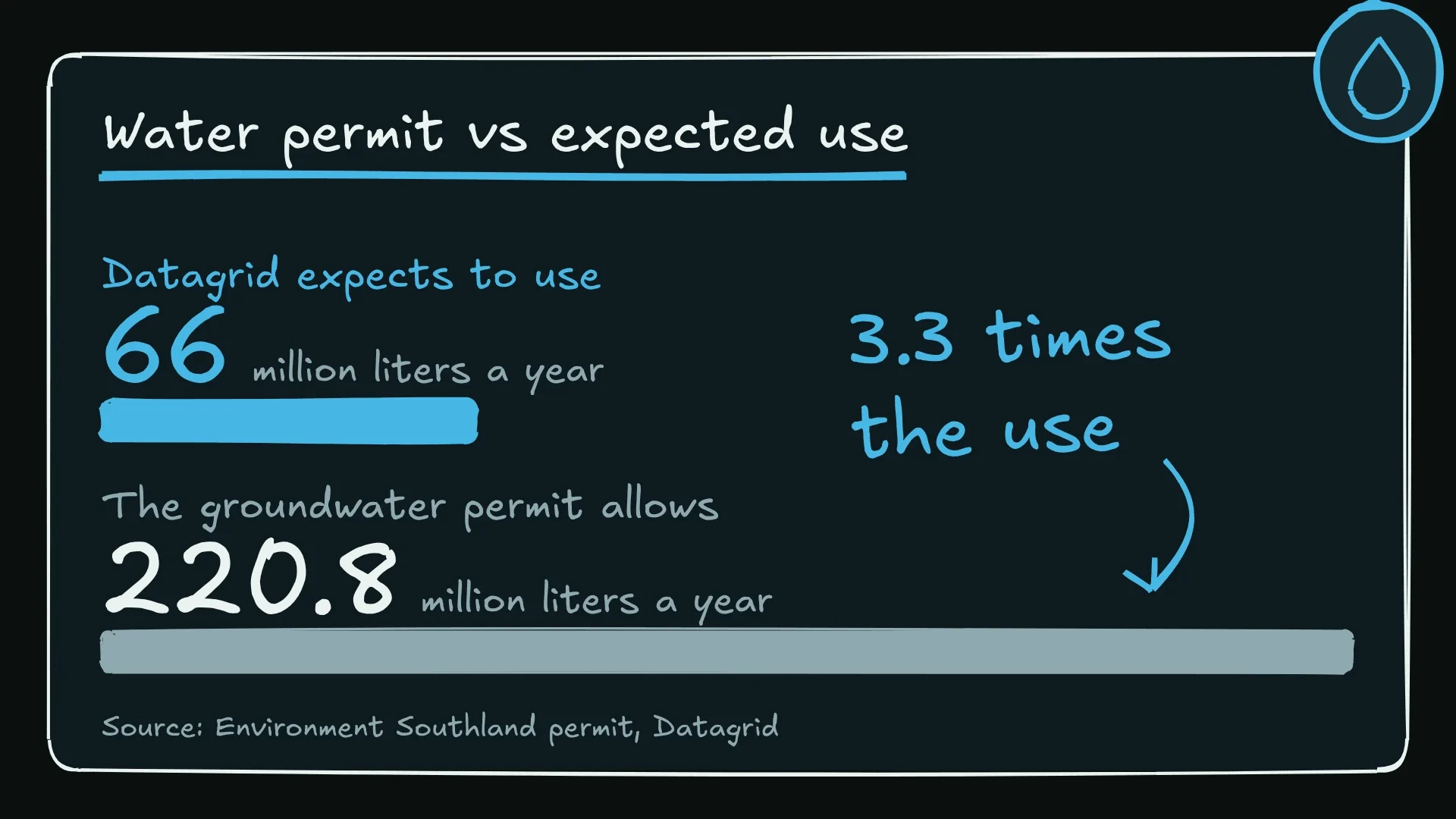
The groundwater permit allows 7 liters a second, 604,800 liters a day and 220,752,000 liters a year. At a meeting with Invercargill business leaders on August 18, Datagrid head of technology Benjamin Black said the company expects to use under 66 million liters a year, 70% less than the permit. He said the consent process starts from “the maximum set of effects, assuming the worst case for everything.”
“This is going to be the most sustainable data center in the whole Asia Pacific.”
Galasso said that at the same meeting, according to RNZ.
Documents released to Newsroom describe a bigger redesign: one long building in place of six data halls, dry coolers that need no groundwater for cooling, and a large battery that cuts emergency diesel generators from 84 to about 10. Black told the meeting fewer than 34 generators. The original consent covered up to 220,000 cubic meters a year of groundwater for cooling. Jonathan Koomey, a former Stanford researcher, told Newsroom dry coolers can use little or no water, depending on the installation.
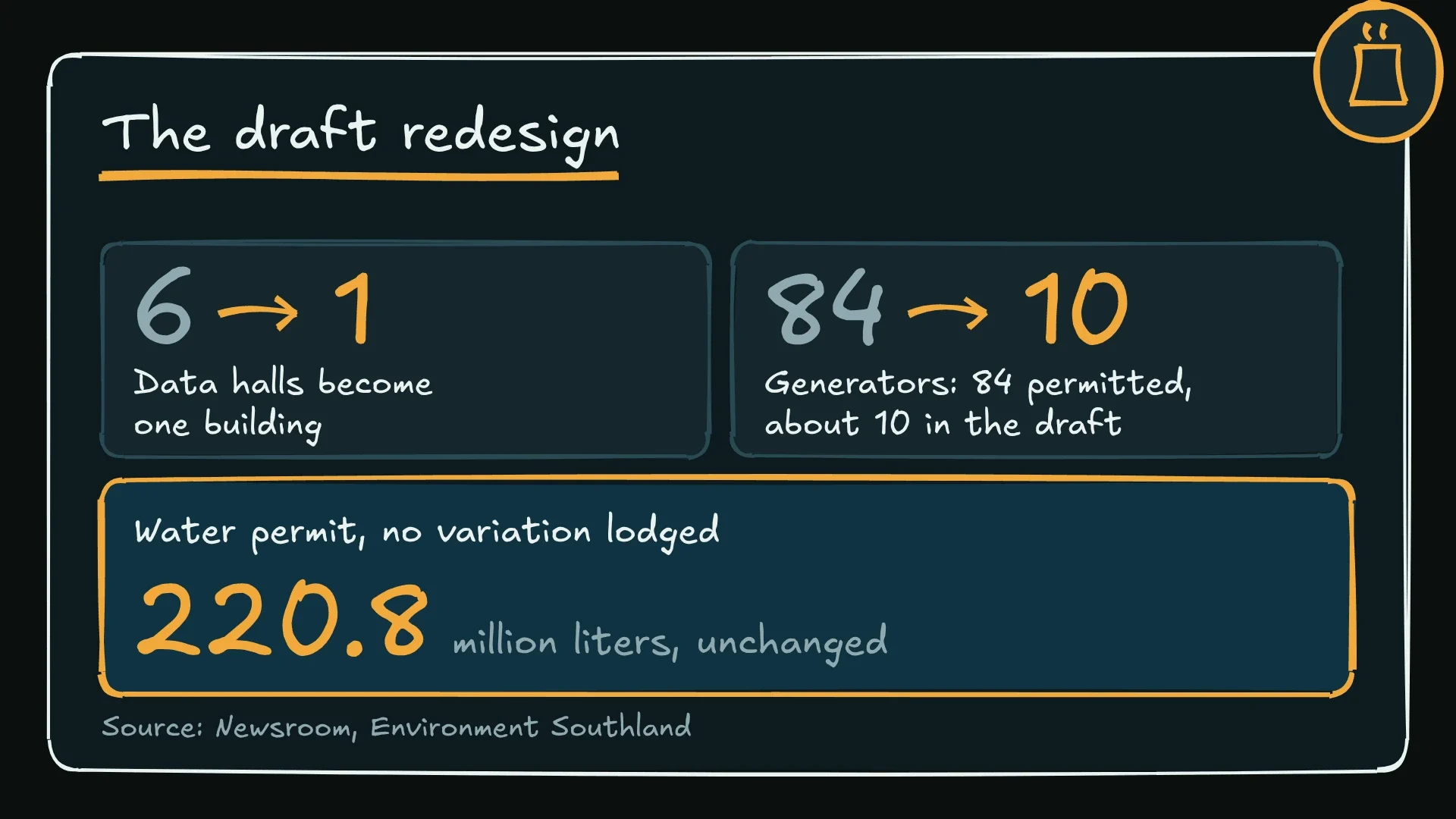
Minutes of a May 29 meeting say Environment Southland understood Datagrid wouldn’t reduce or relinquish its consented water take. Environment Southland says no variation has been lodged. A new application, covering stormwater and wetland work, has been.
On September 22, Environment Southland declined the Southland Sustainable Resource Coalition’s request to review the water permit. General manager Hayley Fitchett said the consented take is less than 10% of the limit in the Proposed Southland Water and Land Plan. She said the consent hasn’t been exercised, so no monitoring data shows the consented rate can’t be fully used. Coalition president Kelly Blomfield told Newsroom that consents that aren’t being used should be cancelled. On September 4, an independent hearing commissioner decided Southland District Council won’t review the land use consent conditions, in response to a coalition request mostly about noise.
Galasso told RNZ the company will hold monthly public meetings at the Makarewa Country Club and promised “full transparency.” Southland Business Chamber chief executive Sheree Carey said some of the concern in the community “comes from a knowledge gap,” and that people want straight answers in plain English.
Looking ahead, watch three things. Environment Southland told the campaign group Stop Data Centres NZ on October 29 that it can’t lawfully revisit its decision not to notify the remaining wetland application. The group had asked whether the campus still qualifies as specified infrastructure after Chorus withdrew from the subsea cable. The decision-maker must still be satisfied that it does before ruling. The coalition has said it intends to seek a judicial review of the regional consents, according to The Press, and Galasso says the consenting process met all statutory requirements. Mercury’s final investment decision is due this year.
Sources
- MBIE, Data centres: options to capture benefits and manage risks (briefing of July 2, 2026)
- Environment Southland, Datagrid resource consents
- Environment Southland, groundwater permit AUTH-20252550-03
- Environment Southland, request and response on review of the water permit
- Environment Southland, notification memorandum for application APP-20262269
- Southland District Council, Datagrid resource consent
- Southland District Council, commissioner decides not to review consent conditions
- Mercury, NZX announcement of July 23, 2026
- Datagrid, Mercury power purchase option announcement
- Datagrid, media fact sheet of March 2026
- MBIE, Energy in New Zealand 2025, electricity
- RNZ, Datagrid pledges less water, generator use at Southland AI factory
- RNZ, Environment Southland rejects request for data centre review
- Newsroom, Giant Southland AI data centre set for major redesign
- Newsroom, From dairy to data, the $3.5 billion bet on Southland
- The Press, Datagrid consents to face High Court challenge
- Chris Lynch Media, Council stands firm on Datagrid consent process