This article reports on sponsored content. “AI and the New Energy Paradigm” is a Wall Street Journal Paid Program, created by Custom Content from WSJ, a unit of the Journal’s advertising department, for Everpure. It presents the company’s view, not WSJ newsroom reporting.
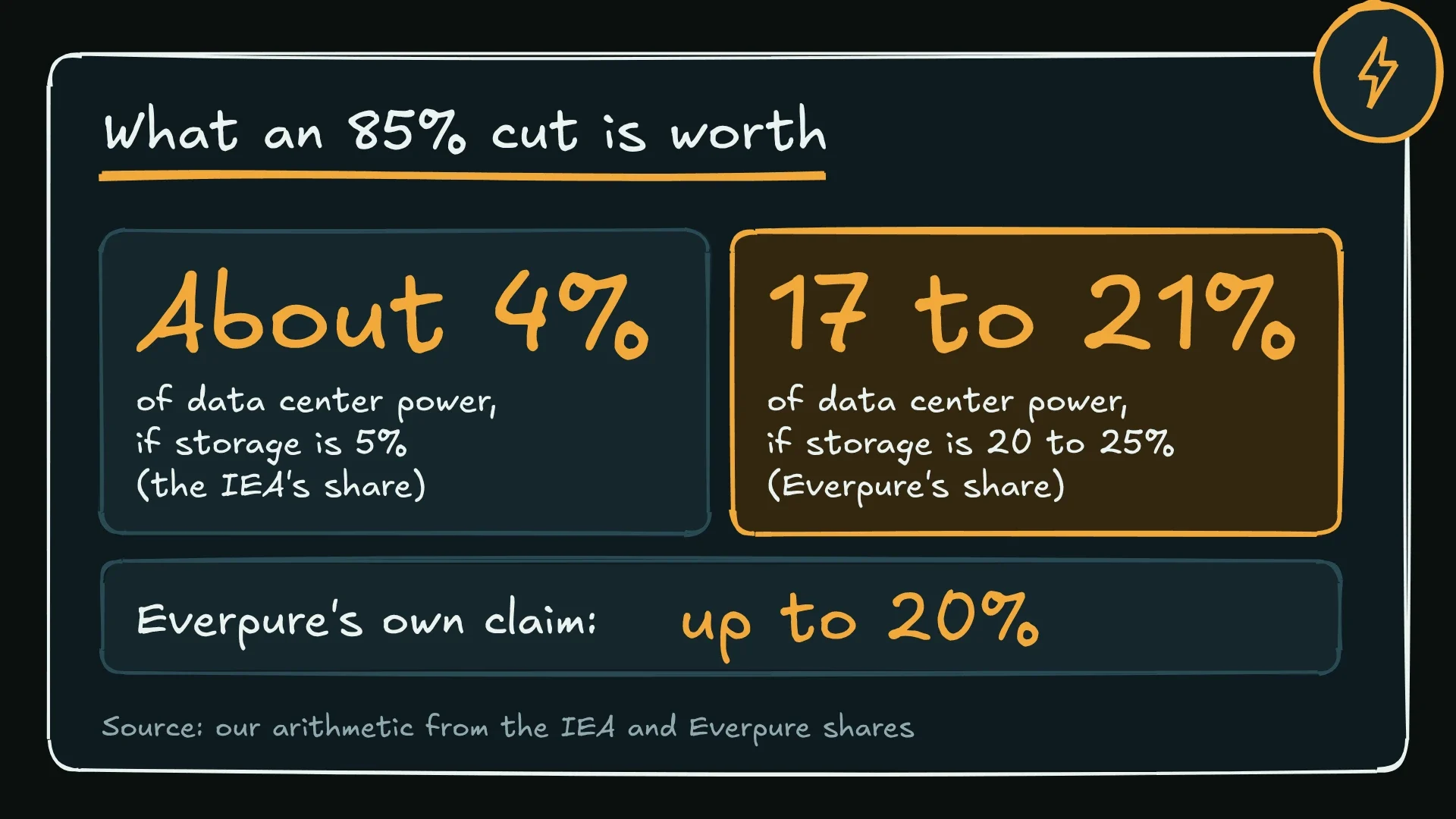
Everpure says its storage technology would save up to 20% of a data center’s power. The International Energy Agency (IEA) says all the storage in a data center uses about 5% of its electricity.
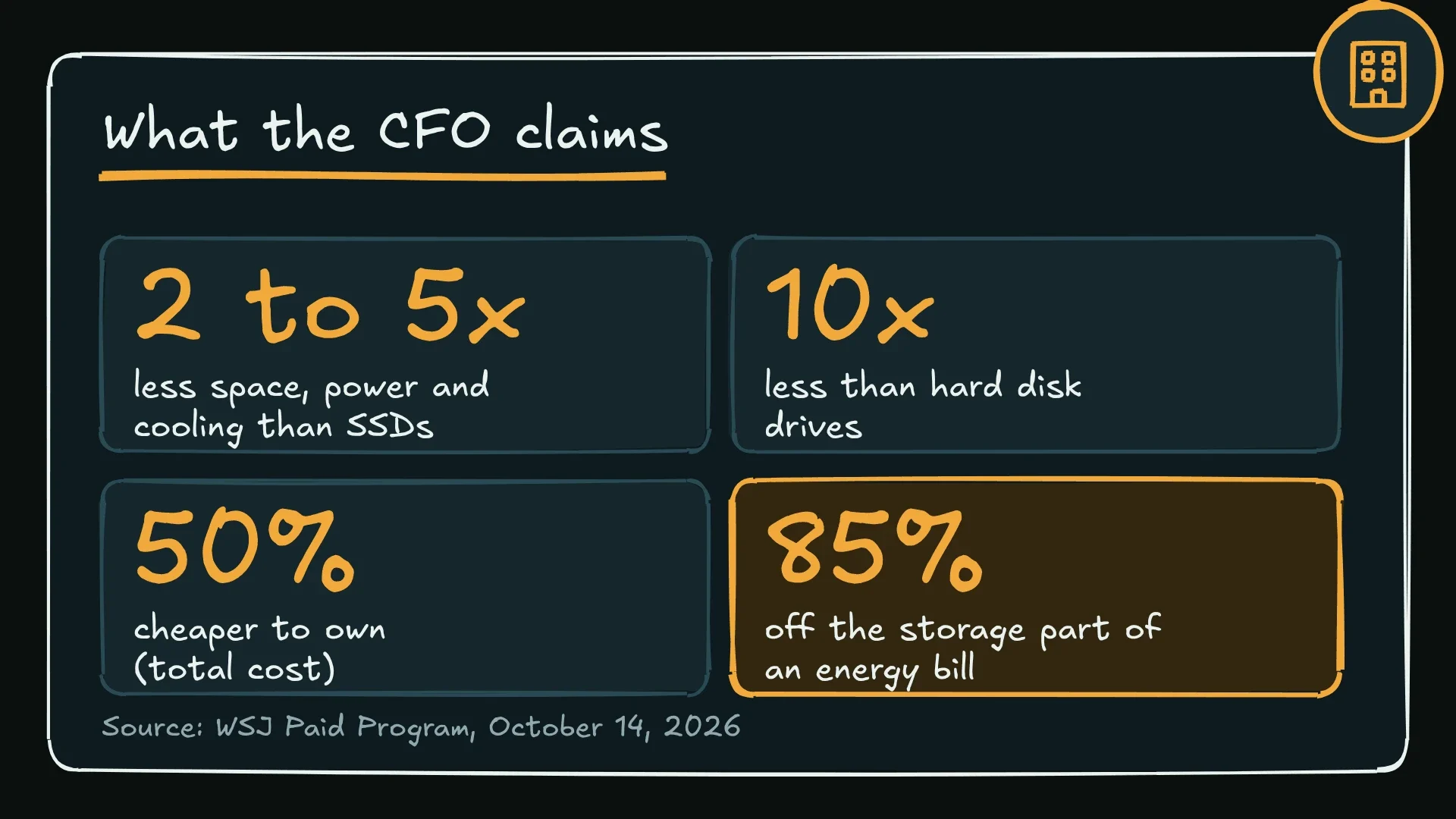
The 20% comes from Everpure’s 2026 Impact Report, published in August. In a paid Wall Street Journal interview on October 14, 2026, chief financial officer Tarek Robbiati made a narrower claim: up to 85% off the part of a company’s energy bill that comes from storage.

What 85% of storage means
Apply 85% to the IEA’s 5% and you save about 4% of a data center’s electricity. Apply it to the 20% to 25% that Everpure’s report gives storage and you save 17% to 21%, close to the report’s “up to 20%.”
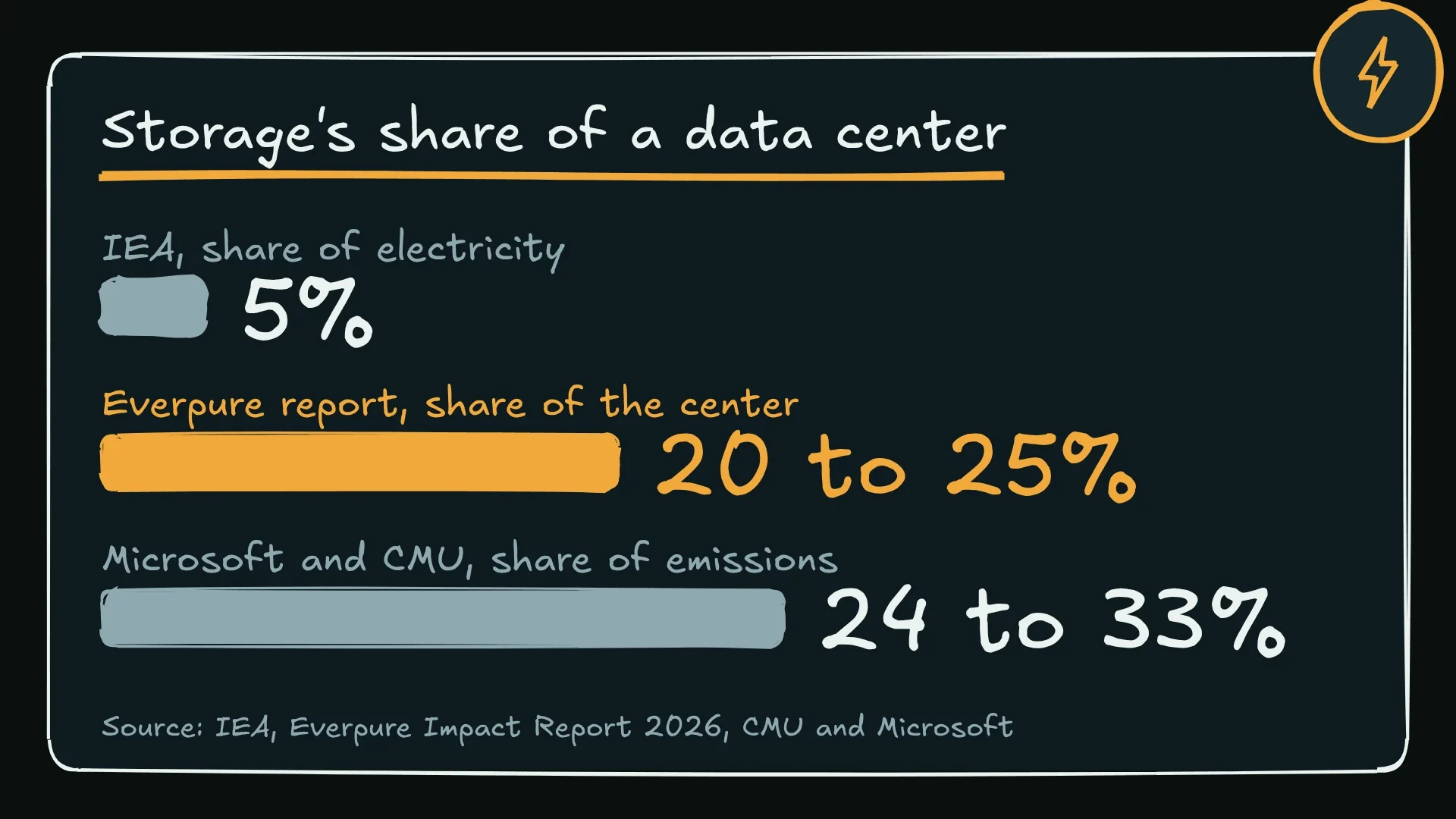
The report says computers take about 70% of a data center, storage 20% to 25% and network switches 5% to 10%. It doesn’t say what those shares measure. They add up to about 100%, which leaves no room for cooling and other equipment. The IEA’s 2024 shares include them: servers about 60%, storage about 5%, networking up to 5%, and cooling from about 7% in efficient hyperscale sites to over 30% in less efficient enterprise ones.
One independent estimate sits nearer Everpure’s. Researchers at Carnegie Mellon University and Microsoft found storage racks caused 24% of operational emissions in Microsoft’s Azure cloud, and 33% counting local storage devices. That measures emissions, not power, in one company’s cloud.
The same paper found Azure’s flash racks emitted about four times as much per terabyte as its disk racks in operation, and about 10 times as much to build. Those are Azure’s racks, not Everpure’s, so they don’t test Everpure’s claim. A 2022 paper that modeled single drives goes the other way on power: in its model a 1 terabyte SSD used about 57 kilowatt-hours over five years against 184 for a hard drive. It also found SSDs carry about eight times the embodied carbon of a hard drive of the same capacity. Everpure’s interview figures cover space, cooling and power, not the carbon of making flash.
What the interview claims
We can save up to 85% of the portion of a company’s energy bill that comes from storage with a product that is by design 50% cheaper in total cost of ownership.
Robbiati, Everpure’s chief financial officer, said that in the Paid Program interview. He also said Everpure’s systems use two to five times less space, cooling and power than conventional solid-state drives, and 10 times less than hard disk drives, and that “we’re not the cheapest to buy.” The interview doesn’t say how any of these figures were measured.
Everpure’s own report measures efficiency in effective terabytes per watt: 18 or more for its systems against 0.3 to 1.5 for disk-based ones. Effective capacity counts data after reduction, so the figure depends on how well a customer’s data shrinks. A customer testimonial in the report, from DoIT, says power for its Tier 0 and 1 storage fell from 28 kilowatts to 1.6, or 94%.
Everpure sells into the AI boom. It was Pure Storage until February 23, 2026, according to a filing with US regulators. For the quarter ended November 1 it reported US$1.46 billion of revenue, up 51%, with product revenue up 77% to US$948 million. On its November 18 earnings call the company announced a design win with a second top-five hyperscaler, with shipments expected to start around the middle of next year, and said it’s lowering prices on average across most models from the fourth quarter.
Delivery, not supply
Robbiati’s bigger argument is that the problem is getting energy to where it’s needed. “The real challenge we have is distribution of energy, not production,” he said. He added that re-running AI models on incomplete data wastes energy, and that companies should track energy use for every workload. He also said neocloud providers “by and large, serve as optional computational capacity for hyperscalers.”
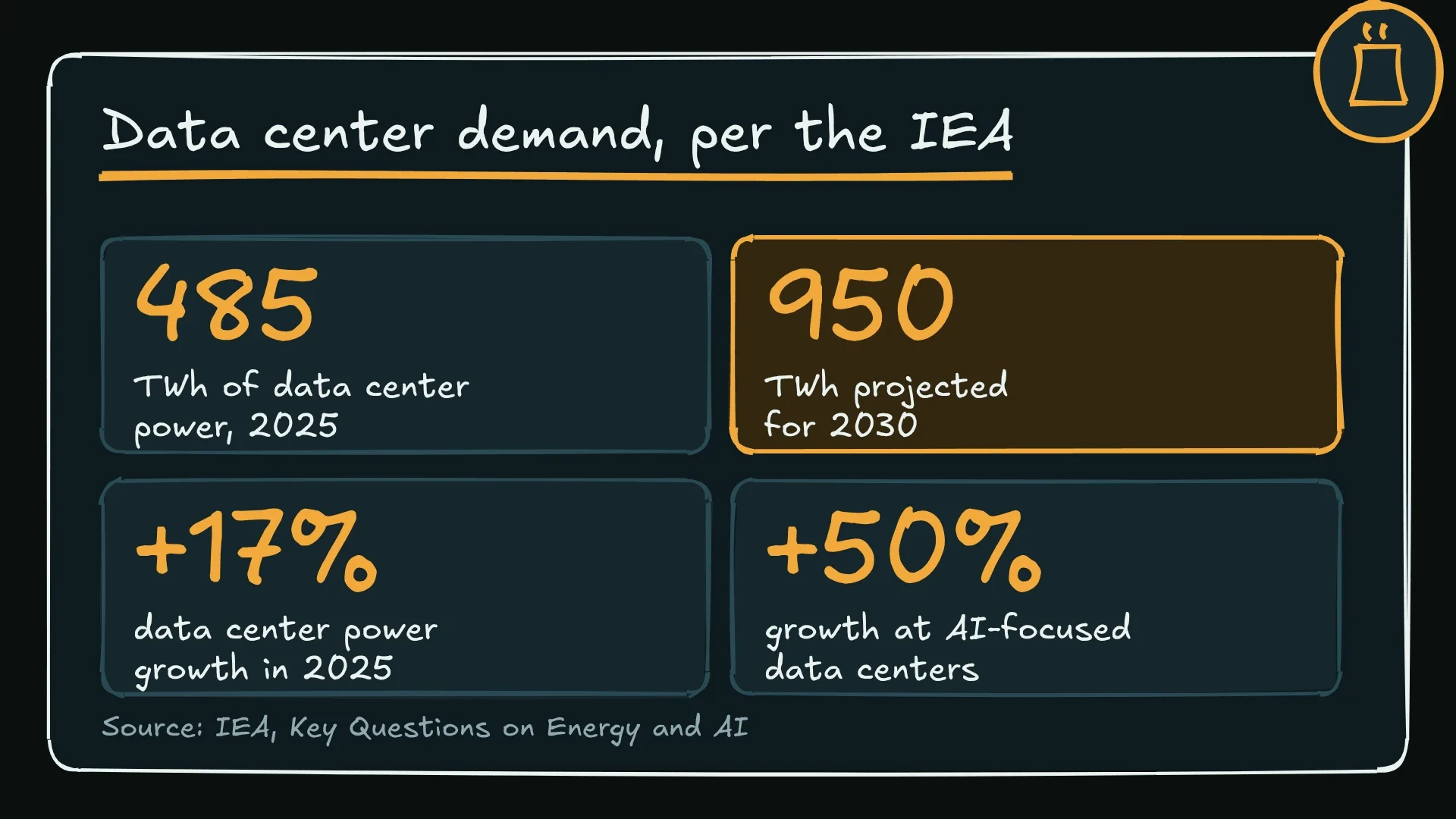
The IEA backs the delivery point. Its latest outlook has data center electricity use rising from about 485 terawatt-hours in 2025 to 950 in 2030, about 3% of global demand, after growth of 17% in 2025 and 50% at AI-focused sites. It says slow grid connections are pushing US developers toward onsite gas power, and it calls for “more systematic energy consumption disclosures.” Everpure’s report doesn’t say what its storage share measures.
On November 19, the US Senate passed a bill that would make data centers pay more for the grid lines they need. On the largest US grid, PJM’s market monitor says data centers have already added US$29.4 billion to capacity costs.
Looking ahead, Robbiati is scheduled to speak at the Wells Fargo TMT Summit on December 8 and the Barclays TMT Conference on December 10, according to Everpure. Watch whether the company publishes the basis for its 20% to 25% storage share and its 20% saving. For readers in New Zealand and Australia buying storage, ask what any percentage saving is a percentage of.
Sources
- The Wall Street Journal Paid Program (Custom Content from WSJ, sponsored by Everpure), AI and the New Energy Paradigm
- Everpure, Impact Report 2026
- International Energy Agency, Energy and AI: Energy demand from AI
- International Energy Agency, Key Questions on Energy and AI
- McAllister et al. (Carnegie Mellon University and Microsoft Azure), A Call for Research on Storage Emissions
- Tannu and Nair, The Dirty Secret of SSDs: Embodied Carbon (HotCarbon 2022)
- US Securities and Exchange Commission, Everpure Form 8-K (name change)
- Everpure, third quarter fiscal 2027 results
- Everpure Q3 2027 earnings call transcript (Motley Fool)