Who pays when a giant data center plugs into the grid? On America’s largest power network, the market watchdog says the bill has reached US$29.4 billion, and it isn’t finished growing.
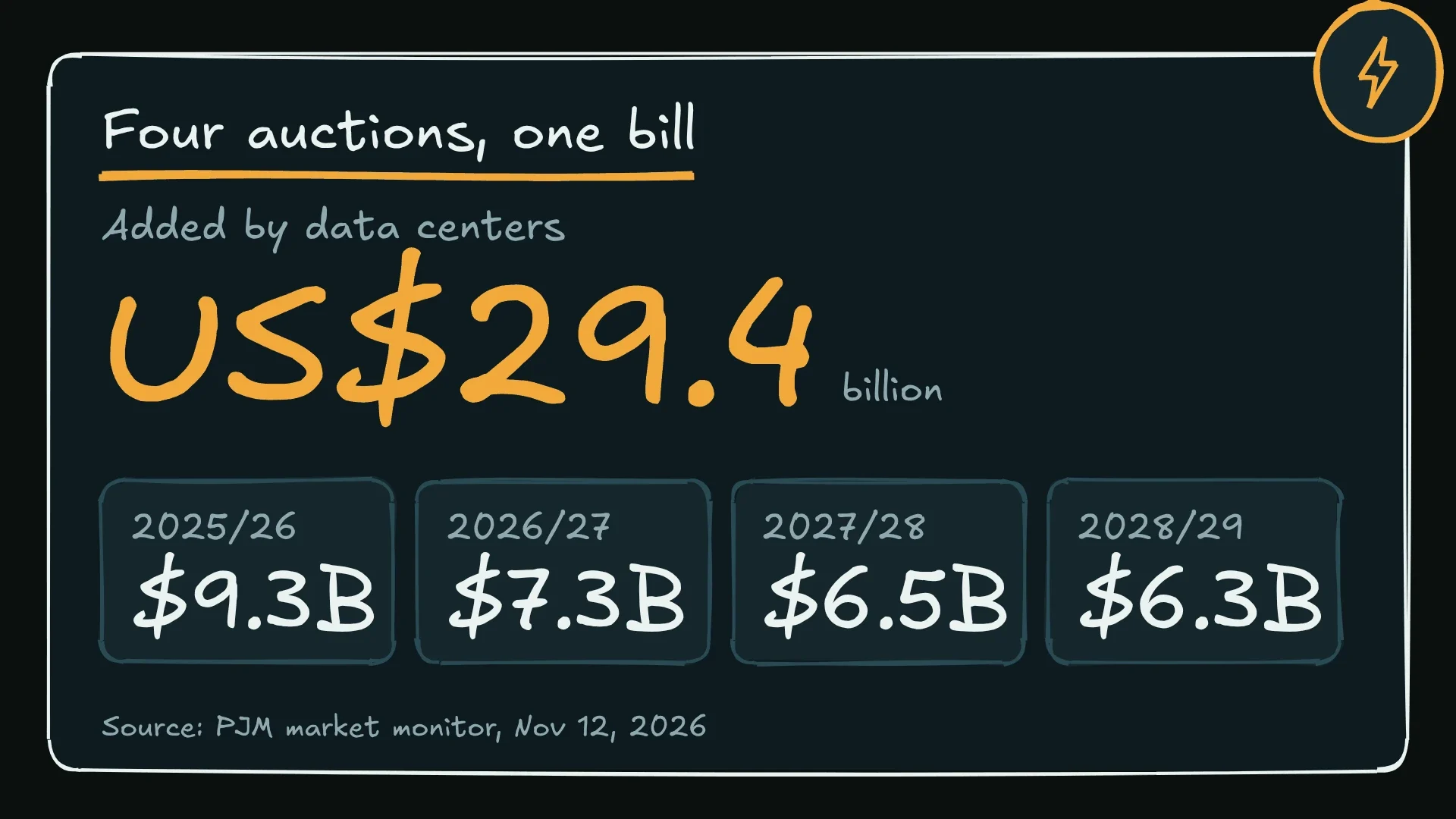
PJM Interconnection runs the grid and power markets across 13 states and Washington, D.C., serving 67 million people. On November 12, 2026, its independent market monitor, Monitoring Analytics, reported that data center demand has raised capacity costs for all PJM customers by US$29.4 billion. It calls the increase “irreversible.” Maryland’s consumer advocate says that’s 46% of the US$63.6 billion in capacity charges for the four years the auctions cover.
How the bill adds up
PJM’s capacity market is an annual auction that pays power plants to be ready for a future year, called a delivery year. The monitor estimated what each of the last four auctions would have paid if the demand forecast left data centers out. The gap was US$9.3 billion for 2025/26, US$7.3 billion for 2026/27, US$6.5 billion for 2027/28 and US$6.3 billion for 2028/29.
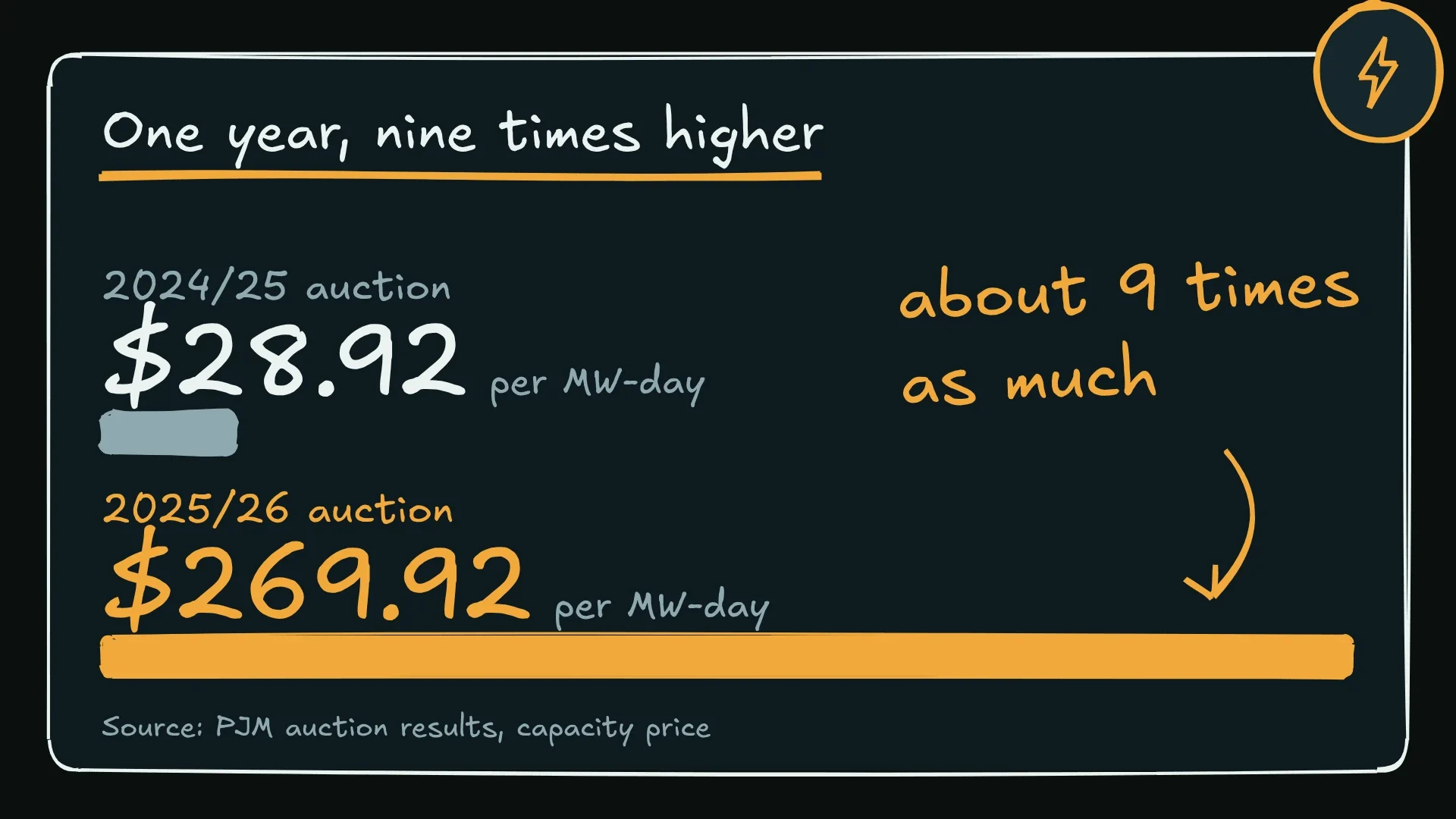
The price has moved fast. The auction for 2024/25 cleared at US$28.92 per megawatt-day. The next year’s cleared at US$269.92, about nine times as much. The latest, for 2028/29, ran from June 30 to July 7, 2026 and hit PJM’s US$325 price cap. It bought 138,318 megawatts for US$16.4 billion, and the monitor says forecast data center load added about US$6.3 billion to that, a 61.8% increase over what it would otherwise have cost.
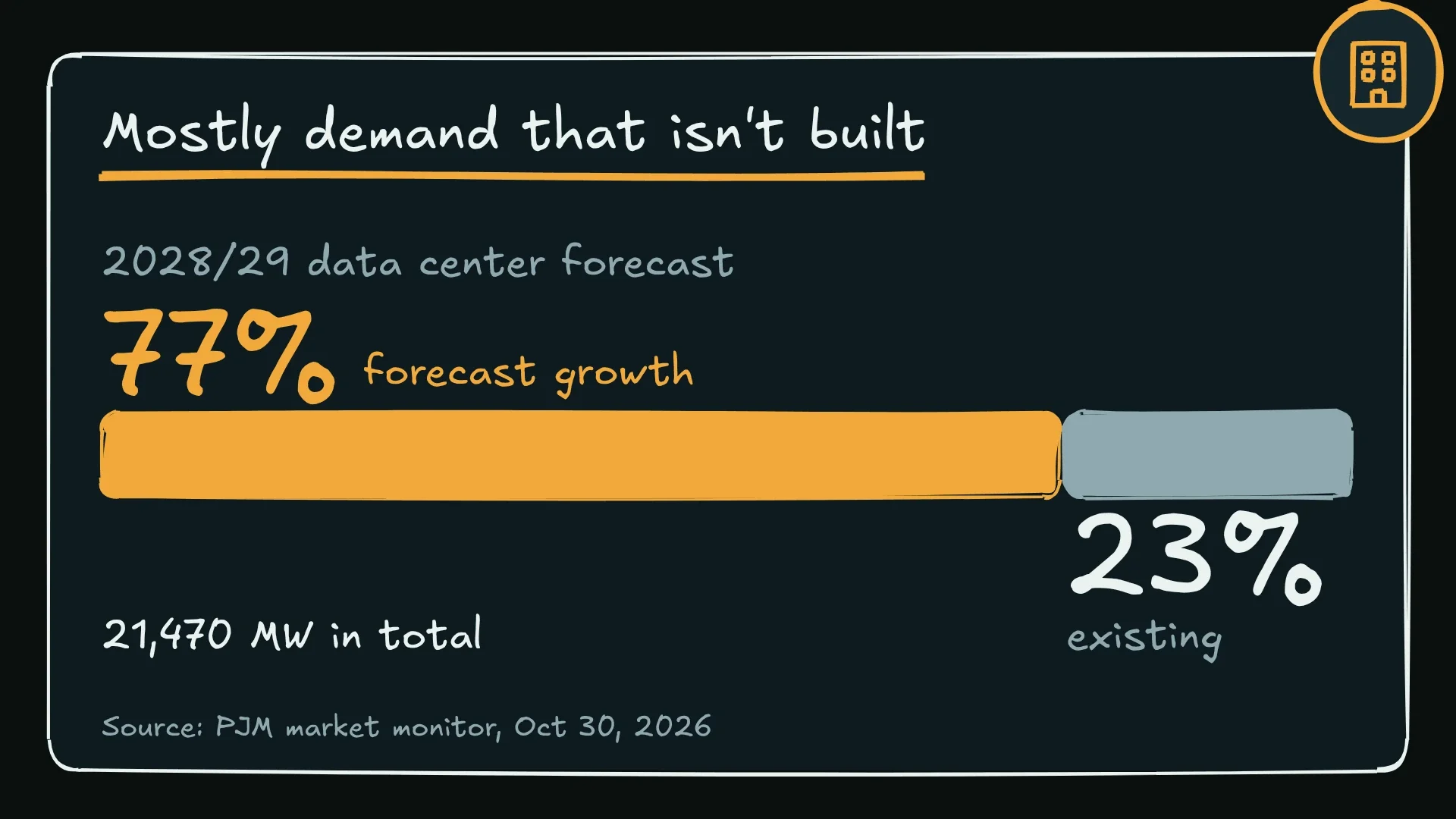
Much of that demand is a forecast. PJM’s forecast for 2028/29 counted 21,470 megawatts of data center load, and 16,436 megawatts of it was projected growth. The monitor calls those forecasts “unverified and overstated.” It says the auction results for 2025/26 through 2028/29 weren’t competitive, primarily because of forecast data center demand.
The auctions also fell short on reliability. The 2027/28 auction cleared 6,516.6 megawatts below PJM’s target, and 2028/29 cleared 6,831.3 megawatts below it. PJM says they were the first two auctions in its history where the whole region came up short. The monitor says there’d have been no shortfall in 2028/29 but for the forecast data center load.
What households pay
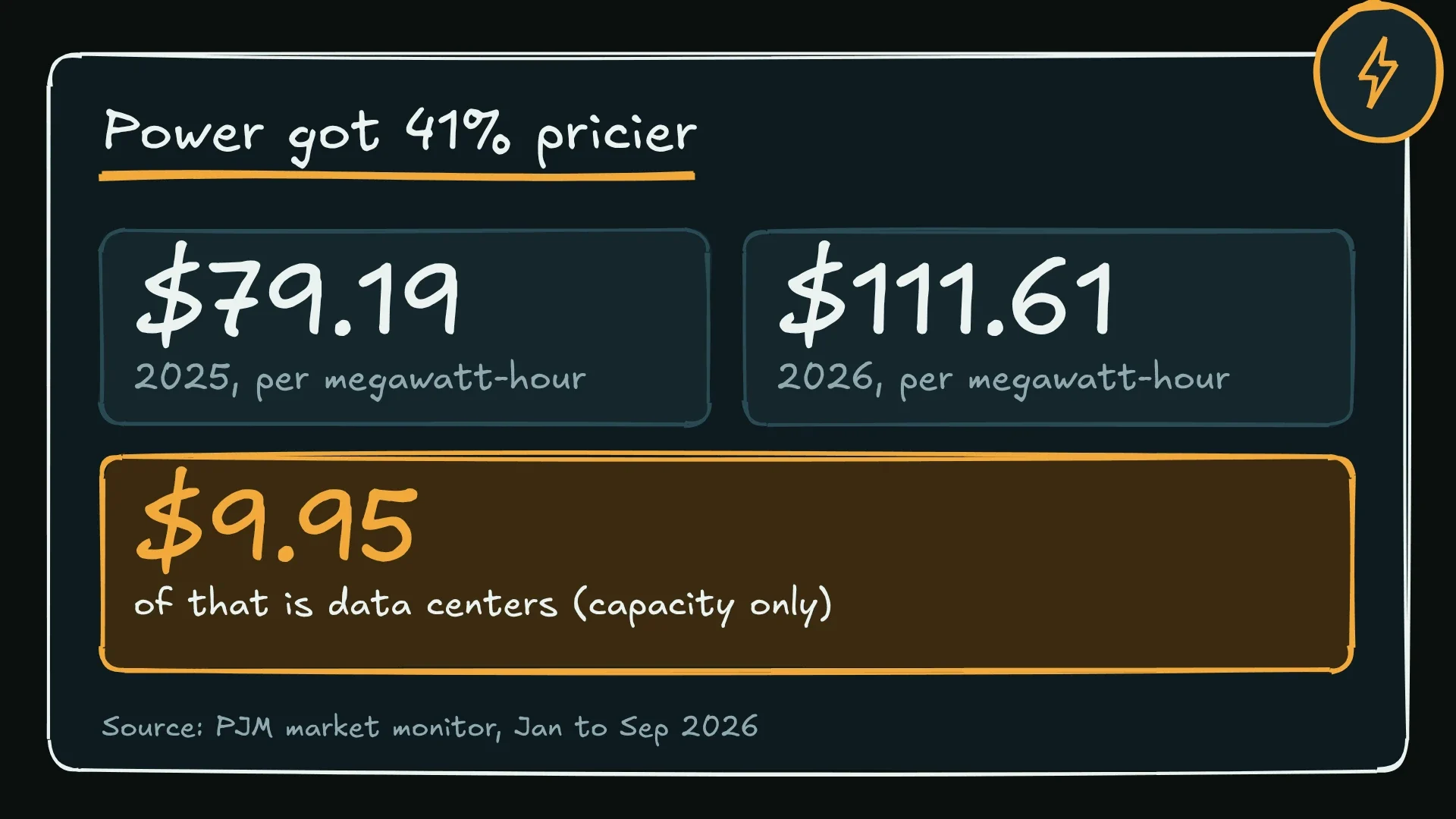
In the first nine months of 2026, wholesale power on PJM’s grid averaged US$111.61 per megawatt-hour, up 40.9% from US$79.19. The monitor says it would have averaged US$101.66 without data centers’ effect on capacity costs. That’s US$9.95, or 9.8%, and it leaves out any effect on energy and transmission costs.
Data centers aren’t the whole story. Energy costs, the biggest part of the total, rose 46.3%, from US$48.47 to US$70.89 per megawatt-hour, and the monitor found the energy market itself was competitive. The biggest pieces of that rise were a US$8.81 penalty price tied to transmission constraints and US$5.73 from fuel. Capacity rose 81.1% but still made up only 17.4% of the total.
For a household, capacity charges are about 10% to 20% of a typical PJM bill, according to FactCheck.org. Sanya Carley, a University of Pennsylvania researcher, told FactCheck.org that capacity costs added about US$18 a month to the average home bill in western Maryland and US$16 in Ohio between mid-2025 and mid-2026. An estimated 63% of that comes from data centers. By our arithmetic, that’s roughly US$11 a month in western Maryland and US$10 in Ohio.
Researchers disagree on how far this reaches. A Lawrence Berkeley National Laboratory and Brattle report, cited by FactCheck.org, found load growth contributed to “significant” price increases in PJM in 2025, but that most recent increases nationally weren’t due to data centers. An MIT paper co-authored by Jacquelyn Pless found data center entry raised retail rates 2.7% from 2010 to 2024, while an unpublished study from the Electric Power Research Institute found a 6% drop. The International Energy Agency (IEA) says load growth can lower prices on a grid with spare supply and raise them on a tight one.
The fight over who pays
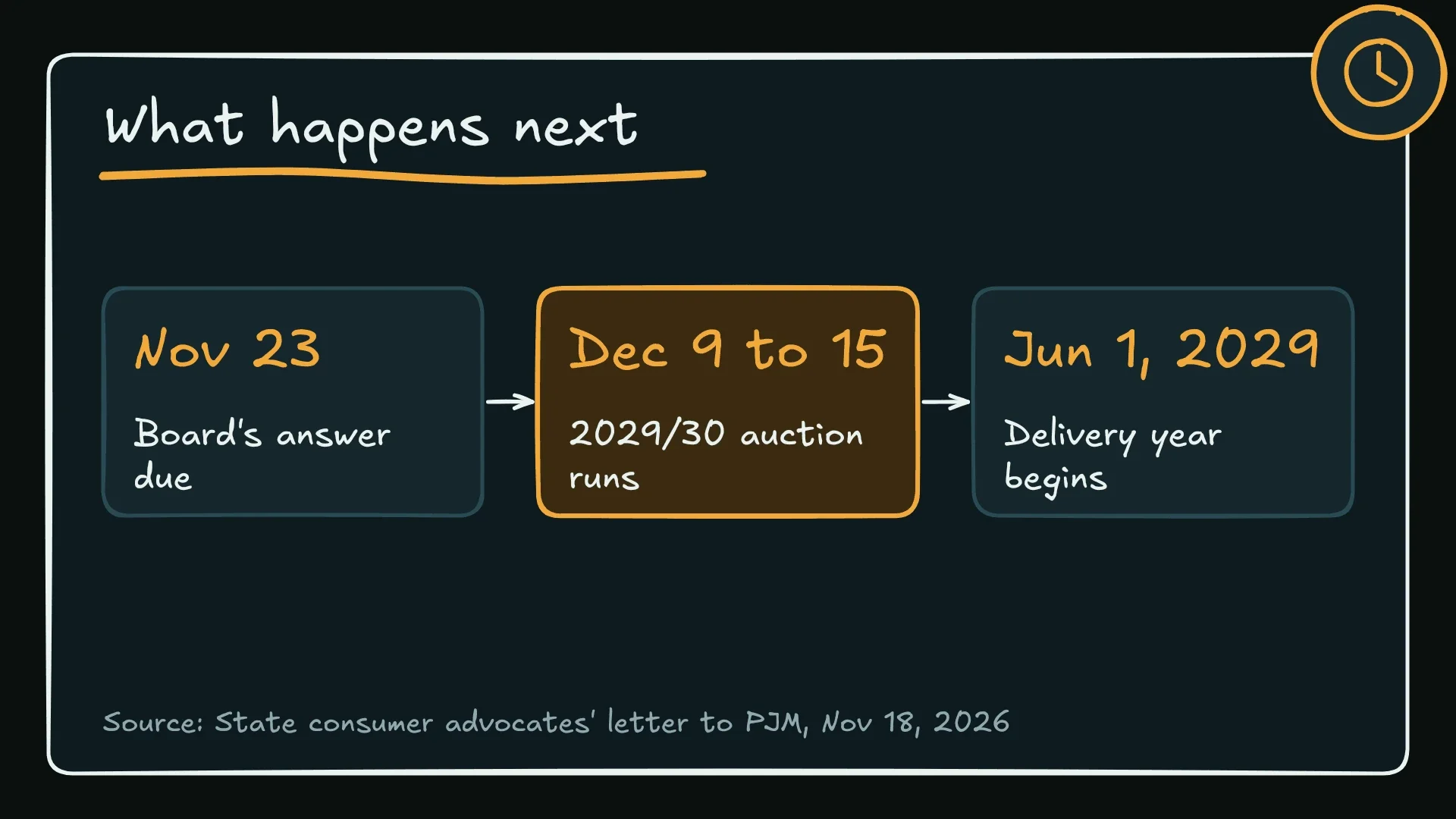
The next auction, for 2029/30, runs December 9 to 15. The monitor says it’ll clear at the maximum price and add another US$5 billion to US$10 billion, because PJM’s forecast still includes data centers that are canceled or unlikely to reach projected demand. It wants data centers kept out of the capacity market and required to bring their own new generation.
On November 18, consumer advocates from seven states asked PJM’s board to postpone it. PJM spokesman Jeffrey Shields said postponing the auction “could destabilize the market and increase the risk of power interruptions when customers need electricity most.” A delay would need approval from the Federal Energy Regulatory Commission (FERC). Exelon had already filed a FERC complaint on November 3 challenging PJM’s three-year-forward auction, partly over how hard data center load is to forecast.
PJM’s fixes are behind schedule. FERC rejected most of PJM’s large-load interconnection plan on October 12, and WITF reported that PJM’s planned backstop auction for data centers won’t happen before December. The monitor says PJM has failed to deliver on the White House’s Ratepayer Protection Pledge, issued in March, to make data centers pay their own costs. The pledge is voluntary.
Congress is split too. The Ratepayer Protection Act passed the House but stalled in the Senate, and as written it asks state regulators only to “consider” protections. On November 19, the Senate passed a different bill that would make data centers pay for the grid lines they need. It still has to clear the House.
“Ultimately, the key question isn’t simply whether a data center promises to pay its own way, but whether new rates and contracts actually ensure that existing customers aren’t left covering the costs.”
Jacquelyn Pless, an energy economist at the University of Toronto, told FactCheck.org.
Looking ahead, PJM’s board owes the advocates an answer by November 23, and the next auction opens December 9. For readers in New Zealand and Australia, the lesson is the order of events: PJM’s customers started paying for data centers that were forecast, not built. Rules on who pays need to exist before the first big connection.
Sources
- Monitoring Analytics (PJM Independent Market Monitor), 2026 Quarterly State of the Market Report for PJM, November 12, 2026
- Monitoring Analytics, Analysis of the 2028/2029 RPM Base Residual Auction Part A, October 30, 2026
- Monitoring Analytics, report to the PJM Members Committee, October 28, 2026
- PJM, 2028/2029 Base Residual Auction results, July 14, 2026
- Utility Dive, PJM urged to delay base capacity auction until data centers cut from forecast, November 19, 2026
- Maryland Office of People’s Counsel, State consumer advocates call on PJM Board to delay upcoming capacity market auction, November 18, 2026
- WITF, Electricity grid watchdog warns of higher prices after delayed PJM market reforms, November 13, 2026
- FactCheck.org, Data Centers and Electricity Prices
- International Energy Agency, Key Questions on Energy and AI