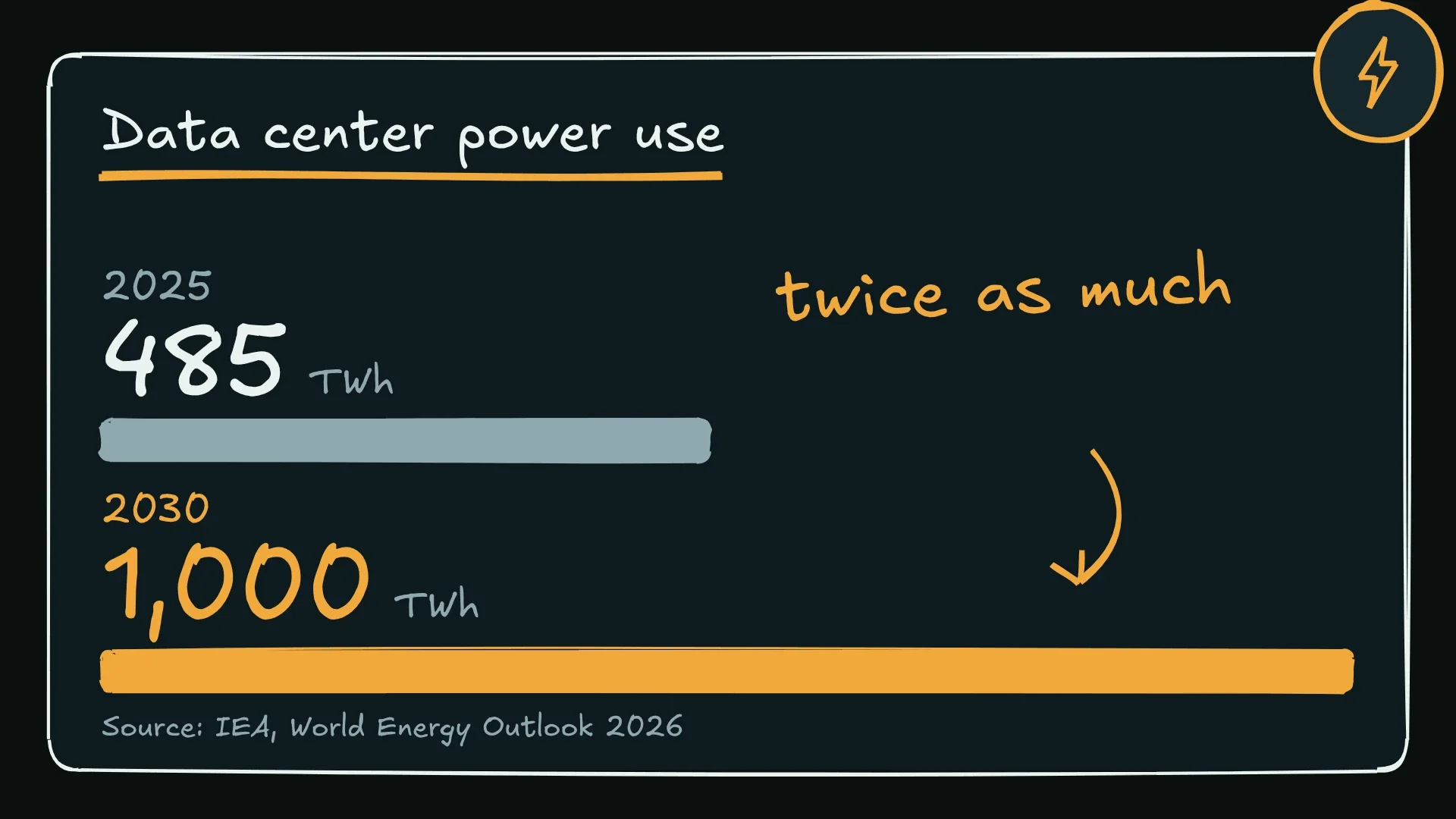
The International Energy Agency (IEA) expects data centers to use twice as much electricity in 2030 as they do today, about 1,000 terawatt-hours (TWh), or 1,000 billion kilowatt-hours. AI-focused data centers drive about three-quarters of that growth, it says.
The IEA’s report Key Questions on Energy and AI, published April 16, 2026, put the 2030 total at 950 TWh. Its World Energy Outlook 2026, published November 19, puts it at 1,000 TWh in its Stated Policies Scenario. We updated this piece on November 20.
What the numbers say
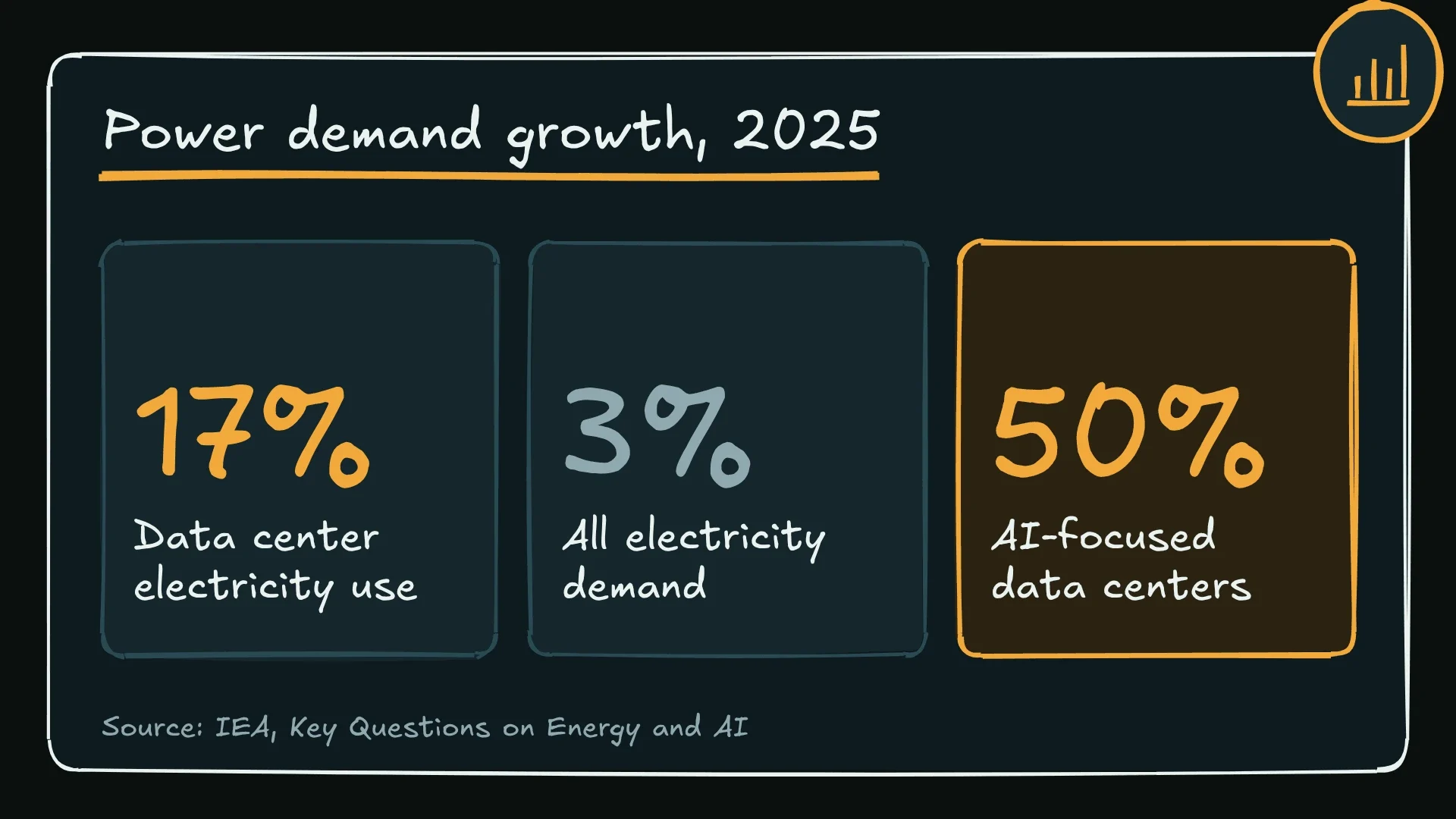
Data centers worldwide used about 485 TWh in 2025, the IEA estimates. That’s 17% more than in 2024, while global electricity demand grew about 3%. AI-focused data centers grew faster still, about 50%, and the IEA’s April projection has their use tripling by 2030.
At 950 TWh, data centers would use about 3% of the world’s electricity. In 2025, the IEA compared a similar total to all of Japan’s electricity use.
The money is moving just as fast. Capital spending by five large technology companies passed US$400 billion in 2025, and the IEA says it’ll rise another 75% in 2026. That’s now more than the world invests in producing oil and natural gas. The IEA expects about US$4 trillion more in data center spending by 2030.
Demand is real. Major AI model providers reported a threefold rise in active users and a fivefold rise in revenue over the past year, the IEA says. Even so, data center investment has grown too large for company balance sheets alone, so the pace of growth will track market sentiment about returns on AI, it says.
Smarter chips, hungrier habits
There’s good news. Energy per AI task has fallen by at least a factor of 10 a year recently, a pace the IEA calls unprecedented in energy history. A simple text question now uses less electricity than running a TV for the same time. If every conventional internet search ran as a simple AI text query, the IEA estimates, it would use under 4 TWh a year, less than 1% of data centers’ use today.
The catch is how people use it. Video, “reasoning” and AI agents can use hundreds or thousands of times more energy per request than a text answer.
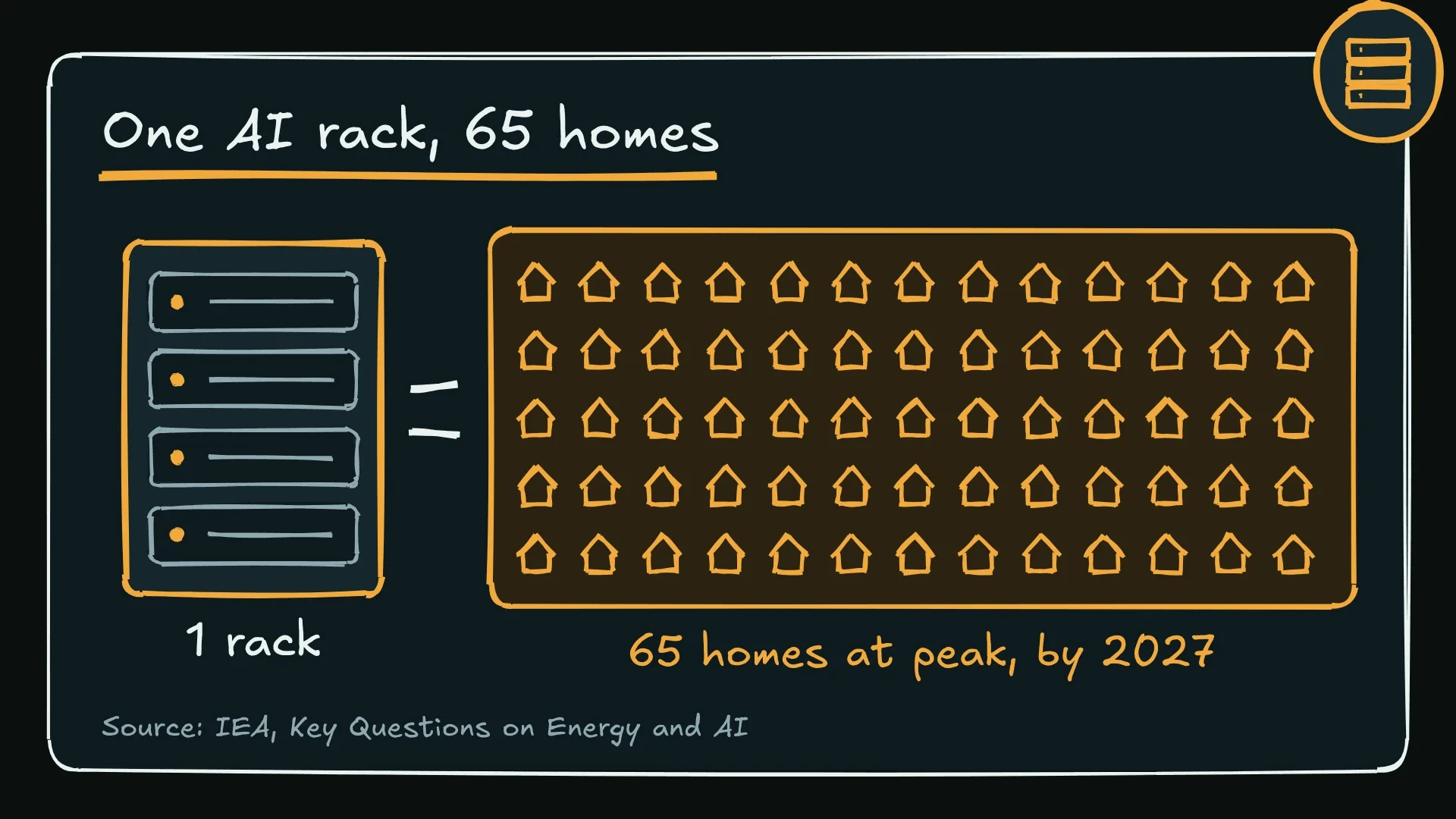
Then there’s density. The power packed into AI servers rose 11 times between 2020 and 2025, and the IEA says it’ll rise fourfold again by 2027. By then, one advanced server rack, about the size of a large fridge, could draw as much power at its peak as 65 households.
Those loads swing fast, so the IEA expects about 20 to 25 gigawatts (GW) of battery storage inside data centers by 2030. With the right incentives, that could make data centers a grid asset.
“Now, we see that while AI is still an energy taker, it is also becoming an energy maker.”
Fatih Birol, the IEA’s executive director, said that in the agency’s April 16, 2026 press release.
Grids, gas and bills
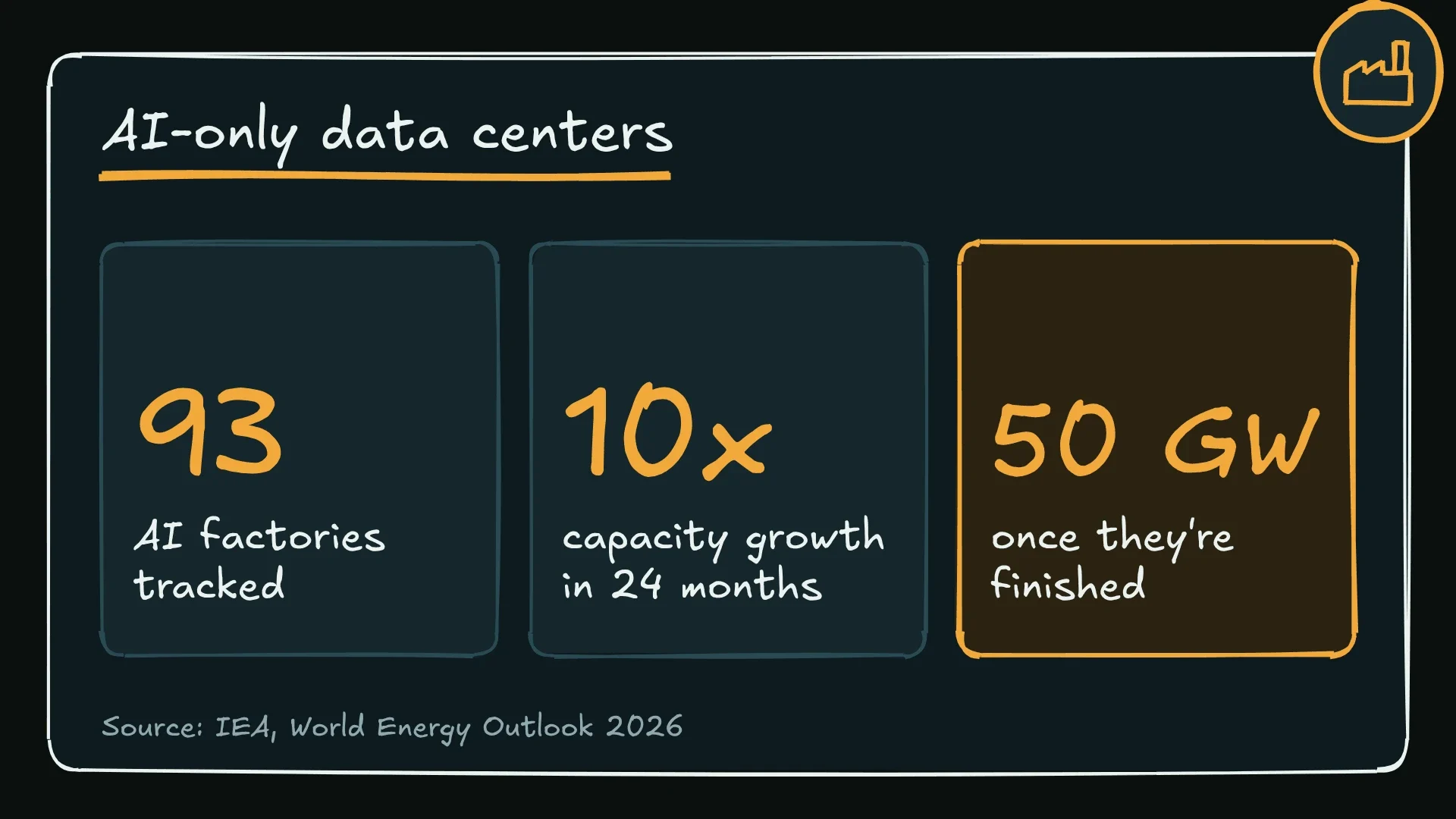
The IEA tracks 93 large “AI factories,” data centers built only for AI, by satellite. Their capacity grew tenfold in 24 months, to 17 GW, and the IEA puts the total at about 50 GW once they’re finished.
Grids can’t keep up. The IEA says planned data center capacity in Denmark, Finland, Northern Virginia and Texas is much larger than the total peak load those grids can support today. Not all of it will be built. Developers also tend to oversize their grid connections at first, so actual peak load is often unclear.
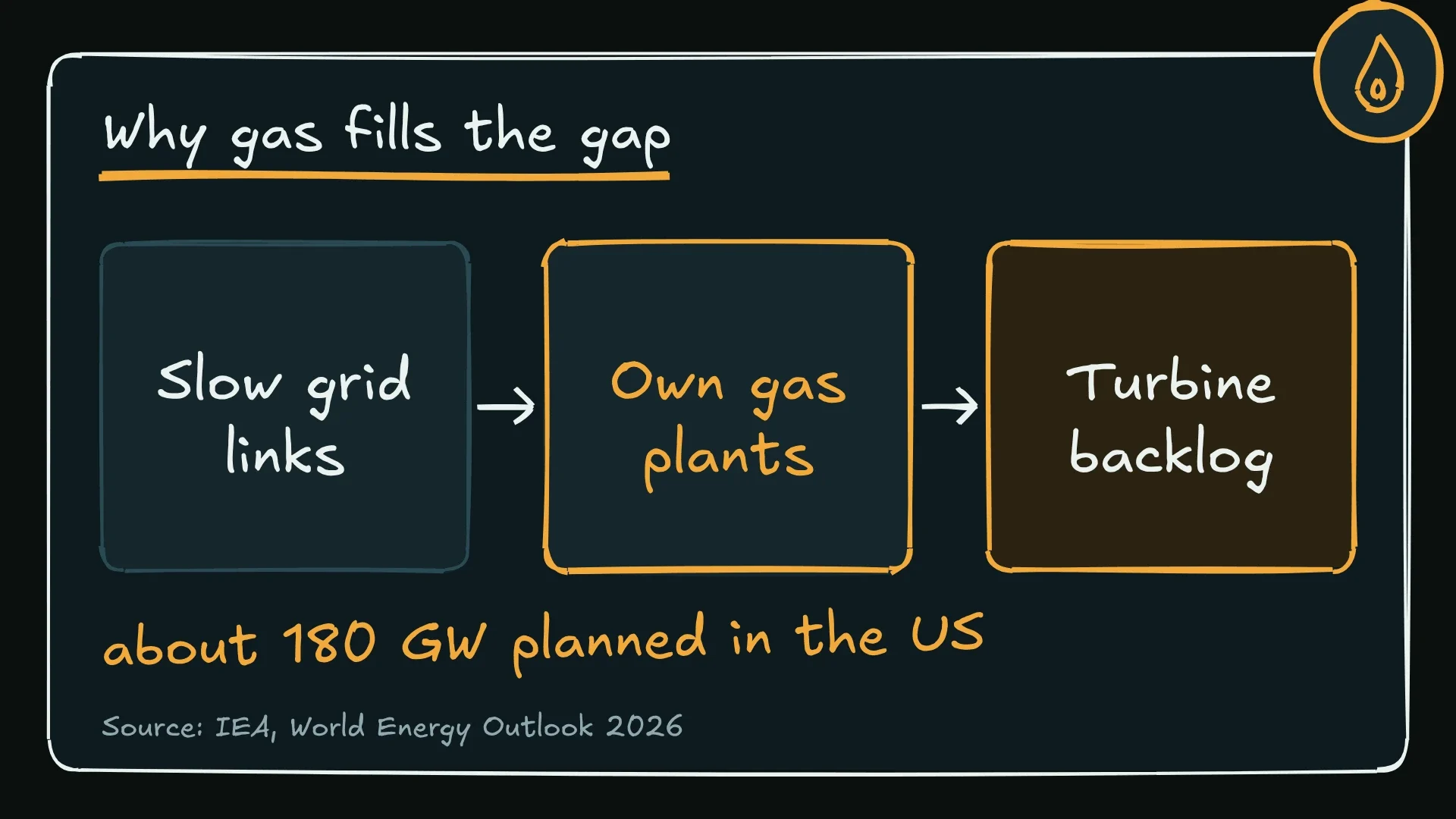
Slow connections push US developers toward their own gas generators. The IEA’s satellite tracking shows about a fifth of those projects have started land clearing or construction, but gas turbine orders jumped 70% in 2025. As of August 2026, about 180 GW of gas-fired capacity was planned in the US for data centers, and a turbine backlog means most of it won’t run until the 2030s.
Onsite gas isn’t a quick fix, either. Reliable power from it means overbuilding generation by 30% to 70% relative to demand, the IEA says, and it expects only about 15 to 27 GW to power data centers by 2030, mostly in the US.
Coal and gas supply about 60% of data centers’ electricity today, and the IEA says the sector’s emissions are on track to rise 70% by 2030.
Tech firms are also buying cleaner power. They signed about 40% of all corporate renewable power purchase agreements in 2025, and the IEA says conditional deals with small modular reactor projects grew from 25 GW at the end of 2024 to 45 GW by April.
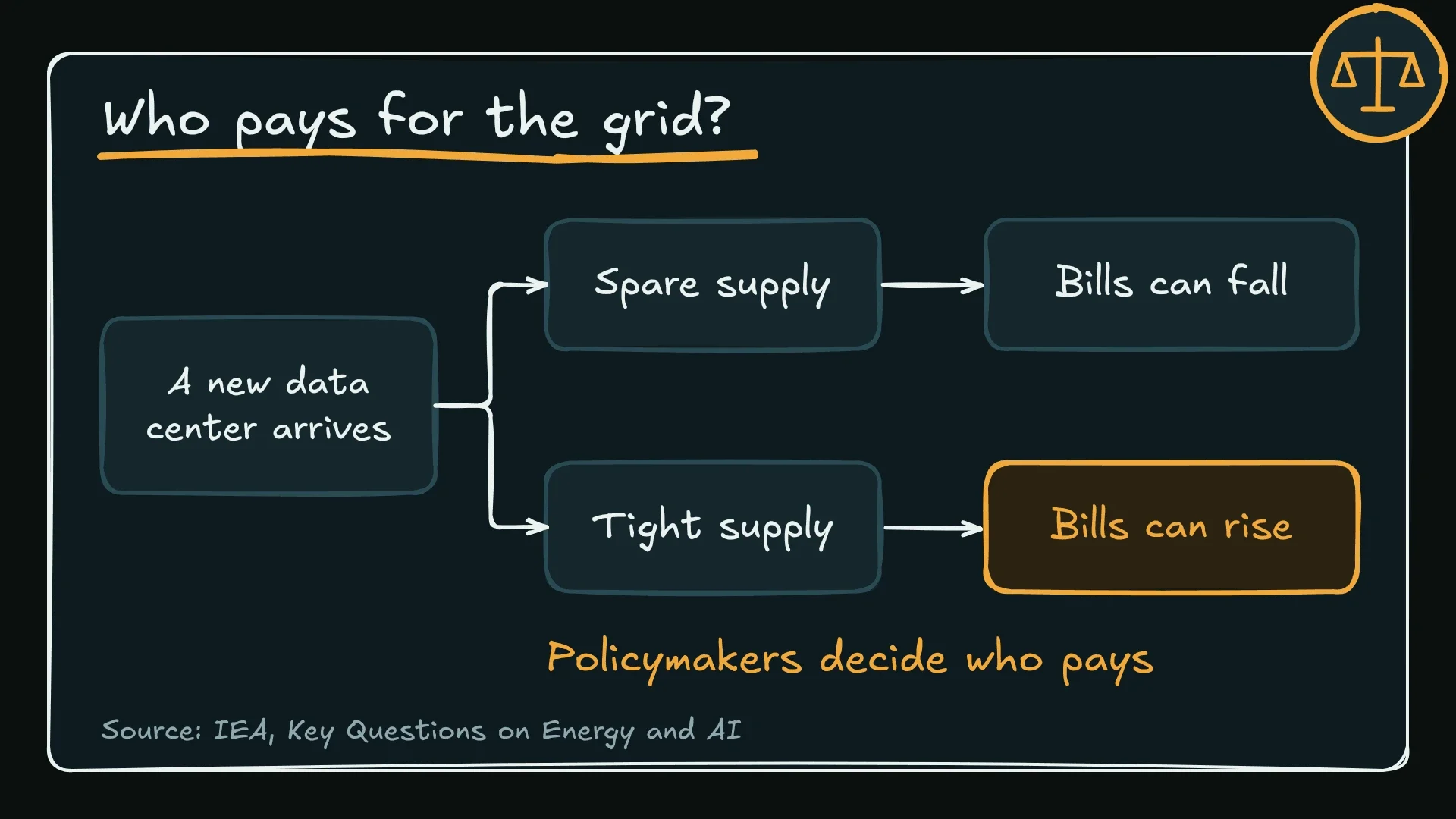
Whether your bill rises depends on who pays. Where a grid has spare supply, the IEA says, new demand can spread fixed costs and even lower prices, the way steady passenger numbers let airlines cut fares on busy routes. Where supply is tight, data centers arrive fast and often force new power plants and lines. Policymakers decide who covers that, it says, and tariffs can make the split fair.
On November 19, the US Senate passed a bill that would make data centers pay the extra grid cost of serving them. It isn’t law yet.
Data centers still use only about 1.7% of the world’s electricity, the IEA says. But they cluster, so some local grids carry far more.
Looking ahead, the IEA says it’ll keep updating its projections and sees a possible higher case after 2030. Watch how regulators decide who pays for grid upgrades. For readers in New Zealand and Australia, the lesson is to settle that before the next big data center connects.