Three of the biggest companies in tech promised to bring their climate pollution to zero, or below. Their latest reports show it climbing instead.
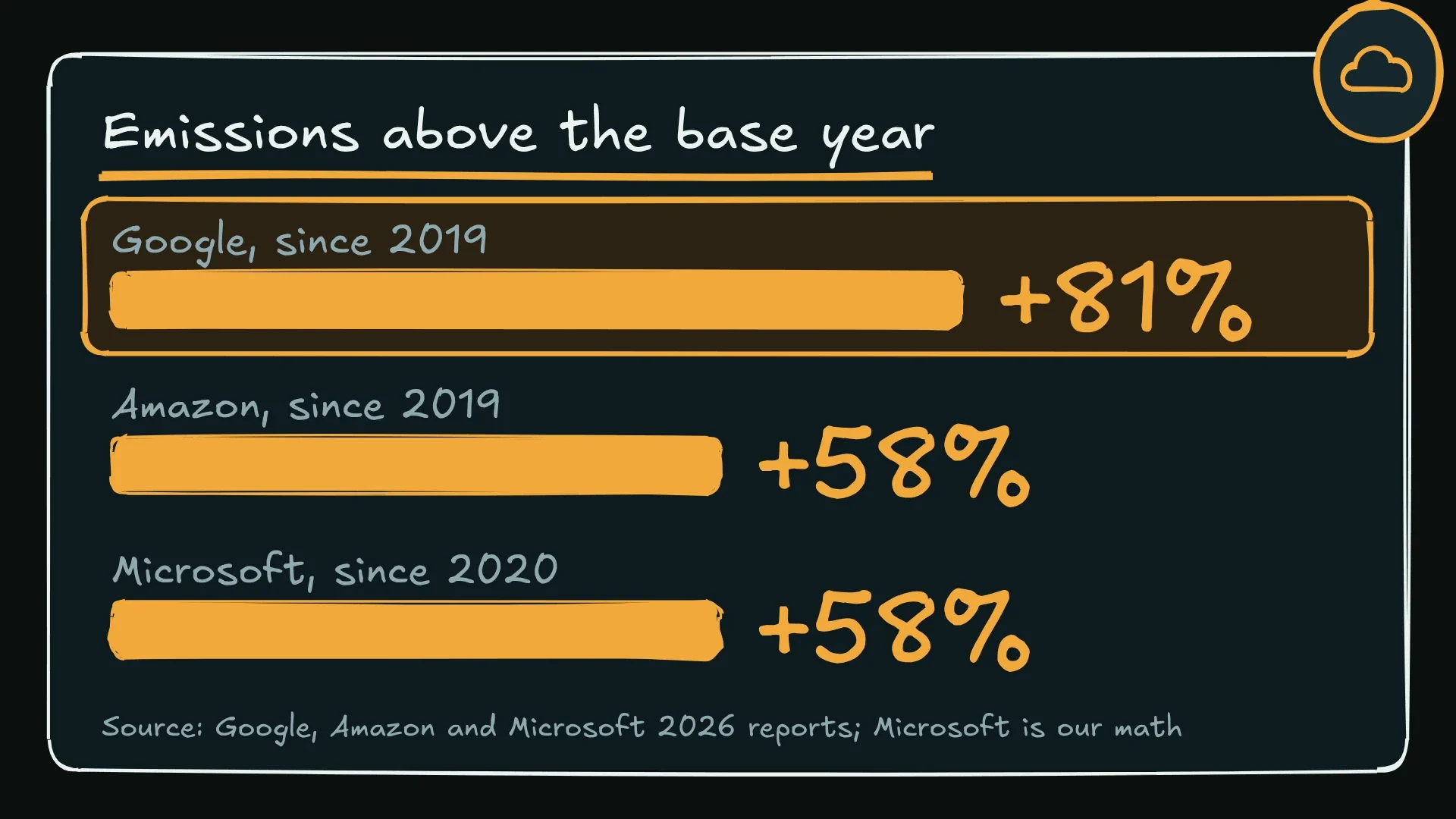
Google published its annual environmental report on June 30, Amazon on July 1 and Microsoft on July 9. Each company’s emissions now sit 58% to 81% above its base year, the starting point its pledge is measured from.
The numbers
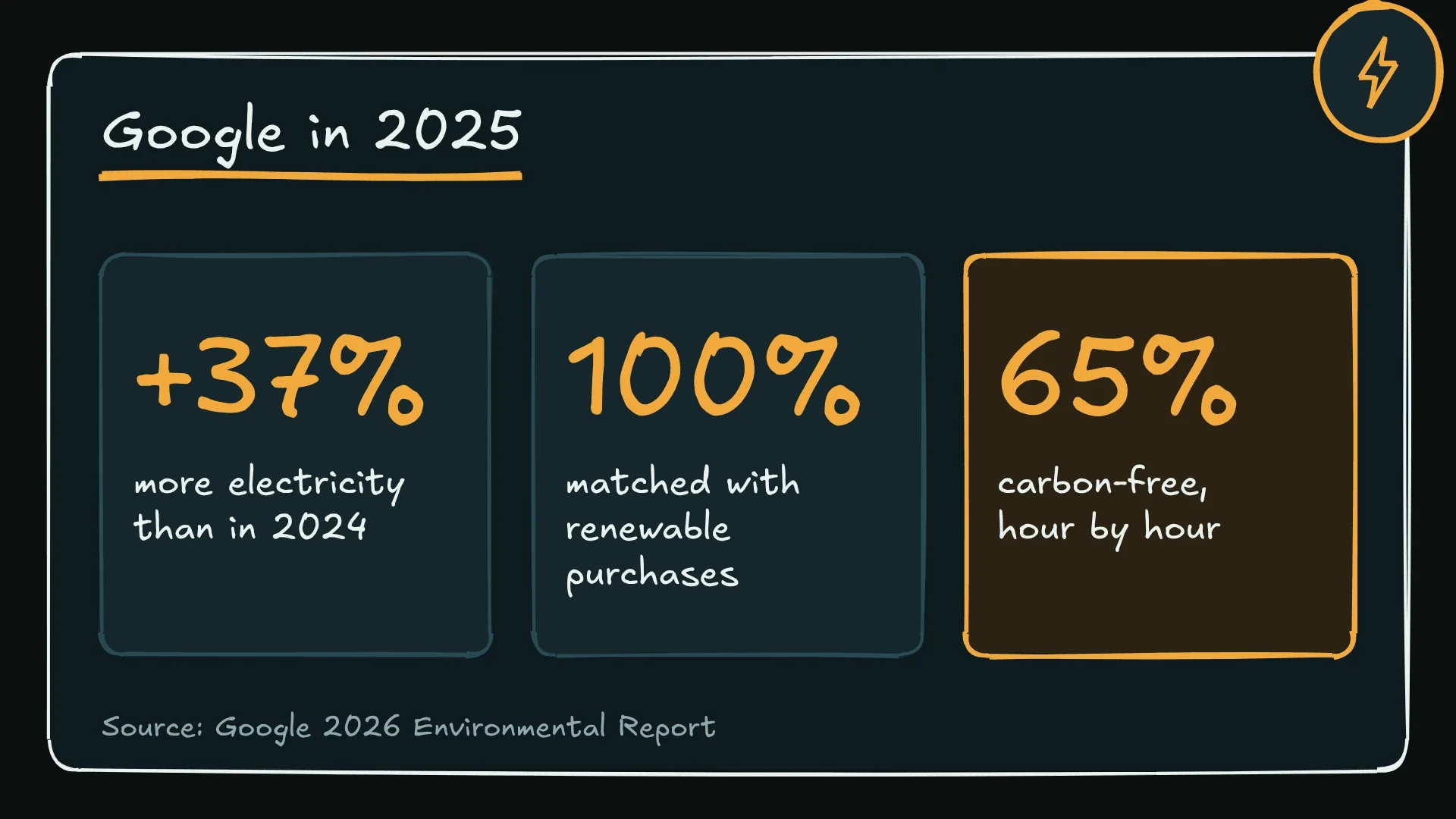
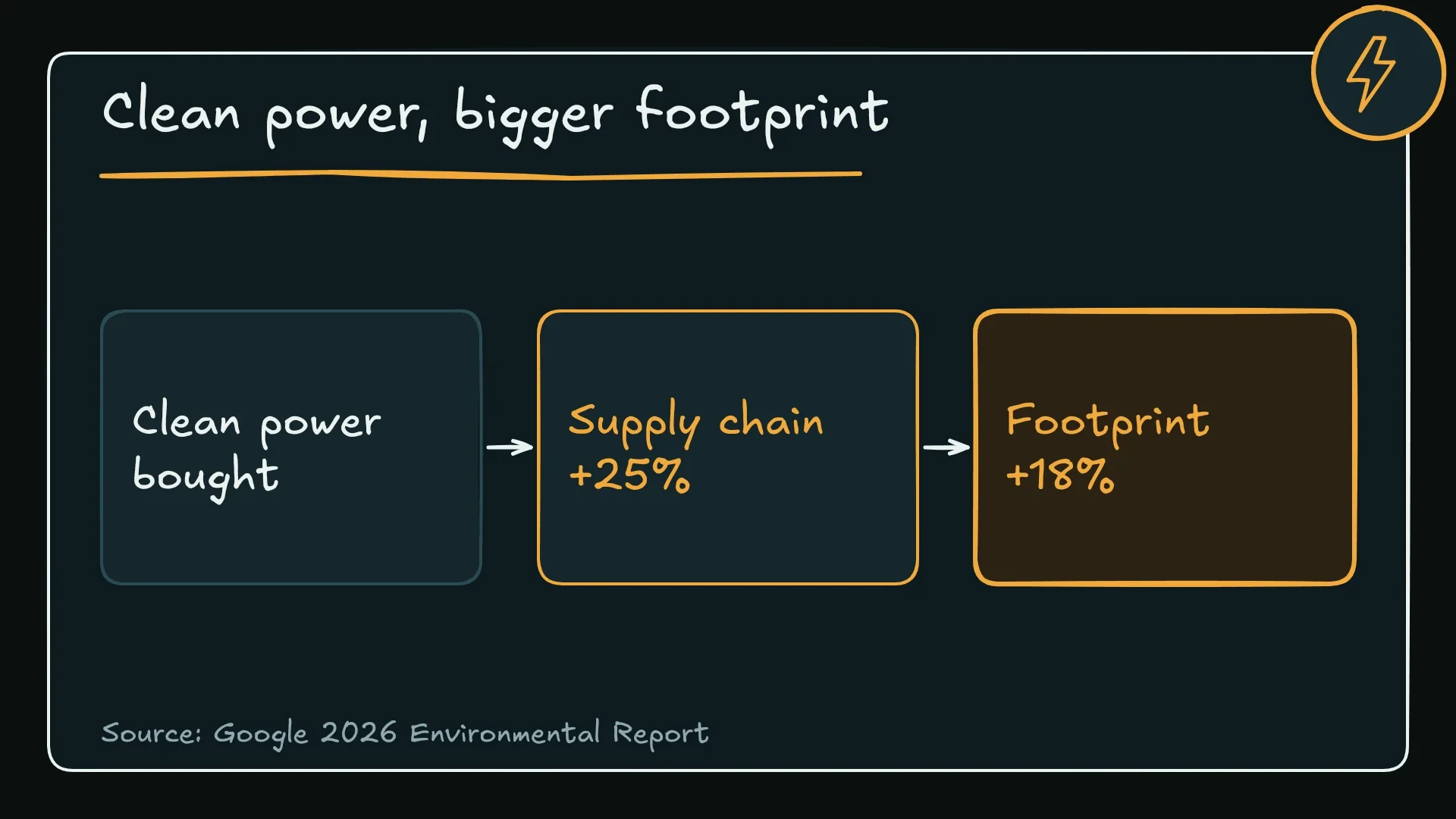
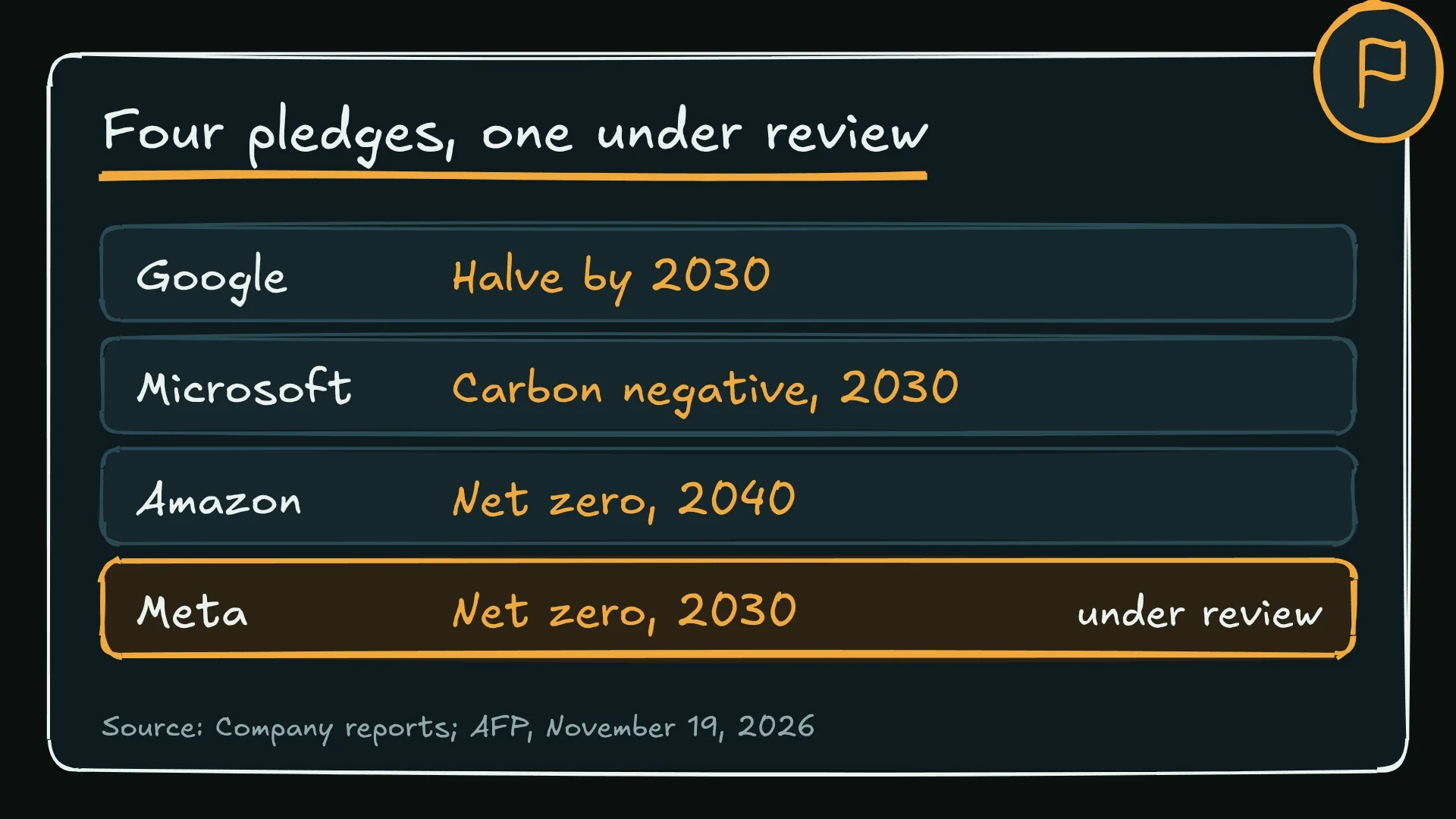
Google’s footprint reached about 14.5 million metric tons of carbon dioxide equivalent in 2025 on its own “ambition-based” count. That’s up 18% in a year, the largest annual rise Google has reported, and 81% above 2019. Google has pledged to halve its 2019 level by 2030. Its electricity use jumped 37%. Emissions from its own operations fell 2%, but supply chain emissions grew 25%, which Google ties to chip and server manufacturing and data center construction. Against 2019, its operations emit 2.9 million tons, up 240%, and its supply chain 11.6 million, up 62%.
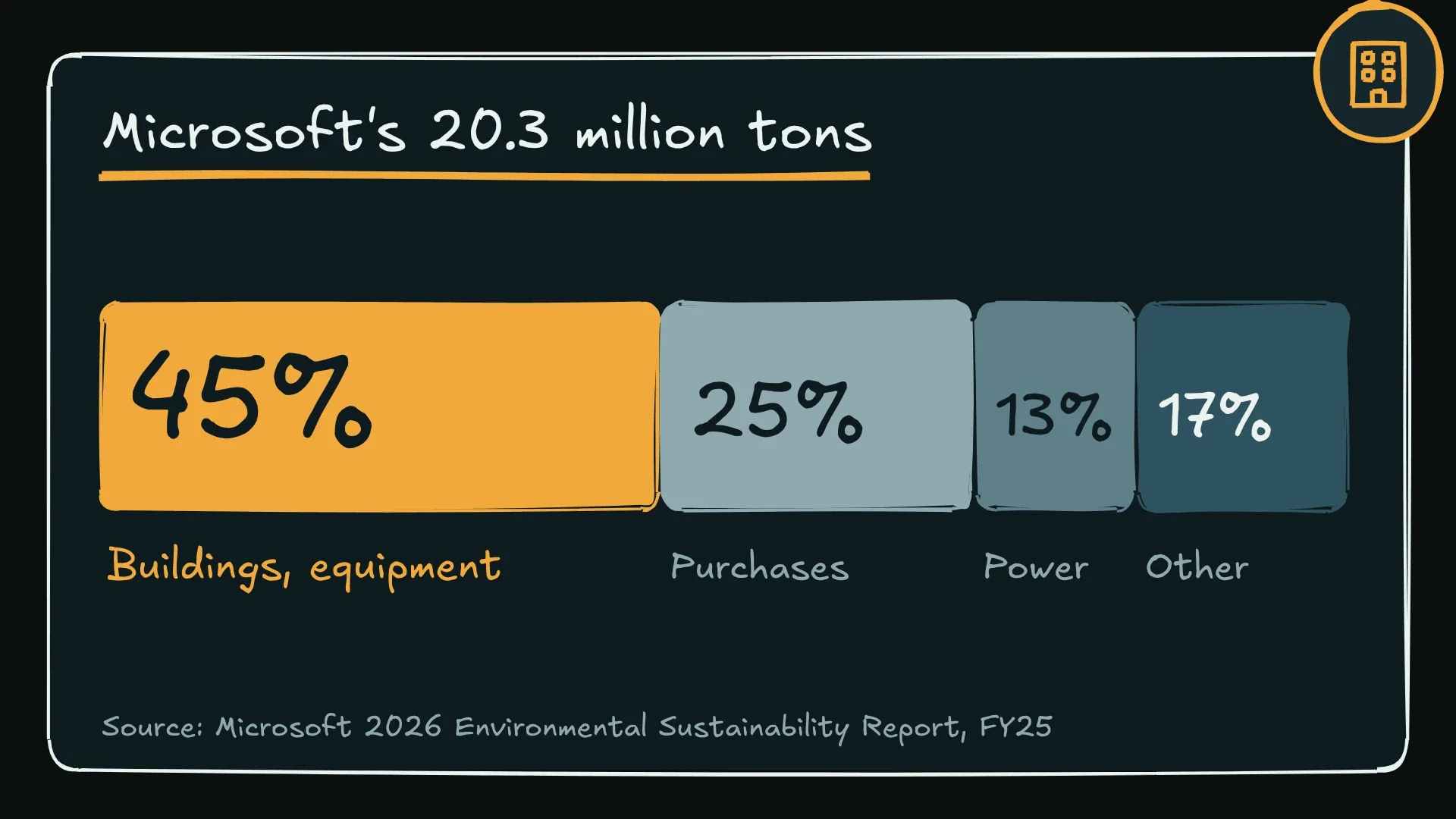
Microsoft’s emissions rose 25% in the year to June 30, 2025, reaching 20.3 million metric tons. Its 2020 starting point was 12.9 million, so by our math it’s 58% above baseline, against a pledge to be carbon negative by 2030. Microsoft attributes the rise to data center expansion and its pause on buying unbundled renewable energy certificates, which don’t add new clean power to a grid. Purchased electricity went from nearly 2% of its footprint to 13%. Brad Smith and Melanie Nakagawa wrote in the report’s foreword that “growth-related emissions pressure was expected.”
Amazon’s footprint hit 80.85 million metric tons in 2025, up 16% in a year and 58% above 2019, the year it co-founded The Climate Pledge to reach net zero by 2040. Its supply chain, which includes data center construction, makes up 76% of the total and grew 20%, and emissions from purchased electricity rose 34%. Amazon’s report still rates the goal “making progress.” Emissions per dollar of revenue are 38% below 2019 while revenue grew 156%, but that intensity rose 3% last year.
Clean power isn’t closing the gap
Each company says it matches all of its electricity with renewable energy: Google for the ninth year running, Amazon for the third and Microsoft in fiscal 2025. The portfolios are big. Amazon counts 42 gigawatts of carbon-free capacity across more than 700 projects, and Microsoft has agreements for up to 40 gigawatts of new renewable energy, with 19 gigawatts online.
Google shows why the claim and the footprint diverge. It signed deals for more than 12 gigawatts of new clean energy in 2025, and its electricity-related emissions fell 3% even as its electricity use rose 37%. But matching is done over a year. Hour by hour, about 65% of the power at its data centers and offices was carbon-free, roughly flat on 66% a year earlier, and 80% of its footprint sits in the supply chain.
Our AI infrastructure buildout is accelerating faster than the grid is decarbonizing.
Kate Brandt, Google’s chief sustainability officer, wrote that in the company’s June 30 blog post announcing the report.
Google’s report also notes that its net-zero ambition allows 50% of emissions to remain by 2030. That doesn’t meet the Science Based Targets initiative’s criteria, which allow 10% residual emissions for a long-term net-zero target, so Google has validated only its near-term target with the initiative.
Where the carbon comes from
A data center’s climate cost isn’t just the power it draws. It’s also the steel and concrete in the building and the factories that make its chips. Microsoft’s report puts “capital goods,” the buildings and equipment a company buys, at 45% of its footprint, and purchased goods and services at another 25%.
Microsoft’s answer is carbon removal. It added 29 projects in fiscal 2025 that it expects to remove more than 45 million metric tons over three decades. By our math, that batch equals about 2.2 years of Microsoft’s current emissions, delivered across 30 years.
The Guardian puts the three companies’ combined emissions at 119 million metric tons, up from about 101 million a year earlier and about a third of France’s. The pressure is global. The International Energy Agency (IEA) says data center electricity demand grew 17% in 2025, and demand from AI-focused data centers grew 50%. It expects total demand to roughly double to 950 terawatt-hours by 2030, about 3% of global electricity. It also expects data center emissions to double to around 350 million metric tons by 2035, still about 2% of electricity-sector emissions. Capital spending by the largest tech companies topped US$400 billion in 2025, and the IEA expects it to jump another 75% in 2026. It estimates 15 to 27 gigawatts of onsite natural gas could power data centers by 2030, mostly in the US.
What’s changed since July
The pledges are already moving. On November 17, Amazon set a goal to cut the carbon intensity of its electricity 65% by 2030 from 2019, and it reiterated net zero by 2040. That’s a goal for emissions per unit of electricity, so it doesn’t cap total emissions while Amazon’s power use grows. On November 19, Meta said it’s “re-evaluating” the 2030 timeframe for the net-zero goal it set in 2020, after its net emissions rose 45% to 11.8 million metric tons in 2025. AFP noted that the figure rests on accounting methods climate advocates view skeptically.
Microsoft’s shareholders vote on December 8 on a proposal from Trillium Asset Management asking for more detail on how the company will meet its 2030 targets. Microsoft’s board recommends voting against it.
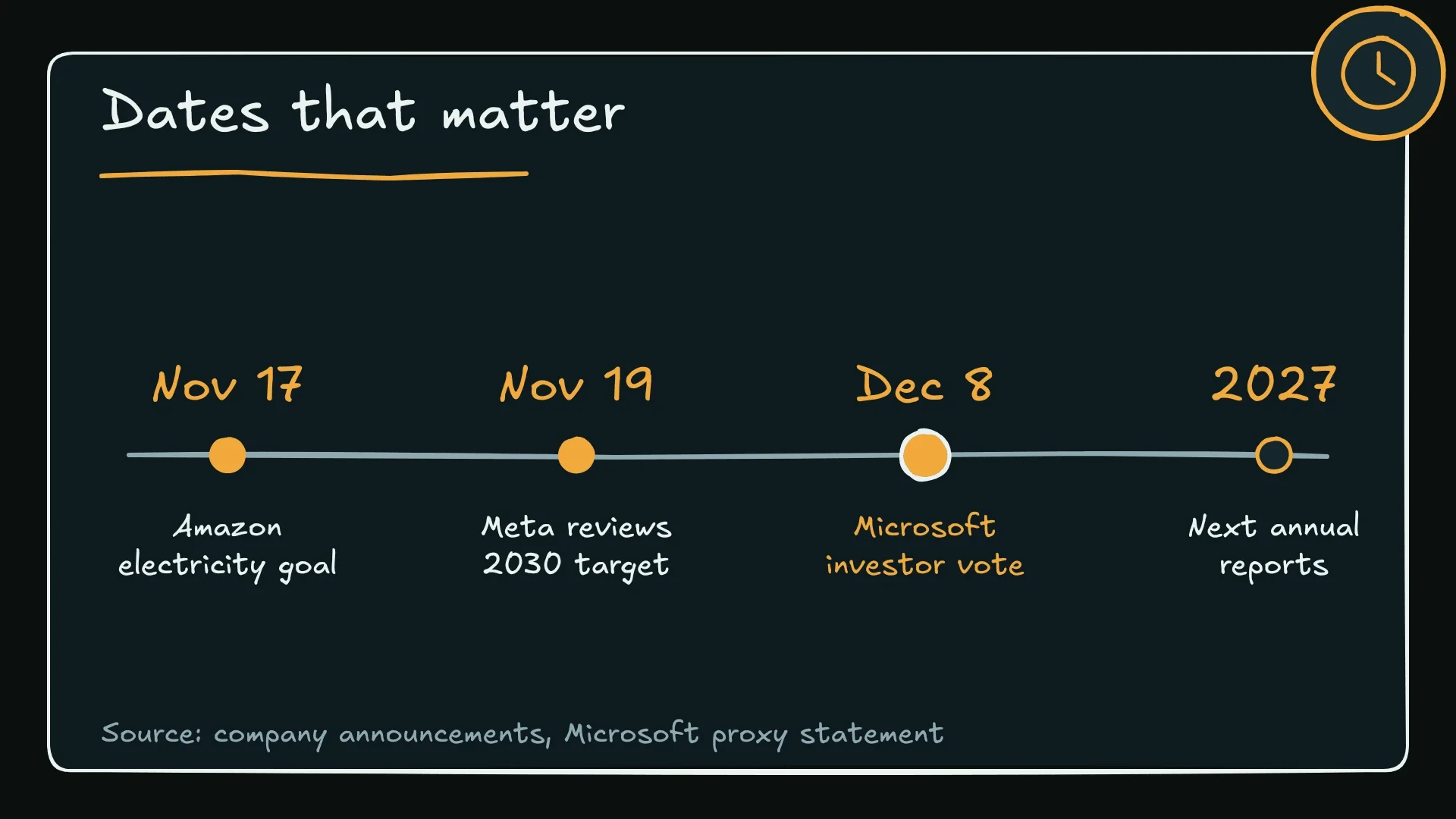
Looking ahead, the December 8 vote and next summer’s reports will show whether Google and Microsoft hold their 2030 dates or follow Meta in reopening them. Watch supply chain emissions most closely. For readers in New Zealand and Australia, the lesson is that a company’s clean-power claim and its total footprint are different numbers, so ask for both.
Sources
- Google, 2026 Environmental Report
- Google, announcement of the 2026 Environmental Report
- Axios, Google’s AI boom sends emissions, power use soaring
- Microsoft 2026 Environmental Sustainability Report
- Microsoft, Responsibly building the AI future (foreword)
- Microsoft, 2026 proxy statement (Proposal 4)
- Amazon 2025 Sustainability Report
- Amazon, new electricity carbon intensity goal
- The Guardian
- AFP, Meta says it is re-evaluating its 2030 net zero target
- International Energy Agency, Key Questions on Energy and AI