AI fellows at a Buddhist monastery in Vermont told the New Yorker that everything the community does is recorded, even their breathing, and fed into an AI. The monastery’s executive director denies it.
The monastery is MAPLE, the Monastic Academy for the Preservation of Life on Earth. Writer Sam Kriss spent a few days there in May and published his feature on November 16. MAPLE’s own quarterly report describes what it calls a “benevolent surveillance system.”
Who goes to MAPLE
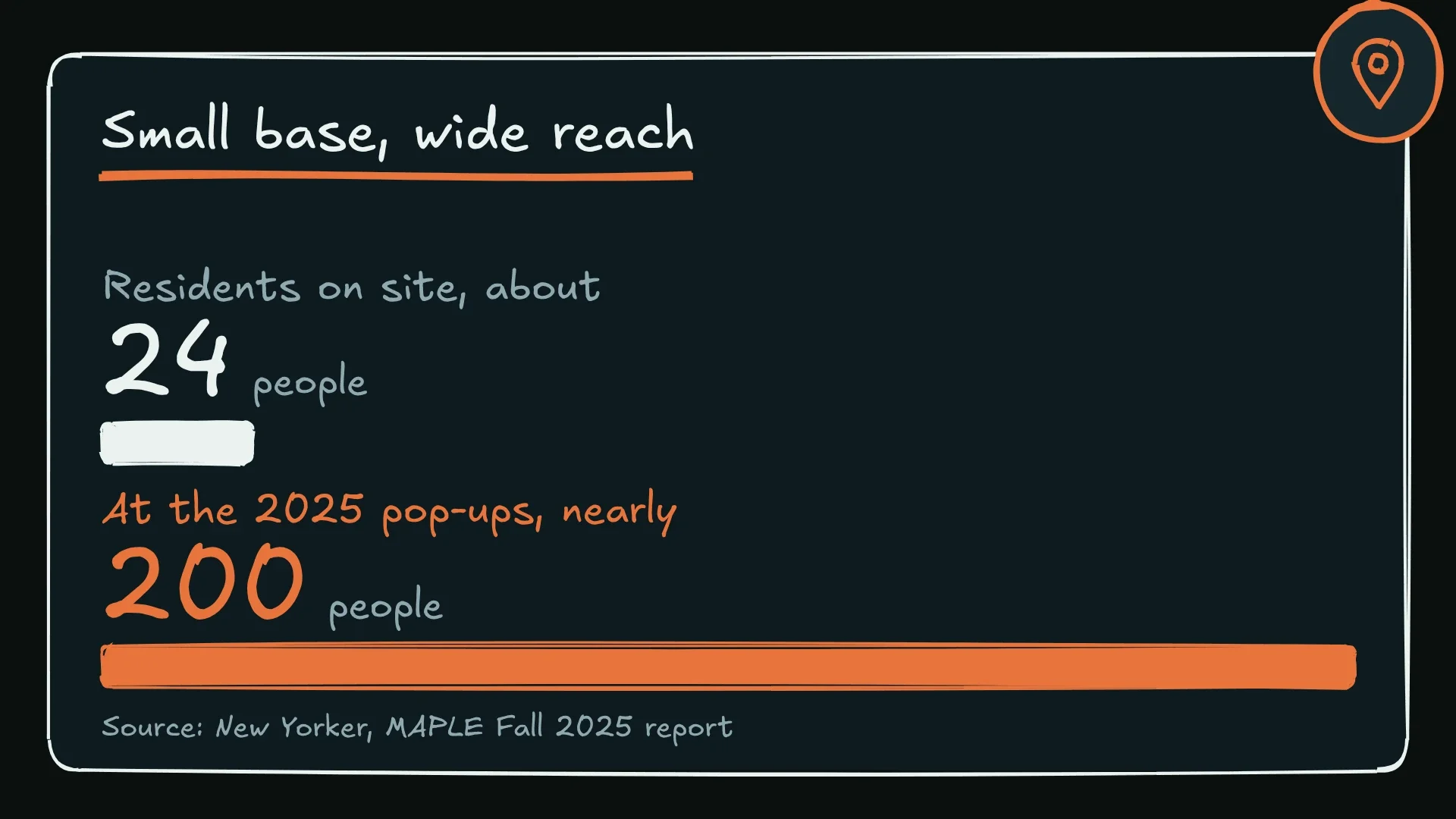
MAPLE says it was founded in 2011. Its Fall 2025 report describes a residential training program on 150 acres in Lowell. Kriss reports that about two dozen residents live there and that hundreds have come through its fellowships and pop-up spaces.
The report says nearly 200 people attended its summer 2025 pop-up monasteries in Seattle and the Bay Area, month-long training spaces that people could live in or drop into.
The money is modest. The report puts the quarter’s revenue at $168,395, mostly donations and grants, including a $105,000 unrestricted grant and $46,515 from pop-up participants. A donor matched that $46,515 one to one, and the match isn’t counted in the total. For 2025 to date, the combined figures for MAPLE and its sister groups show $607,141 in income, $535,619 in expenses and $957,663 in debt.
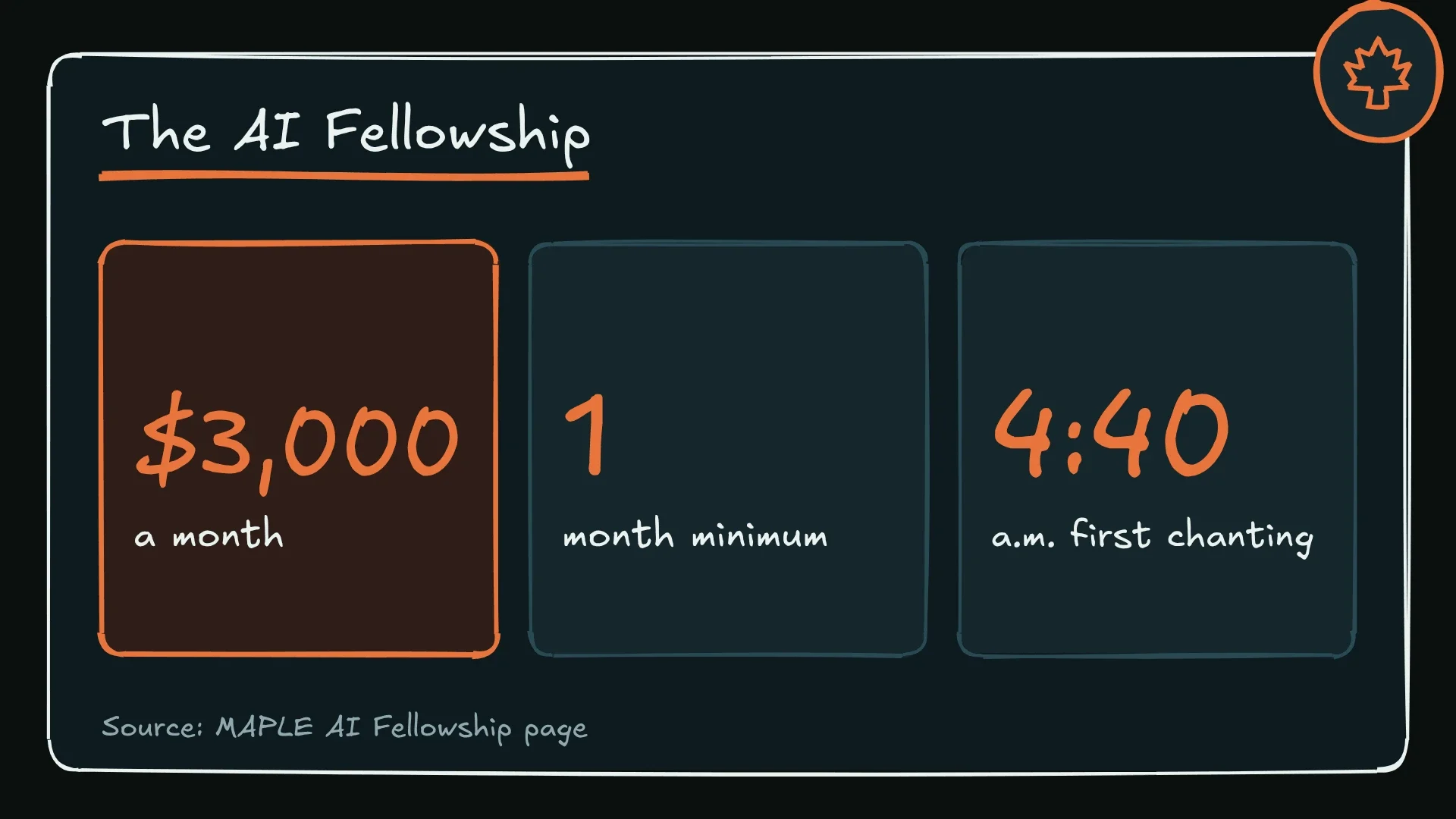
The AI Fellowship is for people who work in AI safety, alignment or development. It costs $3,000 a month, with a one-month minimum, according to MAPLE’s website. The first chanting session of the day starts at 4:40 a.m.
One visitor, Colin Vail, told Kriss he found MAPLE after his dream job, at a real estate developer, turned out to be building data centers. He asked himself what he was part of. He has since returned and says he has trained there for four months.
MAPLE’s founder and head teacher, Soryu Forall, says the AI industry runs on a religion of turning everything into data. He told Kriss that AI is:
“the next step in attempting to turn all of life into a dead model of life.”
Forall said this to Kriss during the visit to the monastery.
Executive director Anandabodhi Becker has his own view of AI’s builders. In the Fall 2025 report he wrote that the mind converting the world into data sees “poisoning entire watersheds” to build massive data centers as a solution, not a problem. He doesn’t cite a site.
What a visit looks like
Kriss arrived in a storm. Visitors first change out of their own clothes and into neutral ones the monastery supplies, because one resident has a severe sensitivity to fragrance. The library shelves Buddhist scriptures beside books on computation theory and four copies of Yuval Noah Harari’s “Homo Deus.”
Before the visit, Becker wrote on MAPLE’s blog that Kriss’s earlier work showed “the cynical, nihilistic, humanist view that is typical in the New Yorker.” Forall’s advice, Becker wrote, was to “connect with his good, honest side.” Kriss quotes both lines.
Recorded, and then what?
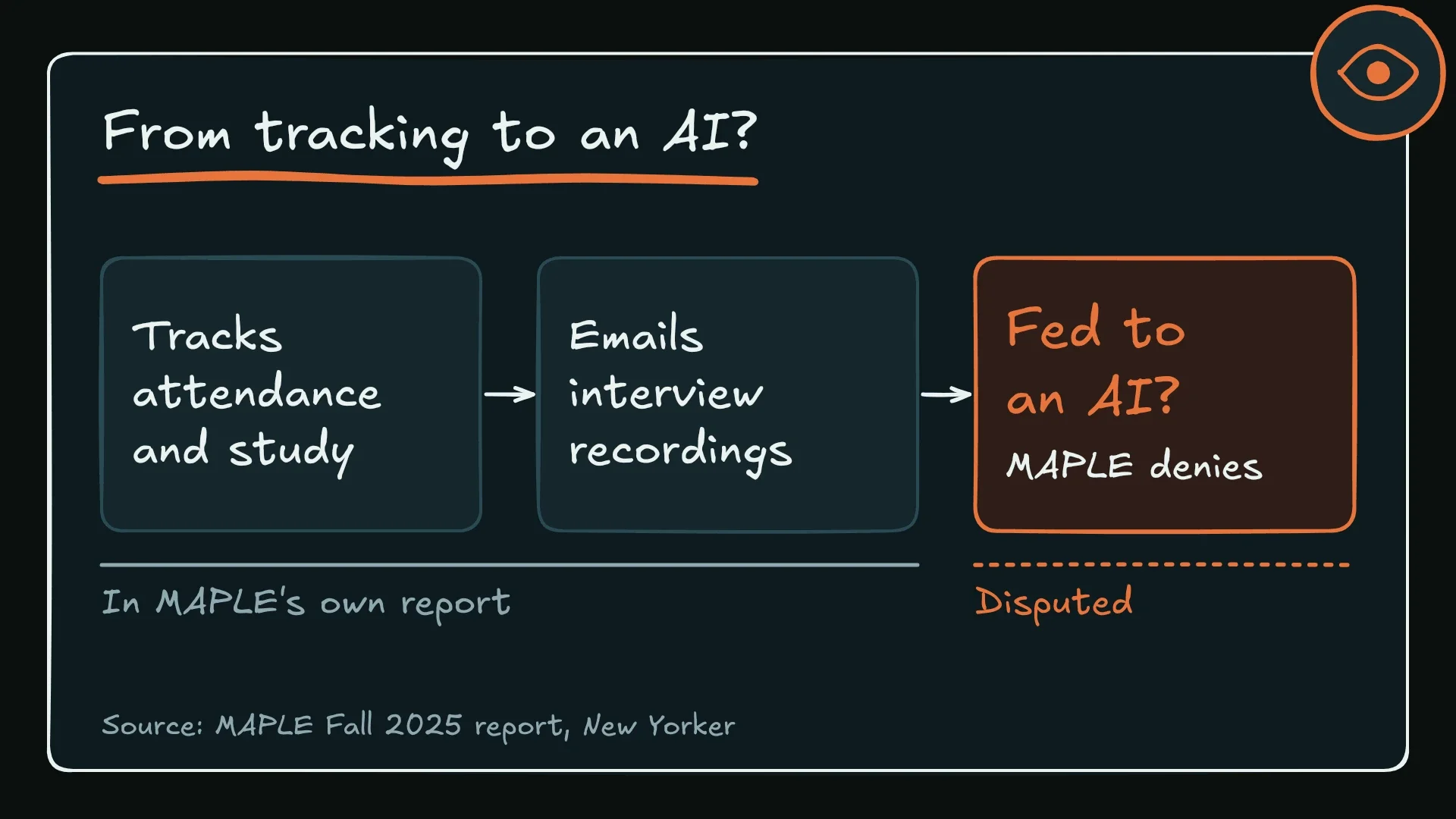
The same report says MAPLE is bringing its practice to technology “to develop a more benevolent surveillance system.” It lists tracking “attendance, sitting meditation, and study data” and “automating the splicing and emailing of interview recordings.”
Becker’s letter in the report doesn’t avoid the word. He wrote that “monasteries have made use of surveillance methods to bring people into alignment with the path to enlightenment,” and that the key difference is “the kind of mind that receives that data and what it does with it.”
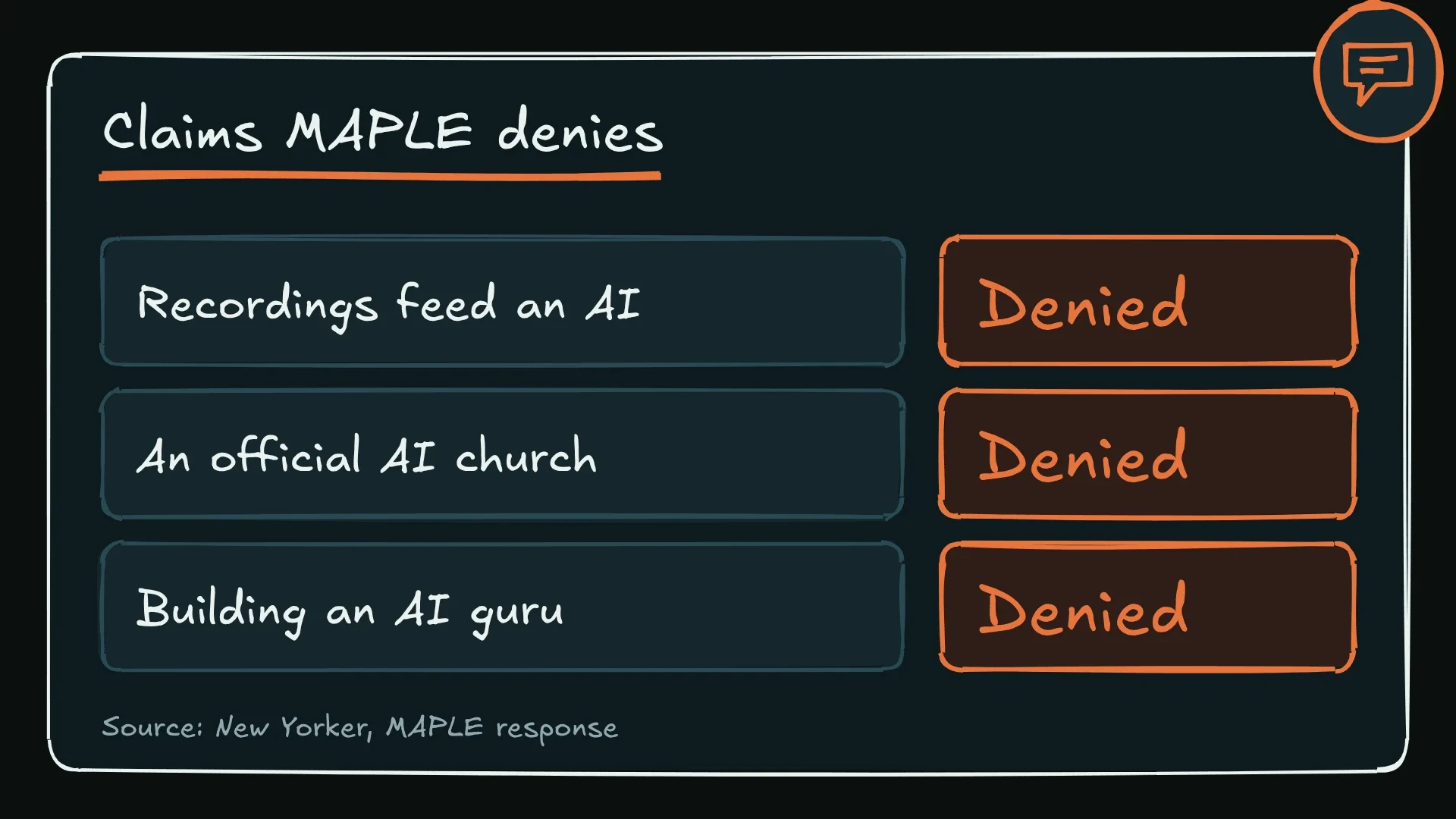
The report doesn’t say any of that goes into an AI. The fellows told Kriss it does. Becker denies that. We haven’t seen the recordings or the data.
Kriss also writes that Forall told him MAPLE’s aim is to become the AI industry’s official church. Former members describe a plan to build an “enlightened” AI that guides other AIs. Becker denies both, and MAPLE says it isn’t building an AI guru.
MAPLE’s answer
MAPLE’s response to the article says its secret doctrine exists and concerns the solution to AI, not the problem. It says it tried publishing more openly and the information was “misused, misquoted, and used for harmful ends.” It says it doesn’t aim to stop AI but to guide it.
The response also addresses the complaint that residents wouldn’t talk to Kriss. It says MAPLE held his visit in “noble silence” and had a chaperone sit in on organized one-on-ones, because a reporter’s visit is a vulnerable moment for people who are new to the monastery.
Kriss ends his piece by saying it’s a shame MAPLE is so secretive about its secret doctrine, because the group is, in a way, “closer to the truth than anyone else I’d encountered.” MAPLE quotes that line in its reply.
Kyle Hubbard lived at MAPLE for three and a half years. He has written that he believes it’s a high-control group, and he told Kriss it breaks people down and pressures them with guilt and shame. MAPLE calls his claims a mischaracterization. Kriss also relays a resident’s account of deliberately harming himself. MAPLE says self-harm is not acceptable or part of its practice, and that a trainee has published a reply to Hubbard called “The Case For MAPLE.”
MAPLE’s response page says the New Yorker piece is only its second mainstream feature, after The Atlantic in June 2023.
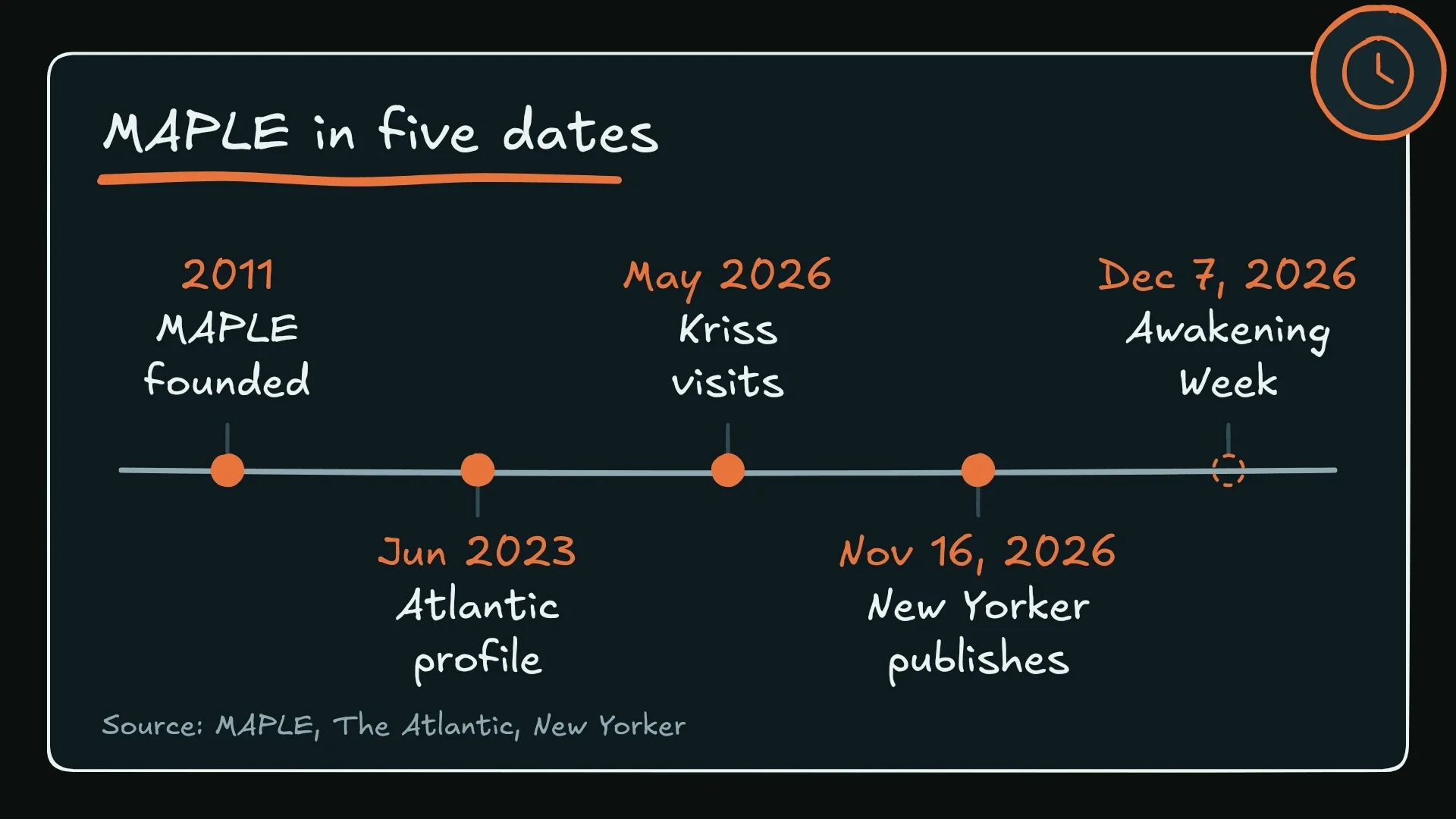
Looking ahead, the open question is where MAPLE’s recordings go. The report says it tracks data and emails recordings, and Becker says none of it reaches an AI. MAPLE’s next Awakening Week with Forall starts December 7. For readers in New Zealand and Australia, the lesson is practical: before joining any retreat, wellness program or workplace scheme that records you, ask what’s captured, who can access it and whether it trains a model.